
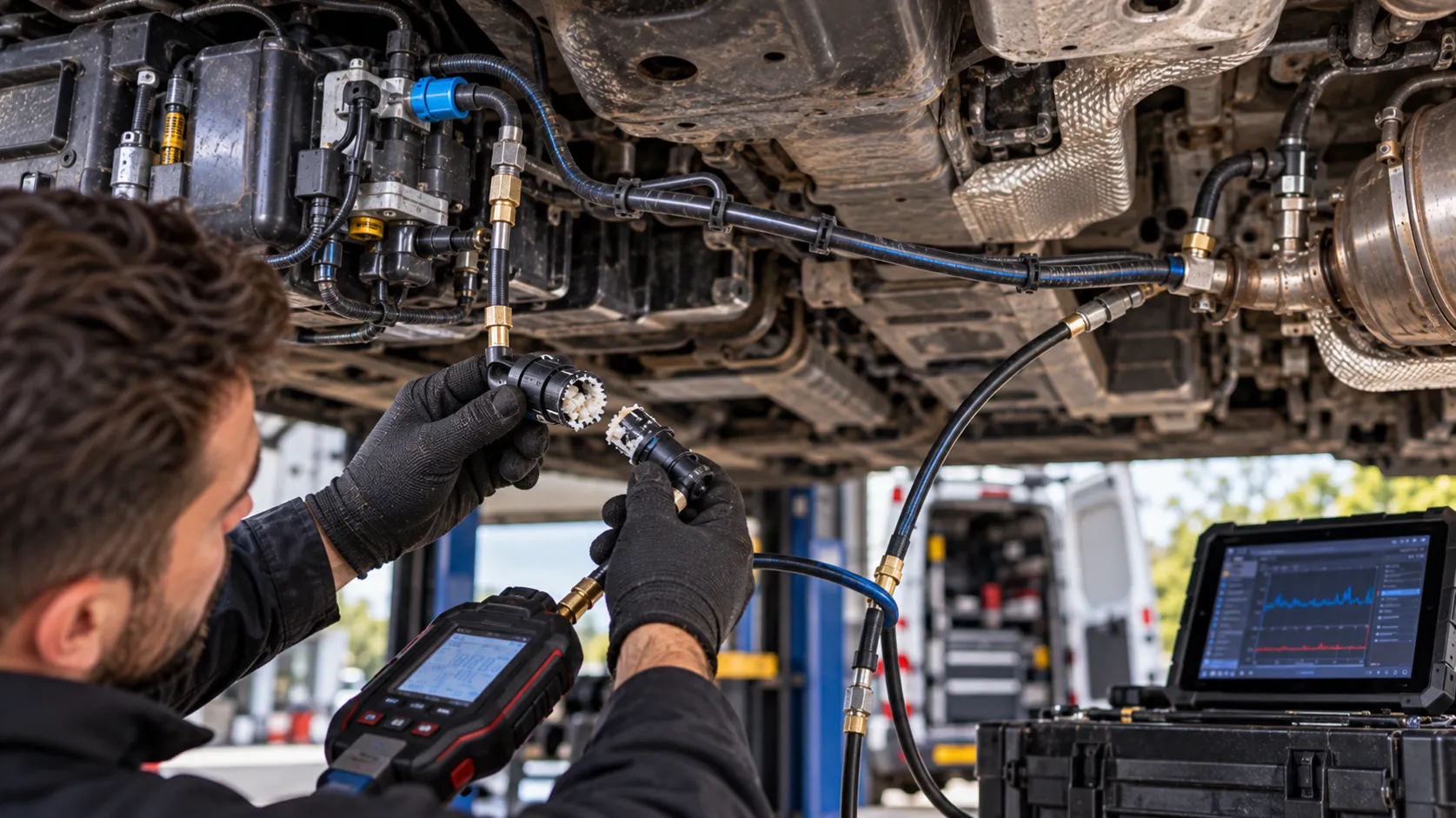
A blocked AdBlue dosing line means the pipe carrying fluid from the tank and pump through to the injector has something physically stopping or restricting flow along the way. Not the injector itself, not the pump, the line running between them. It’s a distinction that matters, because the fix is completely different depending on where the actual blockage sits.
This one catches people out more than you’d think. A blocked line produces symptoms that look almost identical to a failed pump or a stuck injector. Same warning light, similar fault codes, similar reduced performance. Unless someone’s actually traced the line itself rather than just assuming the nearest component’s at fault, it’s easy to replace the wrong part and have the same warning back within days.
We’ll go through what actually blocks a dosing line, what you’ll notice before it gets serious, and how we trace it properly on the vehicle rather than guessing.
What Actually Blocks a Dosing Line
Crystallised urea is the one we see most. AdBlue is roughly 32.5% urea dissolved in water, and if it sits without moving in the line for long enough, or picks up heat from a nearby exhaust component, the water evaporates and leaves solid urea crystals behind. Those crystals build up gradually inside the line itself, narrowing the internal diameter until flow drops off or stops completely.
A physically damaged or pinched line is a different cause entirely. Road debris, a poorly routed repair from previous work, or just age and vibration over years of driving can crush or kink a section of the line enough to restrict flow, even without any crystallisation involved at all.
Freezing is a genuine cause too, particularly relevant through UK winters. AdBlue freezes at around minus eleven degrees Celsius, and a line that’s exposed or poorly insulated can freeze solid overnight in cold conditions, blocking flow completely until it thaws. Most modern systems have heating built into the lines specifically to prevent this, but a failed heater circuit can leave a line vulnerable exactly when it’s needed most.
Debris or contamination getting into the system, usually from a dirty AdBlue container during a top up, is less common but does happen, and it can settle and build up inside the line over time in a similar way to crystallisation.
Symptoms You Might Notice
The AdBlue warning light is usually first, often with a dashboard message referencing the AdBlue or emissions system. A few drivers notice reduced dosing accuracy before the light even comes on, though that’s hard to spot without diagnostic equipment actually measuring flow.
Inconsistent performance is a genuinely telling sign if the blockage is partial rather than complete. A line that’s narrowing gradually from crystallisation often produces a fault that comes and goes before it settles into something constant, since flow might just barely get through on some attempts and not on others.
Reduced engine performance tends to follow once the system’s confident dosing isn’t happening properly, and from there a restart countdown can appear, following the same pattern as most other AdBlue faults once the vehicle decides emissions compliance can’t be guaranteed.
Can You Keep Driving With a Blocked Line?
For a while, generally yes, especially if the blockage is only partial and no countdown message has appeared yet. The engine itself isn’t damaged by restricted AdBlue flow on its own. That said, a partial blockage tends to get worse rather than better over time, particularly if crystallisation is the cause, since the same conditions that caused it in the first place keep adding to it. Getting it looked at while it’s still partial is genuinely easier and cheaper than waiting for it to block completely.
How We Trace and Diagnose a Blocked Line
We start with a full fault code scan, since the specific codes stored often point toward a flow or pressure problem that narrows down where to look first.
From there we check pressure at different points along the system rather than assuming the blockage sits in one specific spot. Pressure that’s fine at the pump but drops off before reaching the injector points toward the line itself rather than either component on its own, which is exactly the kind of distinction a proper diagnosis is built to catch.
We also visually inspect the line’s full routing where it’s accessible, checking for obvious kinks, damage, or crystallisation visible at connection points. Combined with the pressure readings, this usually confirms fairly quickly whether the line itself is the actual problem, rather than the pump or injector taking the blame for something happening somewhere else entirely.
Line Blockage, Pump Fault, or Injector Fault? Why It’s Easy to Mix Up
All three produce a genuinely similar symptom picture from the driver’s seat. Reduced or no dosing, a warning light, a stored fault code referencing pressure or flow. The difference only becomes obvious once someone’s actually measured pressure at multiple points rather than assuming the first likely looking component is guilty.
We had a van in recently with what looked, on paper, exactly like a textbook pump failure. Low pressure reading at the injector, warning light, the works. Turned out the pump was working perfectly fine. A section of line further back had crystallised almost completely shut, and the pump was simply unable to push fluid through a pipe that had narrowed down to almost nothing. Replacing the pump wouldn’t have fixed a single thing.
Does This Happen the Same Way on Every Vehicle?
The underlying cause is consistent across any SCR equipped diesel, though line routing and how exposed it is to heat, cold, and road debris varies quite a bit by manufacturer and model. We see this fault across a genuinely wide mix of vehicles, and our guides on specific manufacturers, including Ford Transit, Citroën, Peugeot Partner, Nissan, Land Rover and Mercedes, cover how AdBlue faults tend to show up on each of those specifically.
Related AdBlue Guides Worth Reading
A few other articles cover ground closely connected to this one. Our guide on AdBlue injector blocked symptoms, causes, and repair covers the injector end specifically, worth reading if you’re not yet sure whether the blockage is in the line or right at the nozzle itself. Our article on AdBlue pump no pressure covers the pump side of this same symptom picture, and our piece on whether AdBlue crystallisation can be repaired goes into more detail on the crystallisation process itself.
If cold weather’s a factor for you, our guide on AdBlue malfunction warnings after a cold night covers the freezing side of things specifically. Our article on AdBlue connector corrosion is worth a look too, since corroded connectors can sometimes present alongside line issues on the same vehicle. Our broader AdBlue problems explained guide and our piece on AdBlue problems by manufacturer both give wider context if you’re still narrowing down exactly what’s going on with yours.
Mobile AdBlue Repair, Wherever You Are
This is exactly the kind of fault that suits a mobile visit rather than a trip to a garage. Tracing a blockage properly along the full length of a dosing line takes time and the right equipment, and our technicians bring that to you, whether that’s at home, at work, or wherever the vehicle happens to be sitting when the warning light comes on.
All of our AdBlue repair work, line blockages included, is backed by our workmanship warranty, so you’re covered if anything related to the repair itself needs revisiting. We’ll always explain exactly what we’ve found and what needs doing before any work starts.
Areas We Cover
We run a mobile AdBlue repair and diagnosis service across a wide stretch of the UK, and every area we cover has its own dedicated page with local details. Across London and the South East, that includes Kingston upon Thames, Lewisham, Islington, Haringey, Havering, Waltham Forest, Redbridge, Newham, St Albans, Slough, Sevenoaks, Loughton, Dartford, Epsom, Esher, Guildford, Reading and Croydon, with our wider South East England and London pages covering the region more broadly.
In the Midlands, we cover Solihull, Dudley, Wolverhampton, Walsall, Tamworth, Stoke on Trent, Nuneaton, Warwick, Rugby, Leamington Spa, Stratford upon Avon, Stafford, Cannock, Lichfield and Birmingham, alongside our West Midlands and Warwickshire region pages.
Further out, we cover Shropshire towns including Telford, Oswestry, Bridgnorth and Shrewsbury, our Shropshire region page, and East Midlands and Lincolnshire towns like Peterborough, Stamford, Spalding, Market Deeping, Grantham and Bourne, covered more broadly by our Lincolnshire page.
Further north we cover Leicester, Derby, Coventry, Sheffield, Leeds, York, Nottingham, Glasgow and Edinburgh. If you don’t see your exact area listed, our full locations page covers everywhere we currently operate.
Quick Answers About AdBlue Dosing Line Faults
Sometimes, yes, particularly if the blockage is crystallisation caught reasonably early. A damaged or genuinely crushed section of line usually needs replacing rather than clearing, since the physical damage doesn’t reverse on its own.
No. This isn’t a fluid level issue, so adding more AdBlue won’t push through a blockage and can’t fix a line that’s physically restricted or frozen solid.
Honestly, you usually can’t tell from the dashboard alone, since all three produce a similar warning and similar fault codes. Pressure testing at multiple points along the system is really the only reliable way to confirm where the actual restriction sits.
Not to the engine directly, but a pump forced to work against a restricted line for an extended period can wear faster than it otherwise would, and what started as a straightforward line issue can end up needing pump attention too if it’s left long enough.
Not necessarily, though it’s worth considering if the fault appeared suddenly after a cold night. Crystallisation and physical damage can happen at any time of year, so proper diagnosis still matters rather than assuming freezing is automatically the cause.
Not reliably without the right equipment. Confirming a blockage, and working out exactly where along the line it sits, needs pressure testing that isn’t something you can do by eye or by guesswork.
Yes, genuinely one of the better candidates for it. Tracing and fixing a line issue doesn’t need a workshop, just the right diagnostic kit and a bit of access to the underside of the vehicle, both of which our mobile technicians bring with them.
Not if the actual cause was properly identified and fixed rather than just a component swapped based on a guess. That’s really the whole reason we test pressure at multiple points before touching anything.
Yes, the same principle applies to any diesel vehicle running SCR emissions control, HGVs included.
Once the blockage location is confirmed, most repairs are same day, though a full line replacement on a vehicle with tricky access can take a bit longer than a straightforward clean out.
Yes, particularly with a dirty or improvised filling container. It’s one of the less common causes, but it does happen, and it’s a good reason to always use a clean, dedicated AdBlue container when topping up.
Book a Mobile AdBlue Diagnosis
If your dashboard’s showing an AdBlue warning and you suspect a blocked line, get in touch through our contact page and we’ll arrange a mobile visit to trace the fault properly, wherever the vehicle happens to be. Catching a partial blockage early is almost always easier and cheaper than waiting for it to fail completely.
