
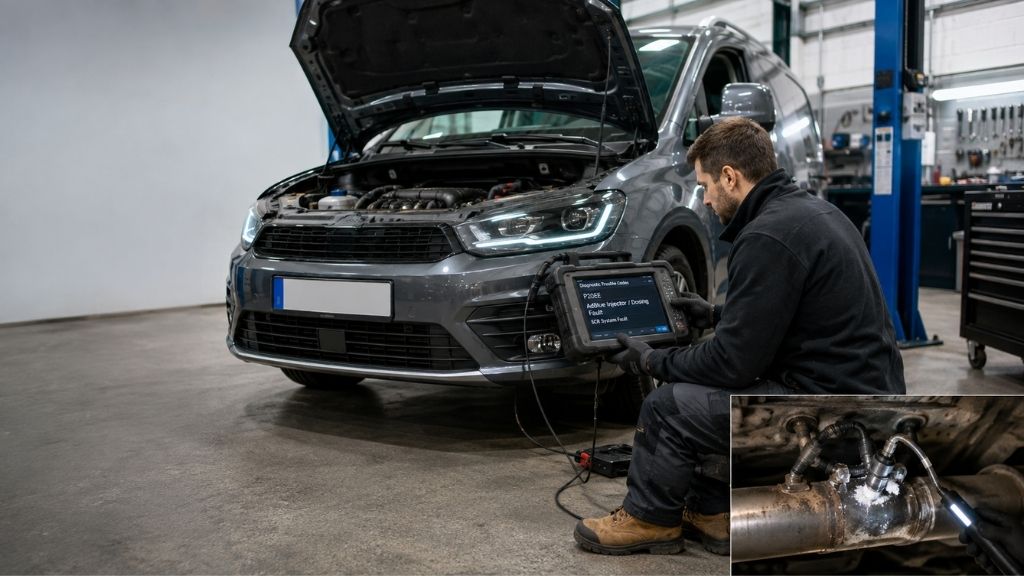
A blocked AdBlue injector stops the right amount of fluid getting into the exhaust, and the ECU notices almost straight away. First you’ll usually get a warning light, sometimes a mileage countdown not long after, and if it’s left too long, reduced power or the car refusing to start at all. Here’s the bit that catches people out though: the injector often hasn’t actually broken. It’s just clogged or crystallised inside, so it’s technically still there and still working, just not doing its job properly anymore.
If this is happening to you right now, you’re probably after two things. First, how do you know it’s actually the injector and not something else. Second, what does fixing it actually involve. That’s what we’re covering here, based on the blocked injectors we deal with pretty regularly on cars and vans up and down the country.
What Does a Blocked AdBlue Injector Actually Do?
The injector, sometimes called the dosing valve, sits in the exhaust line and sprays a precise amount of AdBlue into the exhaust gas. That’s the core of the SCR process that keeps NOx emissions in check. For it to work, the spray pattern and the dosing amount both need to stay accurate. The second it’s blocked, even partly, that accuracy goes out the window, and the ECU picks up on it fast because it’s constantly checking dosing performance against what it’s expecting to see.
A full blockage stops dosing altogether, which is at least easy to diagnose. A partial blockage is honestly more annoying to live with, since the system might still be dosing something, just not enough, and that tends to show up as an intermittent fault that comes and goes rather than one clean failure you can point to.
Symptoms of a Blocked AdBlue Injector
- AdBlue or engine management warning light on the dash
- A mileage countdown, or a message warning the engine won’t restart after a set distance
- Reduced power, or the car dropping into limp mode
- Fault codes tied to dosing performance, injector flow, or reductant quality
- AdBlue not depleting from the tank at the rate you’d normally expect
- A rougher idle, or a slight change in exhaust smell, though this one’s easy to miss and less common than the others
None of these confirm it’s the injector on their own, since a few different AdBlue faults share the same symptoms. That’s really why a proper diagnostic check matters more than trying to guess from the dashboard alone.
Fault Codes Commonly Linked to a Blocked Injector
If you’ve already had a scan done, codes like P204F, P2047, P2048, P2049, P204A, P204B, P204C or P20EE tend to point specifically at dosing and injector faults, rather than something further up the chain like a tank sensor. Send us whatever code you’re seeing and we’ll tell you straight away whether it lines up with an injector problem or something else entirely.
What Actually Causes an AdBlue Injector to Block?
There’s usually more than one thing going on, not just one isolated cause.
Crystallisation is the big one, and probably the most common. AdBlue is essentially urea and water, and if it sits still for too long, especially inside the small internal passages of the injector, it can crystallise into a solid deposit that narrows or completely blocks the nozzle. Short journeys, infrequent driving, or a vehicle left sitting for a while all make this more likely to happen.
Contaminated or the wrong fluid causes something similar. Using anything other than genuine AdBlue or DEF fluid, or fluid that’s picked up dirt or moisture in the tank somewhere along the way, can leave deposits behind that proper fluid simply wouldn’t.
A failing heater circuit plays into it too. Most systems have a built-in heater to stop the fluid freezing and to help stop crystallisation forming around the injector in the first place. If that heater’s not doing its job, blockages become a lot more likely, particularly once it gets cold.
Age and mileage matter as well, in a fairly obvious way. Like any component handling fluid under pressure day after day, injectors wear down over time, and older or higher-mileage vehicles are simply more prone to blockages building up gradually rather than appearing overnight.
Can You Unblock an AdBlue Injector Yourself?
Sometimes, if it’s a light blockage, a proper AdBlue system flush can clear it. We wouldn’t recommend attempting this without the right kit though. Pushing cleaning fluid or compressed air through the system without knowing what you’re doing can damage the injector further, or push crystallised deposits deeper into the line instead of clearing them out entirely. And if the injector’s badly blocked, or has actually failed, a flush won’t touch it anyway. You’ll just have delayed the real fix by however long you spent trying.
The safer route, and honestly the cheaper one in the long run, is getting it properly diagnosed first, so you actually know whether you’re dealing with a blockage that can be cleared or a part that genuinely needs replacing.
How We Diagnose and Fix a Blocked AdBlue Injector
Our engineers start with a full diagnostic check using the same OEM-level equipment a main dealer would use, to confirm the injector’s actually the problem rather than a sensor or pump fault presenting the same symptoms. From there, what happens next depends on what we find.
Where the injector’s only partially blocked, a proper AdBlue fix, including a full system flush and clean, can often sort it without replacing anything at all. Where it’s failed outright, we’ll replace it as part of our AdBlue repair service, fitting a proper OEM or OEM-equivalent part rather than a cheap aftermarket substitute that’s likely to block again within a few months anyway.
If you’d rather this stopped being a recurring headache altogether, an AdBlue delete removes the SCR strategy from the ECU entirely, so there’s simply no injector left to block. AdBlue removal works along similar lines, disconnecting the system so dosing, and any future blockage that comes with it, isn’t a factor anymore. Want to keep the system running as it was designed to, just without the warnings and countdowns derailing your week? Our AdBlue bypass handles that without fully disabling anything. And if you’re already locked out right now, countdown at zero, because of this exact fault, our no-start countdown bypass is built specifically to get you moving again fast, no dealer slot required.
Unlike a lot of standard repair shops, we don’t just swap the part and hand the keys back. We check the whole dosing system, the heater, related sensors, all of it, so a brand new injector isn’t going to block again for the exact same reason the old one did. Every repair we do comes with a lifetime warranty for as long as you own the vehicle.
What Does It Cost to Fix a Blocked AdBlue Injector?
Costs vary depending on whether it’s a flush, a straight injector swap, or something bigger like a failed heater alongside it. A flush and clean is generally the cheaper route where it’s actually viable. A full injector replacement costs more, especially on premium makes where the parts themselves carry a higher price tag. We’ll always give you a fixed quote once we’ve actually seen the fault ourselves, rather than a vague figure over the phone that might not hold once we’re under the bonnet looking at it properly.
Preventing Future Blockages
A few habits genuinely cut the risk of this happening again. Stick to genuine AdBlue or DEF fluid rather than a cheaper unbranded version, since that avoids introducing anything that could crystallise or contaminate the system down the line. Drive the car regularly rather than leaving it sitting unused for long stretches, which keeps fluid moving through the system instead of sitting static inside the injector. Get the heater circuit checked at a service, particularly heading into winter, so a developing fault gets caught before it turns into a full blockage. And don’t ignore warning lights for weeks on end. Sorting it early usually means a smaller, cheaper fix rather than a bigger bill further down the road.
Mobile Engineers, Wherever You’re Based
Sorting a blocked injector shouldn’t mean a tow truck and a week’s wait for a garage slot to open up. Our mobile engineers come straight to you, home, workplace, roadside, wherever, carrying the same diagnostic and repair kit a franchised dealer would use, just without the dealer pricing attached to it.
We cover a lot more of the UK than the obvious big cities. Around London and the South East, we’re regularly out in Croydon, Reading, Guildford and Market Deeping. North of the border, we’re in Edinburgh and Glasgow, and across Yorkshire you’ll find us in Leeds, Sheffield and York.
The Midlands is one of our busiest patches, taking in Coventry, Derby, Leicester, Nottingham, Birmingham and Grantham. Further east, we’re just as often out in Peterborough, Spalding and Stamford too.
Can’t see your area on that list? Get in touch anyway. We travel well beyond these towns fairly often, and same-day callouts are usually available across most of the UK if you book before midday.
Frequently Asked Questions
Mainly an AdBlue or engine management warning light, a mileage countdown, reduced power or limp mode, and dosing-related fault codes. AdBlue not depleting normally from the tank is another sign worth watching for.
Mostly crystallisation from fluid sitting still too long, contaminated or incorrect fluid being used, a heater circuit that’s on its way out, or plain wear from age and mileage building up over time.
Sometimes, if it’s caught early and the blockage is partial. A full AdBlue system flush can clear it in those cases. If the injector’s actually failed, though, it needs replacing rather than cleaning.
Short term, usually yes. But most vehicles start a mileage countdown once the fault’s picked up, after which the engine won’t restart once you switch it off. Best to get it looked at before that happens.
Depends entirely on whether a flush sorts it or a full replacement’s needed, plus the vehicle itself. We always confirm a fixed price after we’ve actually diagnosed it, not before.
Yes. AdBlue freezes at around -11°C, and if the tank heater isn’t working as it should, crystallisation around the injector becomes far more likely once the weather turns.
Yes. Anything other than genuine AdBlue or DEF fluid can leave deposits or contamination behind that proper fluid wouldn’t, and that raises the risk of a blockage considerably.
Codes like P204F, P2047, P2048, P2049, P204A, P204B, P204C and P20EE commonly relate specifically to dosing and injector performance faults.
No, not at all. Mobile independent specialists use the same OEM-level diagnostic tools dealers rely on, and can usually get it sorted faster and cheaper, without waiting on an appointment.
It can, if whatever caused it in the first place, a faulty heater or contaminated fluid, say, isn’t addressed alongside the injector itself. That’s why we check the whole dosing system rather than just swapping the part and moving on.
Yes. Once dosing accuracy drops far enough, plenty of vehicles reduce power or drop into limp mode as a protective measure, since the emissions system isn’t performing the way it’s legally meant to.
Yes. Book before midday and we’ll usually reach you that same day, at your home, workplace or the roadside, across most of our UK coverage areas.
Blocked Injector? Get It Sorted Today
Seeing a warning light, a countdown, or reduced power that lines up with a blocked AdBlue injector? Don’t wait for it to turn into a full no-start. Get a free, no-obligation quote and we’ll tell you exactly what’s going on and what it’ll actually take to fix. Browse our full AdBlue fix services, or call 0330 043 4431 to speak to an engineer now.

8 Comments
[…] rather than a leak? Our guide on AdBlue injector blocked symptoms, causes, and repair goes into that side properly. Crystallisation shows up often enough around this fault that our […]
[…] the fault is intermittent. We’ve written separate guides on an AdBlue pump with no pressure, an injector that’s blocked, an injector that isn’t spraying, a level sensor fault and a wiring fault, and any of them can be […]
[…] still be spraying badly, which is why we don’t trust a visual check on its own. Our guides on an injector that’s blocked and one that isn’t spraying properly go into how those spray faults […]
[…] blocked line starts the same slow decline on day one. Our guides on a blocked dosing line and a blocked injector show what that looks like, and the injector not spraying guide covers the end result when the […]
[…] Blocked AdBlue injector […]
[…] a detailed look at what a blocked injector looks like in practice, the guide on AdBlue injector blockage symptoms and repair goes into more depth. If you are also seeing white crystalline deposits around the injector […]
[…] conditions that killed the old one. We’ve covered this pattern specifically in our piece on blocked AdBlue injectors, where the injector itself is often the symptom, not the […]
[…] fault’s tracing back to something specific, a blocked injector is a common one, our guide on blocked AdBlue injectors covers the symptoms and fix in detail. And if you’re just trying to work out what the warning […]