
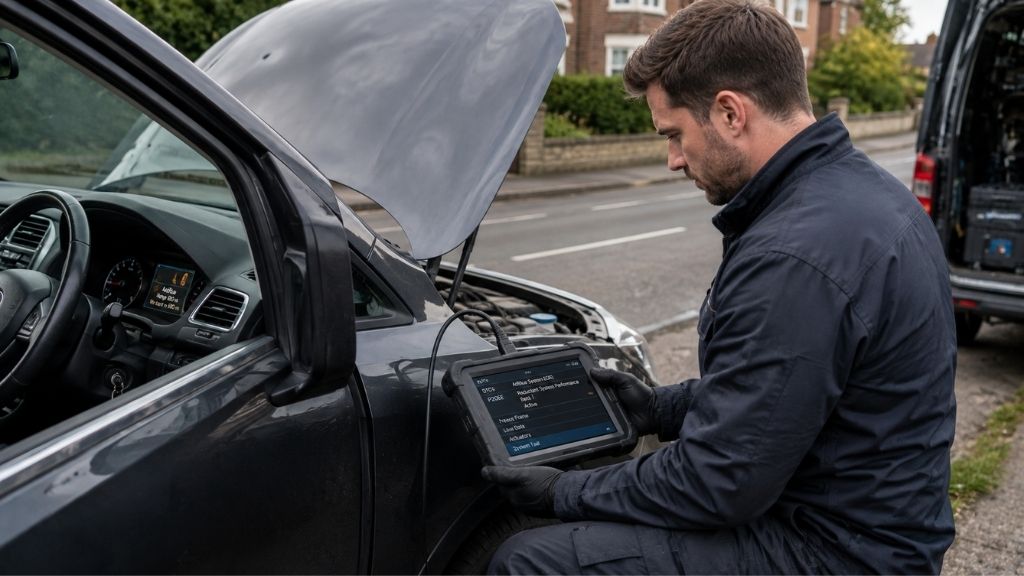
An AdBlue system fault means your vehicle’s SCR emissions system has spotted something wrong with how AdBlue is stored, measured, or injected into the exhaust, and it’s flagging it. Could be low fluid, a dying sensor, a blocked injector, a wiring gremlin, honestly it could be a few things. Until it’s sorted, expect a warning light, quite possibly a mileage countdown, and reduced performance if you let it drag on.
That’s the quick version. If this fault’s actually sitting on your dashboard right now, though, you probably want more than a one-liner. So here’s what the warning’s really telling you, what usually causes it, and how we go about fixing it properly rather than just clearing the light and crossing our fingers.
What Does “AdBlue System Fault” Actually Mean?
AdBlue, also known as DEF or diesel exhaust fluid, gets dosed into the exhaust as part of the SCR process, which exists to bring NOx emissions down on diesel vehicles. Under Euro 6 rules, that system has to keep working properly, not just be bolted on and forgotten about. So the ECU watches it constantly, checking fluid level, fluid quality, dosing accuracy, and sensor readings against what it’s expecting.
The moment any of that drifts outside normal, you get an “AdBlue system fault” warning. It’s deliberately vague. Think of it less as a diagnosis and more as the ECU waving a flag to say something in the chain isn’t right, without telling you exactly which link’s broken. Which is exactly why two cars can show the same warning and have two completely different faults underneath it.
Common Symptoms of an AdBlue System Fault
- AdBlue or engine management warning light on the dash
- A message saying the engine won’t restart after a certain number of miles
- Reduced power, or the car dropping into limp mode
- AdBlue depleting faster or slower than you’d expect
- The warning staying on even right after a refill
- Occasionally a rough idle, or a slightly odd exhaust smell, though this one’s rarer and easy to miss
If you’re seeing any of this, don’t sit on it too long. Most vehicles start counting down toward a full no-start once the fault’s logged, and sorting it before that happens is nearly always quicker and cheaper than after.
What Causes an AdBlue System Fault?
There’s rarely just one cause. It genuinely varies vehicle to vehicle, but these are the ones we see most.
Low or empty AdBlue. The obvious one, though not always the real story, especially if you’ve already topped up and the light’s still glaring at you.
A faulty quality or level sensor. The ECU can talk itself into thinking the tank’s empty, or the fluid’s wrong, when neither’s actually true. This is a big reason faults sometimes seem to make no sense at first glance.
A blocked or failed injector. If AdBlue isn’t getting into the exhaust in the right amount, the system flags it as non-compliant, regardless of how full the tank actually is. We cover this specific fault in more detail in our guide to a blocked AdBlue injector, if that sounds like what you’re dealing with.
NOx sensor problems. AdBlue and NOx systems are tightly wired together, so a NOx sensor on its way out can throw up warnings identical to a genuine AdBlue fault.
Frozen or crystallised fluid. Cold snaps can freeze the tank outright, and old or contaminated AdBlue tends to crystallise around the injector and sensors over time, especially if the tank heater isn’t pulling its weight.
Wiring or connector faults. Corrosion, a loose plug, or damaged wiring anywhere in the system can throw codes that look identical to an actual component failure, even when the part itself is perfectly fine.
The wrong fluid altogether. Anything other than genuine AdBlue or DEF fluid can confuse the quality sensor and set the whole fault chain running.
Fault Codes Commonly Linked to an AdBlue System Fault
Has a scan been done already? You might be looking at codes like P20E8, P207F, P204F, P20EE, P229F, P20BD, P20BA, P2047, P204C, P21AB, P2089, P20BE, P2058, P2200 or P2201. Between them, these span reductant pressure and heater circuit faults right through to NOx sensor range and performance issues. Send us your exact code and we’ll tell you straight away what it’s likely pointing to and roughly what fixing it involves.
If your countdown’s already hit zero and the car won’t restart, that’s a slightly different situation to a fault that’s just showing a warning light. Our guide on what happens when the countdown reaches 0 miles covers that specific scenario in more depth.
Can You Fix an AdBlue System Fault Yourself?
Sometimes, if it really is just low fluid caught early, a top-up sorts it there and then. Past that point, it gets a lot harder without proper diagnostic equipment. A basic scan tool might clear the warning temporarily, but if the actual cause hasn’t been dealt with, the fault’s usually back within days.
Cycling the ignition repeatedly, or pulling the battery hoping that resets something, rarely fixes anything, and can honestly make the eventual diagnosis trickier rather than easier. If the warning’s still there after a top-up, or you’re already watching a countdown tick down, it’s worth getting it looked at properly rather than working through guesses on your own driveway.
How We Diagnose and Fix an AdBlue System Fault
Our engineers start with a full diagnostic scan using the same OEM-level kit a main dealer would use, checking fluid quality, sensor readings, dosing performance and wiring integrity to actually pin down the cause, rather than clearing the code and hoping for the best.
From there, what happens next depends entirely on what we find. Sensor or wiring issue, that gets addressed directly. Blocked or failed injector, that’s handled as part of a proper AdBlue fix. Where a part genuinely needs replacing, our AdBlue repair service covers the pump, injector, heater or sensor, whichever’s actually at fault.
Want this to stop being a recurring problem altogether? An AdBlue delete removes the SCR strategy from the ECU permanently, clearing the fault at the root. AdBlue removal takes a similar approach, disconnecting the system entirely so there’s no dosing cycle left and nothing left to fault. If you’d rather keep the system running closer to how it was designed, minus the constant warnings, our AdBlue bypass stops the interruptions without fully switching anything off. Where the fault traces specifically back to the NOx sensor, our NOx sensor services covers that directly. And if you’re already locked out, countdown sitting at zero right now, our no-start countdown bypass is built to get you moving again fast, no dealer appointment required.
Here’s what actually separates us from a standard garage. Most shops replace whatever’s obviously failed and hand the keys back. And more often than you’d think, the fault turns up again within a few months, because the ECU strategy that caused it in the first place never actually changed. We rewrite that strategy directly, so there’s genuinely nothing left to fail the same way twice, and every job we do carries a lifetime warranty for as long as you own the vehicle.
What Does It Cost to Fix an AdBlue System Fault?
Depends entirely on the cause, honestly. A sensor fix or a wiring repair costs a fair bit less than replacing an injector or a pump, and a straightforward flush costs less again. We won’t throw a number at you over the phone before we’ve actually seen the vehicle, because that’s just guessing, and guessing tends to mean either underquoting or overcharging somebody. A proper diagnostic first means you only pay for what’s genuinely wrong, not what might be.
Preventing Future AdBlue System Faults
A handful of habits go a long way here. Stick to genuine AdBlue or DEF fluid rather than a cheaper unbranded version, since that keeps contamination the system was never built to handle out of the equation. Drive the car regularly rather than leaving it parked up for long stretches, which stops fluid sitting static and crystallising inside the system. Get the heater circuit checked at a service, particularly before winter properly sets in. And don’t ignore a warning light hoping it’ll sort itself out. Dealing with it early is nearly always cheaper than waiting for it to snowball into something bigger.
Mobile Engineers, Wherever You’re Based
An AdBlue system fault has an annoying habit of showing up at the worst possible moment, and towing the vehicle to a workshop just piles cost and delay on top of a day that’s already gone sideways. That’s why we come to you instead of the other way round. Our mobile engineers carry the same OEM-level diagnostic and ECU tools franchised dealers use, minus the dealer markup, and most jobs are sorted at your home, workplace or the roadside within the hour of us turning up.
We cover a lot more of the UK than just the obvious cities. Around London and the South East, we’re regularly out in Croydon, Reading, Guildford and Market Deeping. North of the border, we’re in Edinburgh and Glasgow, and across Yorkshire you’ll find us in Leeds, Sheffield and York.
The Midlands is one of our busiest patches, taking in Coventry, Derby, Leicester, Nottingham, Birmingham and Grantham. Further east, we’re just as often out in Peterborough, Spalding and Stamford too.
Can’t spot your area on that list? Get in touch anyway. We travel well beyond these towns fairly often, and same-day callouts are usually available across most of the UK if you book before midday.
If you’re running more than one vehicle, or a full fleet of vans and HGVs, it’s worth a look at our HGV remapping service too, covering both economy and performance remapping alongside any AdBlue work you need doing.
Frequently Asked Questions
It means the ECU has detected something wrong with the AdBlue system, whether that’s low fluid, a sensor issue, a blocked injector, or wiring, without necessarily identifying which part is actually to blame.
For a while, generally yes. But most vehicles start a mileage countdown once the fault is logged, after which the engine won’t restart once switched off, so it’s worth getting it sorted before that point arrives.
Usually because the real cause isn’t low fluid. More likely, there’s a sensor, injector, or wiring fault that a top-up alone simply won’t fix.
Yes, quite easily. AdBlue freezes around -11°C, and a faulty tank heater can cause fault codes, warnings, or crystallisation once temperatures drop.
Codes like P20E8, P207F, P204F, P20EE, P229F, P20BD, P20BA and P2047 commonly come up, covering everything from pressure and heater faults to NOx sensor issues.
You can usually clear the warning light temporarily, but if the actual cause hasn’t been addressed, the fault will typically come straight back within days.
No, not at all. Mobile independent specialists use the same OEM-level diagnostic tools dealers rely on, and can usually fix it faster and cheaper, without the wait for an appointment slot.
It depends entirely on the cause. Sensor and wiring fixes generally cost less than injector or pump replacements. We always confirm a fixed price after diagnosis, never before.
It can, if only a symptom was treated rather than the underlying cause. That’s why we check the whole system and rewrite the ECU strategy where it’s needed, backed by a lifetime warranty regardless.
Yes. The NOx and AdBlue systems are closely tied together, so a failing NOx sensor can trigger warnings that look identical to a genuine AdBlue fault.
A repair fixes the actual faulty part so the system keeps working as designed. A delete removes the SCR strategy from the ECU entirely, which some drivers prefer on older or high-mileage vehicles.
Yes. Book before midday and we’ll usually reach you the same day, at your home, workplace or the roadside, across most of our UK coverage areas.
AdBlue System Fault? Get It Sorted Today
Warning light on, countdown ticking down, or a fault code you can’t make sense of? Don’t wait around for it to get worse. Get a free, no-obligation quote and we’ll tell you exactly what’s causing it and what it’ll actually take to put right. Browse our full AdBlue fix services, or call 0330 043 4431 to speak to an engineer now.

12 Comments
[…] if dosing was interrupted mid cycle rather than purely a level or quality issue. Our wider guide on what an AdBlue system fault actually means is worth a read if your scan tool’s thrown up something we haven’t covered specifically […]
[…] wider guide on what an AdBlue system fault actually means is worth a read if your scan tool’s thrown something not covered specifically […]
[…] if that’s what’s actually showing on your scan tool instead, and our wider piece on what an AdBlue system fault actually means is worth a read for the broader picture beyond just this specific […]
[…] the other usual causes before assuming that’s what you’re dealing with. Our guide to AdBlue system faults and what they mean is a reasonable starting point if you’re not sure which category applies to you. From there, […]
[…] you’re not sure what the warning symbol on your dash actually is, our broader guide on AdBlue system faults covers the range of messages this system produces across different […]
[…] Then there’s the boring stuff that people forget. A weak battery, a corroded plug or old software can throw faults that aren’t real. A proper scan with live data is what tells a real failure from an electrical hiccup, and it saves you buying parts you never needed. For a wider look, try AdBlue problems explained and AdBlue system fault: what does it mean and how do you fix it? […]
[…] of what an AdBlue warning can mean before narrowing down to your specific model, our piece on AdBlue system faults is a good starting […]
[…] car’s Engine Control Unit stores fault codes when something in the AdBlue system fails its own performance check. These checks run automatically. The SCR system monitors NOx sensor readings, AdBlue dosing […]
[…] directly. And if you’d rather understand the fault in general terms first, our overview of what an AdBlue system fault means and how to fix it and our wider AdBlue problems explained guide are both good starting […]
[…] guide on blocked AdBlue injectors covers those symptoms and causes too, and our broader piece on AdBlue system faults is worth a read if you’re trying to understand the full range of what an AdBlue warning can […]
[…] the first place. We’ve gone into just how broad that initial warning can be in our guide on AdBlue system faults, which is worth a read if you’re trying to understand why “AdBlue fault” on its […]
[…] sure this is your exact issue, or think it might be something broader? Our guide on AdBlue system faults walks through the wider range of causes an AdBlue warning can point to, sensor faults […]