
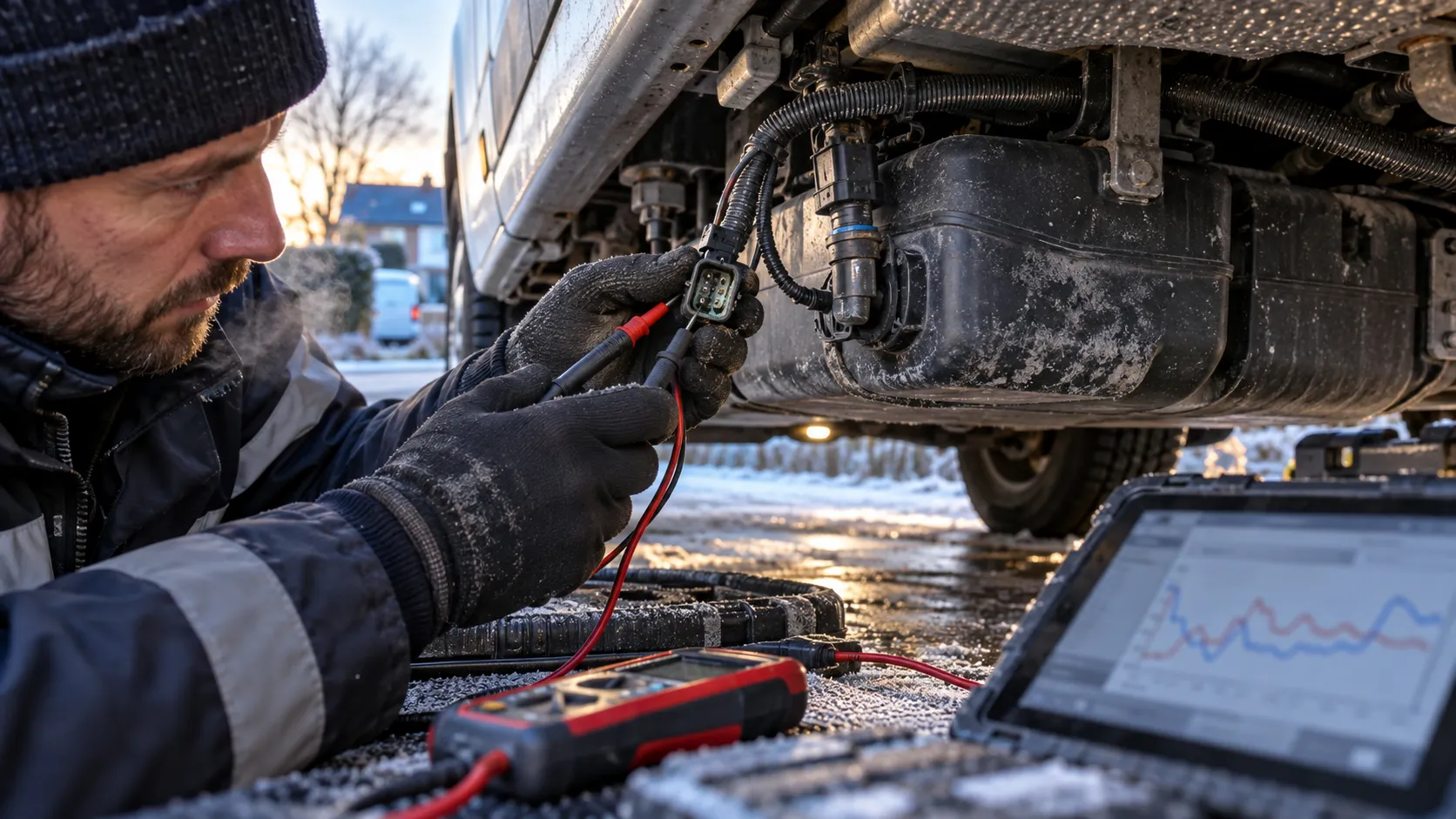
Warning light’s on. Tank’s full. And somewhere in the fault codes sits a reference to temperature rather than level or pressure, which throws a lot of people, because nobody expects a thermometer to be the thing stopping their van from starting properly.
Makes more sense once you know why it’s there at all. AdBlue freezes at around minus 11°C, and the system needs to know exactly how cold it is before it decides whether the fluid’s usable yet. That job falls to a temperature sensor sitting in or near the tank. Get a wrong reading from it, and the ECU makes the wrong call about whether AdBlue’s actually available to dose, regardless of what’s really going on in the tank.
We’re mobile, so wherever the vehicle’s sitting when this shows up is generally where we can get to it. No towing required.
What the Temperature Sensor Is Actually There For
AdBlue needs to be liquid to dose properly. Below about minus 11°C it starts freezing, and most systems carry a small heater built around the tank and sometimes the feed line specifically to stop that happening, or to thaw it back out again once it’s gone solid.
The temperature sensor is what tells that heater when to switch on, and tells the ECU whether the fluid’s actually warm enough to use yet. Without an accurate reading, the whole heating side of the system is working blind. It might run the heater when it doesn’t need to. It might not run it at all when the tank’s genuinely frozen solid.
What Causes a Tank Temperature Sensor Fault
A sensor that’s failed internally is the straightforward version. Like most sensors sitting in a harsh spot underneath a vehicle, they don’t last forever, and some go gradually, drifting out of accurate range before failing completely, rather than all at once.
Wiring and connector corrosion is the one we catch most often though. The sensor and its connector sit low down, exposed to road spray, grit, and salt through every winter it lives through. A corroded pin produces a reading that looks exactly like a genuinely failed sensor, right down to the fault code stored, even when the sensor itself still works perfectly fine.
We had a Sprinter in a few weeks back showing a stored temperature circuit fault and a warning that wouldn’t clear, even sitting in a warm workshop overnight. Sensor tested fine on the bench. The connector behind it had corroded enough to interrupt the signal intermittently, which is exactly the kind of thing that gets missed if wiring’s not checked before a sensor gets swapped out for no reason.
Crystallised urea building up around the sensor’s mounting point is another real cause, same as with a lot of AdBlue faults. AdBlue’s roughly a third urea in water, and if it sits without moving near the sensor for long enough, water evaporates out and leaves crystals behind that interfere with an accurate reading.
A failing tank heater can produce something that looks similar too, even with a perfectly good sensor. If the heater genuinely isn’t warming the tank, the sensor’s just reporting a real cold tank accurately. Diagnosis has to separate those two rather than assuming it’s the sensor by default.
Symptoms You Might Notice
The AdBlue warning light tends to be first, often alongside a dashboard message that mentions the AdBlue or emissions system rather than anything specifically about temperature.
This one shows up more in cold weather than most other AdBlue faults, which is actually one of the better clues. A fault that only ever appears on genuinely cold mornings, and seems to improve or clear once the vehicle’s been running a while, points more toward temperature sensing or heating than almost anything else on this list.
Some drivers notice the fault clearing on its own once the engine’s warmed up properly, only for it to return the next cold morning. That pattern on its own is worth mentioning when booking a diagnosis, since it narrows things down before anyone’s even looked at the van.
Left unresolved, reduced performance tends to follow, same as most AdBlue faults once the ECU decides it can’t be sure emissions dosing is working properly. A restart countdown can follow that, on the same timeline as any other AdBlue related fault.
Can You Keep Driving With This Fault?
Usually yes, for a while, especially before any countdown message appears. The engine itself isn’t harmed by an inaccurate temperature reading on its own.
Worth getting looked at reasonably promptly though, particularly heading into winter. A fault that’s manageable in October can turn into a proper cold morning no-start by December if the heating side of the system genuinely isn’t working and nobody’s addressed it yet.
Is This the Same as a Frozen AdBlue Tank?
Related, but not the same thing. A genuinely frozen tank in deep cold is its own separate situation, and our guide on an AdBlue warning after a cold night covers that scenario specifically.
A temperature sensor fault is different. It’s the sensor or its wiring misreporting what’s actually happening, rather than the fluid being frozen at all. The tank can be perfectly liquid and still throw this fault if the sensor itself is giving a bad reading.
How We Diagnose It
We start with a full fault code scan to see exactly what’s stored, since the specific code usually narrows things down quickly on this one.
From there we check the sensor’s actual reported value against real ambient and fluid temperature, rather than trusting the dashboard warning alone. That’s the only reliable way to tell whether the sensor itself is faulty or accurately reporting a real heating problem sitting elsewhere in the system.
We check wiring and the connector directly too, given how often corrosion turns out to be the actual cause rather than the sensor, as the Sprinter case above shows well enough. Skip that step and the same fault often turns up again within weeks on a freshly fitted sensor.
If sensor and wiring both check out clean, we test the tank heater itself, since a heater that isn’t drawing power properly or isn’t heating evenly produces symptoms that look identical from the dashboard.
Fault Codes You’re Likely to See
A code reader will usually flag something referencing a temperature sensor circuit, range, or performance issue on the AdBlue or SCR system, rather than a level or pressure code. Exactly which one depends on the manufacturer’s own coding convention and how far the reading’s drifted from expected.
Our wider guide on what an AdBlue system fault actually means is worth a read if your scan tool’s thrown something not covered specifically here.
Sensor Fault or Heater Fault? Easy to Mix Up
A failing tank heater and a sensor inaccurately reporting a cold tank as warm, or a warm tank as cold, can look nearly identical from the driver’s seat. Same warning light. Similar cold weather pattern. Similar reduced performance if it’s left long enough.
Measuring actual temperature independently of what the sensor reports is the only real way to separate them. We don’t assume it’s the sensor by default for exactly this reason. Replace it on a van with a genuinely failed heater, and the fault just comes straight back, with a new part fitted for nothing.
How We Fix It
Once we’ve confirmed where the fault actually sits, the fix depends on what’s found. A failed sensor gets replaced directly. Corroded wiring or a damaged connector gets properly repaired rather than patched over. A heater issue is addressed on its own terms, separate from the sensor entirely.
We clear the fault code and confirm it’s genuinely gone before finishing up, rather than clearing it and assuming it’ll hold. Every job we do carries a workmanship warranty too, so if something related to our repair gives trouble again, you’re covered.
Does the Vehicle Make a Difference?
A bit. Mercedes Sprinters and similar vans tend to show this one through winter more than most, likely down to how exposed the tank and sensor sit on that platform. Ford Transit vans show a similar seasonal pattern on high mileage examples that have spent a lot of time parked outdoors.
Citroën and Peugeot Partner models we’ve dealt with run their own specific heater and sensor check sequence, which is part of why a generic read of the fault code doesn’t always tell the full story on its own.
We Come to You, Properly
Not just a line in an advert. Call outs run across London and a wide stretch of the South East, the Midlands, and further out still, with a mobile technician carrying the equipment needed to diagnose and fix the system on site, wherever the vehicle actually sits.
London
Croydon, Newham, Waltham Forest, Redbridge, Kingston upon Thames, Lewisham, Islington, Haringey, and Havering are all covered, alongside the rest of the London area.
South East England and the Home Counties
St Albans, Slough, Sevenoaks, Loughton, Dartford, Epsom, Esher, Guildford, and Reading sit under our South East England coverage.
West Midlands
Out through the West Midlands, that’s Solihull, Dudley, Wolverhampton, Walsall, Birmingham, and Coventry.
Staffordshire
Stafford, Cannock, Lichfield, Stoke-on-Trent, and Tamworth too.
Warwickshire and Shropshire
Warwickshire coverage takes in Nuneaton, Warwick, Rugby, Leamington Spa, and Stratford-upon-Avon. Shropshire means Telford, Oswestry, Bridgnorth, and Shrewsbury.
Lincolnshire and the East Midlands
Peterborough, Stamford, Spalding, Market Deeping, Grantham, and Bourne round out our Lincolnshire coverage.
Further Out Still
Nottingham, Leicester, Derby, Leeds, Sheffield, York, Glasgow, and Edinburgh round things out.
Not seeing your area named above? Our nationwide coverage page and locations hub list everywhere else we reach.
FAQs
Because the sensor and heater are specifically there to manage freezing temperatures, so a fault in either tends to surface exactly when it’s actually cold enough to matter.
The warning sometimes clears on its own in milder weather, but the underlying fault is usually still there and will come straight back the next time it’s genuinely cold.
No. A frozen tank is a real physical state of the fluid. A sensor fault means the system’s misreporting temperature, whether or not the fluid’s actually frozen.
You can, but if the actual cause is a wiring fault or a failing heater, a new sensor won’t fix it and the fault returns quickly.
It can, indirectly, if the ECU decides the system can’t confirm the AdBlue is usable and restricts performance as a result.
A straightforward sensor or wiring repair is usually same day. A heater replacement, if that turns out to be the cause, can take a little longer depending on parts.
We come to you. Wherever the vehicle’s sitting is generally where we can carry out the diagnosis and repair.
It can, particularly if the real cause was a wiring fault that’s only partially addressed. A proper repair now is the better route than a quick clear and hope.
Yes. Every job carries a workmanship warranty, so anything related to our repair causing further trouble is covered.
Yes, the same principle applies to any diesel running SCR emissions control with a heated AdBlue tank, though we see it more often on vans and HGVs that sit outdoors overnight through winter.
