
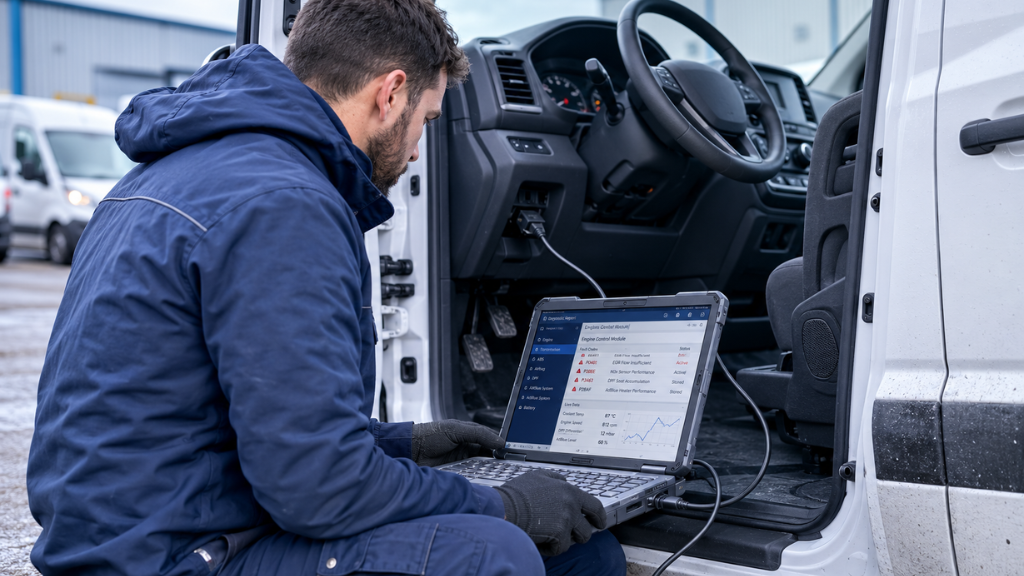
If your AdBlue warning light has come on, your van’s gone into limp mode, or you’re staring down a countdown to zero starts on a depot forecourt, you need answers not a lecture.
This guide covers everything UK van, HGV and fleet operators need to know about AdBlue faults: what causes them, whether to repair or remove the system, what it costs, and where mobile technicians fit in.
We’ll also cover the legal side honestly, because most of the confusion around AdBlue removal comes from vague or misleading advice elsewhere.
What Is AdBlue and Why It Matters
AdBlue is a urea-based fluid injected into the exhaust stream of diesel vehicles fitted with Selective Catalytic Reduction (SCR) technology.
It reacts with nitrogen oxides (NOx) in the exhaust, converting them into nitrogen and water vapour before they leave the tailpipe.
Most Euro 6 diesel vans, HGVs and light commercial vehicles built from around 2015 onwards rely on it to meet emissions standards.
When the system works properly, you won’t think about it. When it doesn’t, it can park a vehicle on your yard within hours AdBlue faults are one of the few faults that actively restrict engine power and starts by design.
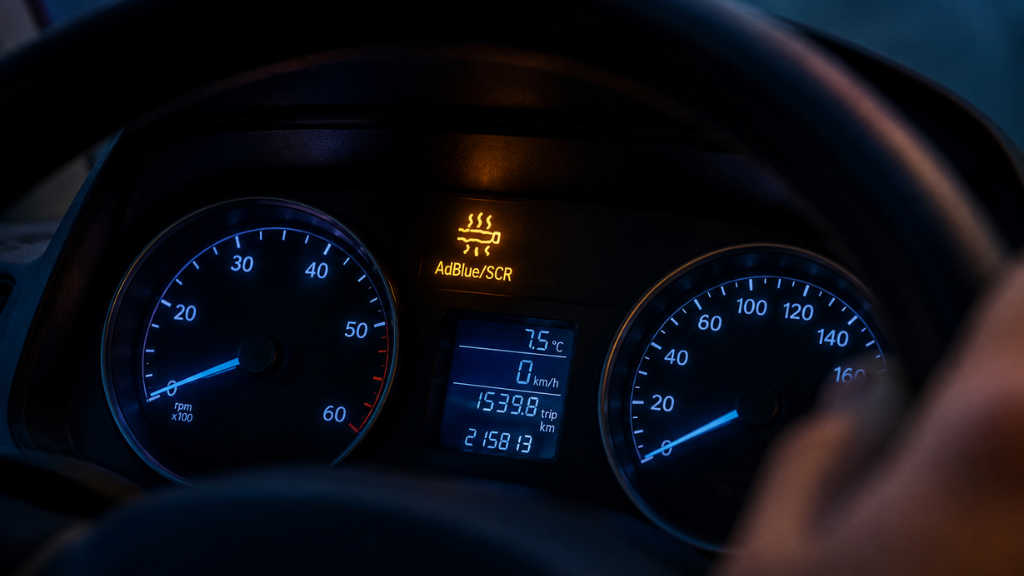
Common AdBlue Fault Symptoms
AdBlue and SCR faults tend to follow a predictable escalation pattern, which is actually useful it gives you a window to act before the vehicle is immobilised.
| Symptom | What It Usually Means |
| AdBlue/SCR warning light | Low fluid, contamination, or a sensor fault flagged |
| Message: “engine power reduced” | SCR system has already logged a fault |
| Countdown to zero starts (e.g. “200 starts remaining”) | Fault uncorrected, vehicle heading to lockout |
| Engine won’t start at all | System has entered full lockout |
| AdBlue tank emptying faster than normal | Dosing module or injector fault |
| White crystalline residue near the tank or lines | AdBlue crystallisation, often cold-weather related |
If you’re seeing a countdown message, don’t ignore it hoping it resolves itself it won’t, and the vehicle will eventually refuse to start.
What Causes AdBlue System Failures
A handful of faults account for most AdBlue-related breakdowns we see on UK fleets:
- AdBlue crystallisation — usually from cold weather, a leaking injector, or fluid sitting too long in the lines
- Faulty dosing module or injector — the most common single point of failure
- NOx sensor failure — sends bad readings, triggering false fault codes
- Tank heater failure — AdBlue freezes below -11°C without it, common in winter breakdowns
- Poor-quality or diluted AdBlue — cheap or incorrectly stored fluid damages sensors and injectors over time
- Wiring and connector corrosion — especially on vehicles that do a lot of muddy site or yard work
Cold snaps are consistently the busiest period for AdBlue-related callouts, simply because crystallisation and heater faults both spike when temperatures drop.
AdBlue Repair vs AdBlue Removal
This is the decision most operators are actually trying to make, and it deserves an honest comparison rather than a sales pitch either way.
| AdBlue Repair | AdBlue Removal/Delete | |
| Legal for road use | Yes | No — off-road/track use only |
| Vehicle stays in factory spec | Yes | No |
| Fixes the underlying fault | Yes, once correctly diagnosed | No — bypasses the system entirely |
| MOT compliance | Maintained | Can fail emissions testing |
| Typical turnaround | Same day in most cases | Same day in most cases |
| Best suited to | Vehicles remaining on public roads | Off-road plant, private land, export, or track use |
Our general advice: if the vehicle runs on public roads in the UK, repair is almost always the right call. AdBlue removal has a narrow, legitimate use case vehicles that genuinely never touch a public road and it’s worth being clear-eyed about that before booking anything in.
We cover AdBlue Repair and AdBlue Removal as separate services precisely because they solve different problems.
What AdBlue Bypass/Delete Actually Involves
An AdBlue delete or AdBlue bypass reprograms the ECU so the vehicle no longer monitors or requires AdBlue dosing to run.
It’s often carried out alongside an EGR delete or DPF removal, since these systems are frequently diagnosed and worked on together on older or heavy-use commercial vehicles.
Genuine reasons operators consider it:
- Vehicles used exclusively off-road (farms, quarries, private estates, construction sites)
- Plant and machinery not intended for public roads
- Vehicles being exported to markets with different emissions rules
- Track-only or show vehicles
It is not a general-purpose fix for a vehicle that still needs an MOT and still drives on public roads
Is AdBlue Removal Legal in the UK?
This is worth stating plainly: removing or bypassing the AdBlue/SCR system on a vehicle used on public roads takes it outside its original Type Approval and emissions compliance.
That has real consequences:
- The vehicle can fail its MOT on emissions grounds
- It’s no longer compliant with the Road Traffic Act 1988 for road use
- Insurance can be affected if the vehicle isn’t in its approved, roadworthy condition
- HGV and van operators holding an operator’s licence carry additional roadworthiness obligations enforced by the DVSA
For the current, authoritative position on MOT emissions requirements, check GOV.UK’s MOT guidance and the DVSA.
We’re upfront with every customer about this. AdBlue removal has legitimate off-road applications, and we’ll talk it through honestly but we won’t pretend it’s a like-for-like alternative to repair for road-going vehicles.
AdBlue Repair & Removal Costs
Costs vary by vehicle, fault, and access, but these indicative UK ranges give a realistic starting point for budgeting.
| Service | Typical Price Range (UK) |
| AdBlue fault diagnosis | £60–£120 |
| AdBlue pump/dosing module repair | £150–£450 |
| AdBlue injector replacement | £180–£400 |
| Tank/heater repair | £200–£600 |
| NOx sensor replacement | £150–£350 |
| AdBlue system delete (off-road use only) | £250–£600 |
| ECU remapping (car/van, Stage 1) | £150–£350 |
| HGV ECU remapping | £300–£700+ |
Get an exact price by contacting us with your registration and symptoms most quotes can be confirmed over the phone before a technician is booked in.
How Mobile AdBlue Repair Works
One of the main reasons operators choose a mobile service over a garage booking is simple: the vehicle doesn’t need to move, and off-road time is minimised.
- Call or message with your registration and symptoms — this lets us pre-diagnose likely causes before arrival
- A technician attends your location — depot, yard, roadside, or home
- Full diagnostic scan — identifies the exact fault codes rather than guessing
- Repair or delete carried out on-site — most jobs are completed in one visit
- Post-repair road test and fault code clear — confirms the fix has resolved the warning
- Paperwork and invoice provided — useful for fleet records and warranty history
Our mobile ECU services cover AdBlue work, remapping, and related diagnostics without the vehicle ever needing to leave your site.
ECU Remapping: When and Why
ECU remapping adjusts the engine’s software calibration fuelling, boost, and timing and is commonly carried out either as a standalone performance/economy service, or alongside AdBlue and EGR work to keep the ECU running cleanly after those changes.
Typical reasons operators remap:
- Improved fuel economy on high-mileage fleet vehicles
- Restoring smooth running after AdBlue or EGR work
- Additional torque for towing or heavy load work
- Correcting factory tunes that are deliberately conservative for emissions margins
For HGVs specifically, remapping is often paired with driveability tuning, since heavy vehicles are more sensitive to torque delivery changes than cars or vans.
Fleet Considerations
Fleet managers are working to a different set of pressures than a single-vehicle owner downtime cost, driver scheduling, and compliance records all matter more at scale.
- Minimise off-road time — mobile technicians attending your depot avoids a round trip to a garage
- Batch scheduling — multiple vehicles can often be seen in one visit if faults are similar
- Compliance paperwork — documented diagnostics and repairs support your operator’s licence maintenance records
- Preventative checks — AdBlue system checks ahead of winter reduce emergency callouts significantly
- Account invoicing — most mobile providers can set up fleet accounts for simpler admin
If you manage vehicles across multiple depots, ask about service areas coverage before booking, so you’re not paying a premium for out-of-area callouts.
Choosing a Mobile AdBlue Specialist
A few questions separate a genuinely competent mobile technician from someone just plugging in a generic reset tool:
- Do they diagnose with proper fault-code scanning, or just reset the light and hope?
- Are they upfront about repair vs delete, including the legal position?
- Do they work on your specific vehicle type van, HGV, or both?
- Can they provide documentation for fleet or warranty records?
- Is pricing confirmed before the technician arrives?
Straight answers to those five questions tell you most of what you need to know before booking.
Mobile AdBlue & ECU questions, answered straight
The questions we’re actually asked on the phone before a callout — no jargon, no sales pitch.
Not for vehicles used on public roads. Removing or bypassing the AdBlue system takes the vehicle outside its Type Approval and can cause an MOT failure. It’s intended for off-road-only vehicles — we’ll always talk you through this honestly before booking anything in.
Repair fixes the fault — a sensor, pump, or injector — so the system keeps working as designed. Removal reprogrammes the ECU to stop requiring AdBlue altogether, which only suits vehicles that never use public roads.
Most AdBlue repairs fall between £150 and £600 depending on the fault, with diagnosis typically £60–£120. Exact pricing depends on the vehicle and parts required — we confirm a price before the technician arrives.
Generally no. Deleting or bypassing the AdBlue/SCR system typically causes an emissions-related MOT failure on vehicles that require it as part of their Type Approval.
Usually yes, or at minimum an ECU recalibration, so the engine runs cleanly without triggering fault codes related to the now-disabled system.
Most callouts within our service areas are same-day, particularly for HGVs and fleet vehicles where downtime is a priority.
It can. Manufacturer warranties are typically voided by AdBlue system modifications, and insurers may query cover if the vehicle isn’t in its approved, roadworthy condition. Always check your specific policy.
AdBlue freezes below -11°C. A failed tank heater, combined with crystallisation in the lines or injector, is the most common cold-weather cause of AdBlue faults on UK fleets.
Still got a question about your vehicle? Ask a technician directly.
Contact Us →Conclusion
AdBlue faults are stressful mainly because of the deadline attached to them — once the countdown starts, the clock is real.
The good news is that most faults are diagnosable and repairable the same day, and for the small number of genuinely off-road vehicles, removal is a legitimate option when handled honestly and transparently.
Whichever route fits your vehicle, get a proper diagnostic first. Guessing costs more in the long run than a £60–£120 scan.
Get Your Vehicle Sorted Today
Don’t let an AdBlue fault take your van, HGV, or fleet vehicle off the road any longer than it has to.
Contact us now for a same-day mobile callout, honest diagnosis, and a straight price before we arrive.

11 Comments
[…] and AdBlue fix pages explain what those services cover. If you can’t bring the vehicle in, our mobile AdBlue repair service may be able to come to you […]
[…] fix pages explain what those services involve, and if the vehicle can’t be driven to us, our mobile AdBlue repair service may be able to come to […]
[…] seeing your area named above? Our nationwide coverage page and locations hub list everywhere else we […]
[…] seeing your area named above? Our nationwide coverage page and locations hub list everywhere else we […]
[…] seeing your area named above? Our nationwide coverage page and locations hub list everywhere else we […]
[…] seeing your area named above? Our nationwide coverage page and locations hub list everywhere else we […]
[…] our full locations page has the complete list, and depending on where you’re based, our mobile AdBlue removal and repair service might be a more convenient option than bringing the vehicle to […]
[…] Can’t see your area listed? Get in touch anyway, since we travel well beyond these towns fairly often, and same-day callouts are usually available across most of the UK if you book before midday. Running a Transit fleet? Our HGV remapping service is worth pairing with any AdBlue work, and you can read more about our mobile AdBlue removal and repair coverage across the UK. […]
[…] listed? Send us your postcode. Our page on mobile AdBlue repair across the UK explains how far we travel, and the full locations hub has everything in one […]
[…] you want to understand all your options before deciding, our mobile AdBlue removal and repair service covers the full UK and includes a diagnostic assessment before any work is carried […]
Hi, this is a comment.
To get started with moderating, editing, and deleting comments, please visit the Comments screen in the dashboard.
Commenter avatars come from Gravatar.