
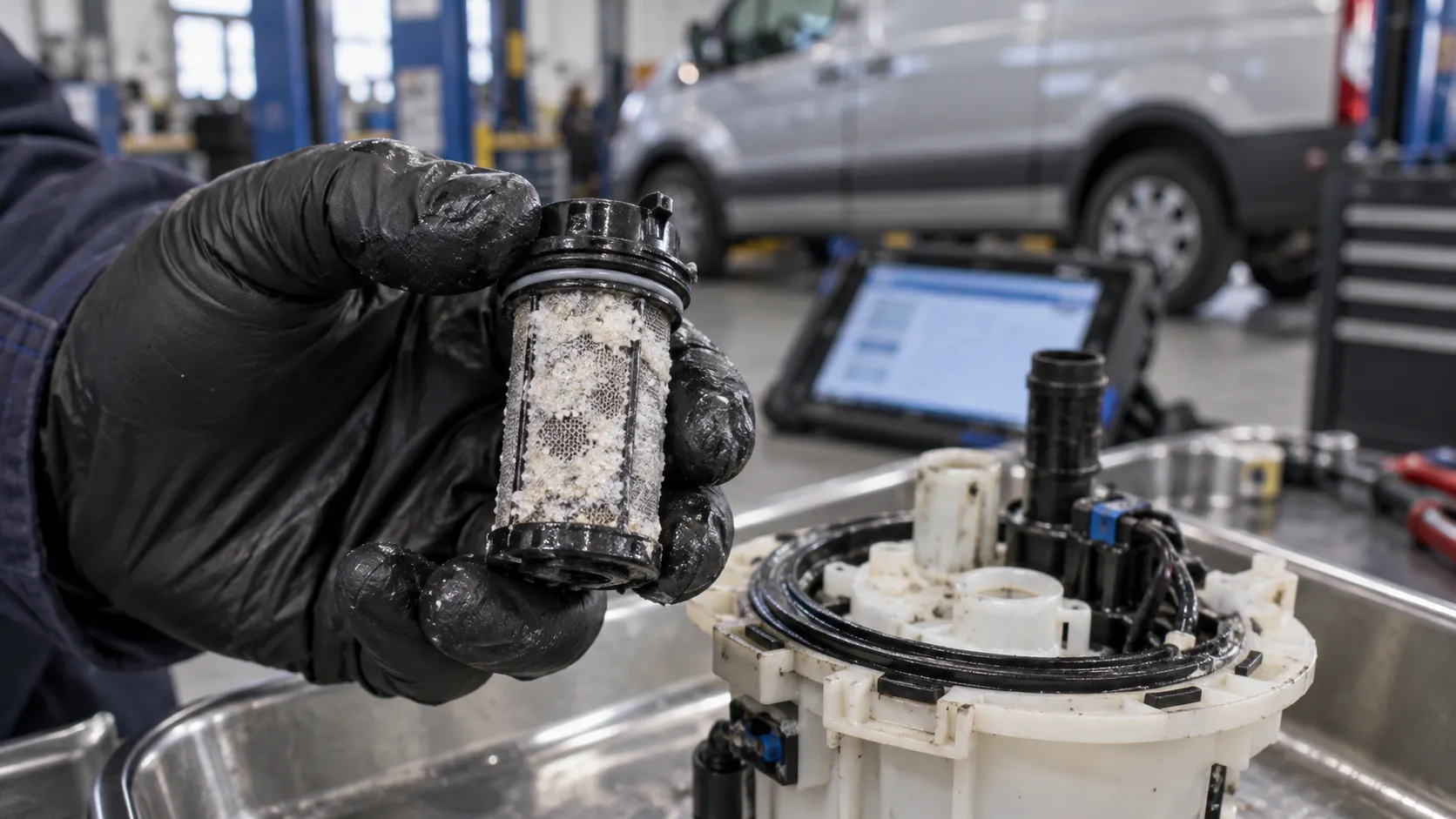
Most people have never heard of the AdBlue filter. That’s fair enough. It’s tucked away inside the tank or the pump module, nobody sees it, and it doesn’t appear on any service schedule. But when it clogs, it can cause a run of fault messages that look like something much more expensive has gone wrong.
We’ve lost count of the cars that have come to us after someone has already replaced a pump, or a sensor, or even an injector, and the warning light has stayed put. Quite often the real culprit was a small, dirty filter that cost almost nothing and had been quietly starving the system the whole time.
So here’s what the filter does, why it blocks, how to spot the signs, and how a proper diagnosis separates it from the faults it loves to impersonate.
What the AdBlue Filter Actually Does
Think of it as the gatekeeper between the tank and everything downstream. AdBlue sits in the tank, the pump draws it out, and before that fluid reaches the pump and the injector, it passes through a fine filter or strainer. Its job is simple: stop dirt, crystals, sludge and debris from reaching components that are far more delicate and far more expensive.
The injector nozzle is tiny. The pump has precision internals. Neither copes well with grit. The filter exists to protect both, and on most systems it does the job quietly for years.
Where exactly it sits depends on the vehicle. On many cars it’s part of the tank’s supply module, sitting alongside the level sensor, heater and pump. On others it’s a separate inline element. On some, it’s built into the pump unit and can’t be serviced on its own. That last point matters, because it affects whether the fix is a simple clean-and-replace or a bigger repair.
Why an AdBlue Filter Blocks Up
A filter doesn’t clog for no reason. Something is always feeding it. These are the causes we see most often.
Crystallised AdBlue. This one comes up in almost every AdBlue story. If fluid sits still and dries out, urea crystals form, and those can break away and travel into the filter. We explain the mechanism in our guide on whether AdBlue crystallisation can be repaired, and if crystals are a recurring theme for you, our article on why crystals keep coming back after cleaning is worth reading alongside this one.
Contaminated or poor-quality fluid. Cheap AdBlue with no certification, a top-up from an old container, or a bottle that’s picked up dust or diesel can introduce particles the filter then has to catch. It’s an easy mistake to make, particularly with van and fleet drivers topping up from whatever’s available.
Wrong fluid in the tank. Water, diesel or coolant poured into the AdBlue filler is more common than you’d think. Diesel pumps and AdBlue caps sit close together at many stations, and in the dark or in a rush it happens. The resulting sludge can clog a filter very quickly.
Sediment and age. Over several years, tiny deposits settle at the bottom of the tank. Every time the pump draws fluid, some of that finds its way to the filter. It builds slowly, and the first sign is often a mild, intermittent fault.
Corrosion and debris from inside the tank. In older systems, flaking material from tank internals or fittings can end up in the filter. We touched on a related issue, corroded contacts, in our guide on AdBlue connector corrosion.
Long periods standing unused. A vehicle parked for weeks gives fluid time to settle, evaporate at the edges, and form deposits that get drawn into the filter the moment the car is driven again.
The Symptoms of a Blocked AdBlue Filter
A blocked filter rarely announces itself with a single clear signal. It tends to show up as a pattern of vague, slightly irritating faults. These are the ones we hear about most.
The warning light appears with a full tank. The ECU sees poor flow or low pressure and treats it like a supply failure, whatever the level in the tank. If that sounds familiar, our guide on an AdBlue fault with the tank full and the warning still on explains why this happens.
The fault comes and goes. A partly blocked filter might let enough fluid through when the system is cold and relaxed, then struggle when demand rises. People describe it as the kind of fault that keeps coming back however many times it’s cleared. We also have a second guide on why an AdBlue fault keeps returning that approaches the same pattern from a slightly different angle.
You hear the pump working harder. A faint, extended whirring or buzzing at start-up or shut-down can mean the pump is straining against a restriction.
Dosing is weak. If not enough fluid reaches the injector, the spray is thin, NOx isn’t properly controlled, and the ECU starts logging efficiency faults. You might see a code like P204F, which points at reduced SCR performance.
The countdown appears. Once the system decides it can’t dose properly, it begins counting down to a restricted restart. Our guides on how long you can drive with an AdBlue fault and the countdown to no-start explain how that escalation works.
Power drops. Left long enough, some vehicles reduce engine output to protect the emissions system.
Why It’s So Easy to Misdiagnose
This is the frustrating bit. A blocked filter produces symptoms that overlap almost completely with other AdBlue faults, so it’s regularly mistaken for something else.
It looks like a failing pump, because pressure is low and the pump is working hard. It looks like a blocked injector, because dosing is weak. It looks like a faulty level sensor, because the warning stays on with fluid in the tank. And it can look like a wiring problem, because the fault is intermittent. We’ve written separate guides on an AdBlue pump with no pressure, an injector that’s blocked, an injector that isn’t spraying, a level sensor fault and a wiring fault, and any of them can be confused with a clogged filter.
That’s why guessing is expensive. Replace a pump when the filter was the issue and the new pump gets starved and damaged too. We’ve seen it happen.
How We Diagnose a Blocked Filter
We don’t start by swapping parts. We start by establishing what the system is actually doing.
First comes a full scan on dealer-level equipment. We read both current and historic codes, because a pattern of pressure-related entries often tells us more than a single live fault.
Then we look at live data: pump pressure, flow, duty cycle and temperature readings. A pump that’s running at a high duty cycle but achieving low pressure is a strong hint that something upstream is restricted.
Next we check the fluid. We inspect it for colour, clarity, debris and smell, and we confirm it’s genuine AdBlue and not diluted or contaminated. Wrong fluid is a surprisingly common finding.
After that, we access the tank module and inspect the filter directly. A blocked one is usually obvious once you see it: crusted with crystals, coated in sludge, or packed with fine sediment.
Finally we look at what’s around it. If the filter is blocked, there’s a reason, and we need to know whether it’s old crystals, bad fluid or something shedding from inside the tank. Replacing a filter without addressing the source is how people end up back with the same fault a month later.
Fixing It Properly
The fix depends on the vehicle and on how far the problem has gone.
Where the filter is serviceable, we remove it, check it, and replace it. Where it’s integrated into the pump or tank module, the repair may involve replacing that module, though we’ll always confirm that’s necessary before recommending it.
We also flush the system where needed. If contaminated fluid has been in there, the tank, lines and pump need to be cleaned out and refilled with certified AdBlue, otherwise the new filter gets blocked again quickly.
If crystals have spread further down the line, we deal with them at the same time. Our AdBlue repair and AdBlue fix pages explain what those services involve, and if the vehicle can’t be driven to us, our mobile AdBlue repair service may be able to come to you.
If your car has a related sensor issue alongside this, our NOx sensor services page covers that side, and for vehicles where emissions faults have spread to the particulate filter, our DPF solutions are there too. For commercial vehicles, we also cover HGV remapping, and for cars that have had calibration work, our performance remapping and economy remapping pages explain how those interact with emissions systems.
Can You Check It Yourself?
You can’t inspect the filter at home on most vehicles, and we’d advise against trying to dismantle the tank module. It holds sensitive parts, and AdBlue is corrosive to skin and bare metal. But there are a few useful things you can do before you book a diagnosis.
Think back to the last top-up. Was it a sealed bottle of certified AdBlue, or a decanted container of unknown age? Did anyone use a funnel that might have been used for something else? Did the warning light begin soon afterwards? That timing can tell a technician a lot.
Notice the pattern. Does the fault appear at start-up, after a long drive, or in cold weather? A warning after a cold night can have several causes, and a partly blocked filter is one of them.
And if you’ve recently had other parts replaced without success, tell whoever looks at it next. It narrows things down quickly.
Make-Specific Notes
Filter and supply module designs vary a lot, and some makes are more prone to this than others. If you drive one of the following, we have a dedicated guide: Mercedes, Land Rover, Ford Transit, Citroën, Peugeot Partner or Nissan. We also have a page on BMW systems. For the bigger picture, our guides on AdBlue problems explained and AdBlue problems by manufacturer show how common this kind of fault is across the market, and our system fault guide explains the warnings in plain English.
Preventing a Blocked Filter
Most of this comes down to simple habits. Use certified AdBlue from a sealed container, and keep spare fluid somewhere that doesn’t bake in summer or freeze in winter. Don’t leave a vehicle standing for months with a part-empty tank. Be careful at the pump, especially with the filler caps on diesel vans, where mix-ups happen. And don’t ignore early, intermittent warnings. A fault that fixes itself is rarely actually fixed.
If you’d like to know more about us, our about page has the background, and our blog has more guides like this one.
Areas We Cover
We diagnose and repair blocked AdBlue filters and the faults that come with them across our whole service area, so if you’re near one of the places below, your local page has more detail.
In the capital, our AdBlue diagnosis London page and our London page cover the city, and we also work across the neighbouring boroughs of Redbridge and Newham. Fleet vans and delivery vehicles doing constant stop-start work are especially prone to filter problems, so it’s a fault we see regularly across London.
Across the South East, we cover Croydon, Guildford, Reading, St Albans, Slough, Sevenoaks, Dartford, Epsom, Esher and Loughton, along with the wider South East England region.
In the Midlands, we cover the West Midlands as a whole, including Birmingham, Solihull, Dudley, Wolverhampton, Walsall, Tamworth, Coventry and Nuneaton. In Warwickshire we’re active in Warwick, Rugby, Leamington Spa and Stratford-upon-Avon, with the county covered on our Warwickshire page. Staffordshire and Shropshire are covered through Stoke-on-Trent, Stafford, Cannock, Lichfield, Shrewsbury, Telford, Oswestry, Bridgnorth and the wider Shropshire area.
Heading east and north, our East Midlands and Lincolnshire coverage includes Nottingham, Leicester, Derby, Grantham, Peterborough, Stamford, Spalding, Market Deeping and Bourne, plus the broader Lincolnshire page. In Yorkshire we cover Leeds, York and Sheffield.
And in Scotland, we cover both Edinburgh and Glasgow.
If your area isn’t named above, our full locations page has the complete list.
FAQs: Blocked AdBlue Filter
It sits between the tank and the pump or injector and catches dirt, crystals and sediment so they can’t reach delicate components downstream.
A warning light with a full tank, intermittent faults, a pump that sounds like it’s working hard, weak dosing, and eventually the countdown to a restricted restart.
Yes. If the system can’t dose properly because fluid isn’t flowing, it will eventually begin counting down regardless of how full the tank is.
They look very similar from the driver’s seat. A pump working hard but achieving low pressure often points to a restriction upstream, which is why live data and a physical inspection matter.
Yes. Diluted, dirty or wrong fluid is one of the most common causes, and diesel or water in the tank can clog it quickly.
That depends on the design. Some are replaceable on their own, while others are part of a module that has to be replaced as a whole.
It can. A pump forced to run against a restriction works harder and may fail early, which is why diagnosing first matters.
For a short time, usually, but the fault tends to escalate into a countdown and possible power reduction if it’s left alone.
It can. Thicker, colder fluid flows less easily past a partly blocked filter, so intermittent faults often show up on cold mornings first.
It depends on whether the filter is serviceable or part of a module, and whether the system needs flushing. We confirm the scope after diagnosis, before any work begins.
It can contribute. Poor flow leads to poor spray, and poor spray often leaves fluid behind to dry into deposits.
Use certified AdBlue from a sealed container, avoid contamination at the pump, don’t leave the vehicle standing for months, and act on early warnings.
Get It Diagnosed Before You Replace Anything
A blocked filter is one of the cheapest faults to fix and one of the most expensive to misdiagnose. If your AdBlue warning keeps returning, or you’ve already replaced a part without success, it’s worth having the supply side checked properly before spending any more. Get in touch through our contact page to book a diagnostic check, wherever you’re based in London, the Midlands, Scotland or the wider UK.
