
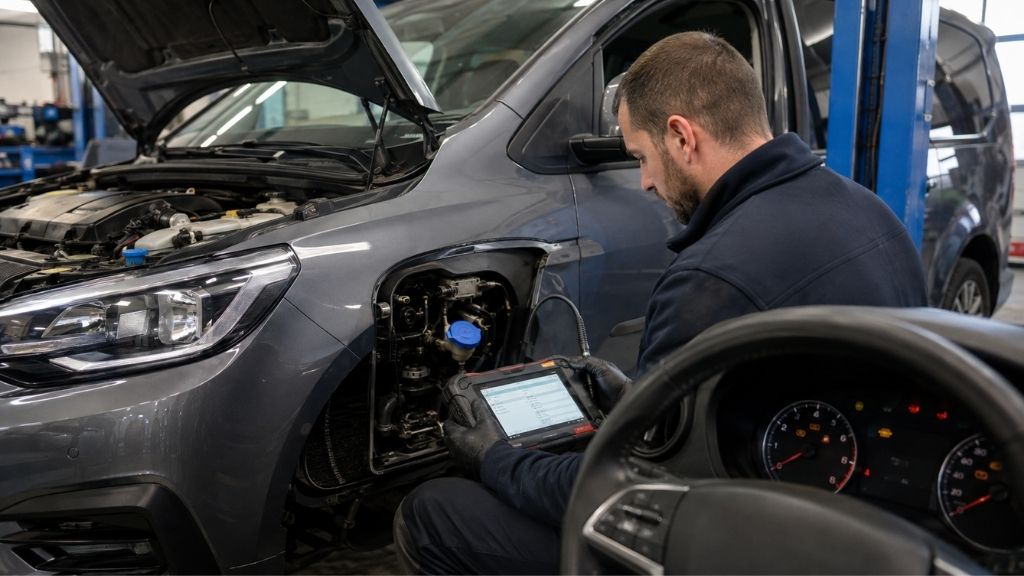
Topped the tank right up and the AdBlue light’s still glaring at you? Nine times out of ten, that’s the level sensor, not the fluid. Its whole job is telling the ECU how much AdBlue is actually sitting in the tank, and when it packs in, it doesn’t just stop working quietly. It keeps feeding the car a reading that’s wrong, usually stuck low, so the ECU genuinely believes the tank’s empty even though you’ve just filled it to the brim.
That’s the short version. It’s one of the more common AdBlue faults we see, and honestly one of the more frustrating ones for drivers, because the obvious fix, filling the tank, does absolutely nothing here. So let’s get into what’s actually happening, why it happens, and what putting it right properly looks like.
What Does the AdBlue Level Sensor Actually Do?
The level sensor lives inside the tank and measures how much fluid’s left, feeding that back to the ECU on a constant loop. On plenty of vehicles it’s built into the same unit as the quality sensor, so one part’s doing two jobs at once: checking how much AdBlue’s there, and whether it’s actually the right stuff at the right strength.
Here’s the catch though. The ECU has no other way of knowing what’s really going on inside that tank. It just trusts the sensor completely. So if the sensor says empty, the car treats it as empty. Doesn’t matter what’s genuinely sloshing around in there.
Symptoms of an AdBlue Level Sensor Fault
- The warning light staying on straight after a refill
- A mileage countdown showing up even with a full tank
- The dash displaying a fluid level that’s clearly wrong, or jumping around
- Fault codes tied specifically to level or quality sensor circuits
- The warning flickering on and off rather than sitting there permanently
- Sometimes, nothing else at all, the car drives completely normally aside from the light
That last one trips people up constantly. A level sensor fault doesn’t always bring reduced power or rough running along with it, so it’s easy to assume the whole system’s on its way out when really it’s one small part sending bad information.
Why Does the Warning Stay On After a Refill?
Probably the question we get asked most, and it comes down to a handful of things.
The sensor’s actually failed. Sensors wear out like anything else does. Once the internal float or circuit degrades, it can get stuck reporting a fixed low reading regardless of what’s in the tank.
Corrosion or crystallised buildup on the sensor. AdBlue crystallises if it sits still too long, and that buildup can coat the sensor itself, throwing the reading off without the sensor being mechanically dead.
Wiring or connector trouble. Sometimes the sensor’s fine and it’s the wiring between it and the ECU that’s not, corrosion, a loose pin, vibration damage, all of it can produce a fault that looks identical to a failed sensor.
Software not recognising the top-up. Occasionally the ECU needs the fault properly cleared through diagnostic software after a refill, rather than sorting itself automatically, particularly once a countdown’s already started.
The wrong fluid. Anything that isn’t genuine AdBlue or DEF can read incorrectly on the sensor, since it’s calibrated for a specific concentration and consistency.
Fault Codes Linked to a Level Sensor Fault
Had a scan already? Codes like P203E, P203F, P2564, P2565, P2566, P2567 or P20EE commonly point to level or quality sensor circuit problems specifically. Send us whatever code’s showing and we’ll tell you straight away whether it lines up with the sensor or something else entirely.
Not sure this is your exact issue, or think it might be something broader? Our guide on AdBlue system faults walks through the wider range of causes an AdBlue warning can point to, sensor faults included.
Can a Level Sensor Fault Cause a No-Start?
Yes, eventually, and this catches a lot of people off guard. Because the ECU trusts the sensor over everything else, a stuck-low reading behaves exactly like a genuinely empty tank as far as the car’s concerned. The same countdown kicks in, and left unresolved, you’ll end up with the same no-start situation as an actual empty tank, plenty of AdBlue sitting right there the whole time. We’ve covered what that looks like in more depth in what happens when the countdown reaches 0 miles, worth a read if you’re already at that stage.
Can You Fix This Yourself?
Not reliably, no. There’s no way to manually recalibrate or clear a level sensor fault without proper diagnostic software, and topping the tank up again won’t touch it if the sensor’s the one lying. Some people try disconnecting the battery, hoping it forces some kind of reset. It rarely works, and every so often it introduces a fresh minor fault that just muddies the diagnosis further down the line.
Worth knowing too, the sensor usually needs replacing outright if it’s genuinely failed internally, rather than cleaning. So even getting to it yourself often wouldn’t be enough to actually fix it.
How We Diagnose and Fix a Level Sensor Fault
We start with a full diagnostic scan to confirm the level sensor’s genuinely the cause, rather than a wiring fault, a quality sensor issue, or something else further up the chain presenting the same symptoms. This step actually matters, since swapping a sensor that was never faulty fixes nothing and just costs you money.
Where the sensor’s failed, we replace it as part of our AdBlue repair service, fitting a proper OEM or OEM-equivalent part rather than something cheap that’ll fail again. Where it turns out to be wiring or a connector, that gets sorted directly instead. And if the fault’s already triggered a countdown or full lockout, we clear that through the ECU in the same visit, so you’re not left with a brand new sensor and a car that still won’t turn over. For anyone already sitting at zero, our no-start countdown bypass handles exactly that situation, getting you moving again without a dealer appointment hanging over you.
If sensor faults keep recurring on an older or higher-mileage vehicle, it might be worth looking at something more permanent. An AdBlue delete removes the SCR strategy from the ECU entirely, sensor and all, so there’s nothing left to fail in this particular way again. AdBlue removal works along similar lines, disconnecting the system so a fresh sensor failure simply isn’t a factor going forward. If you’d rather keep the system doing what it was designed to do, minus the warnings derailing your week, our AdBlue bypass is worth a look too. And if you’re not sure whether it’s the sensor alone or something wider going on, our broader AdBlue fix service covers diagnostics and repair across the whole system, not just one part of it. Where the trouble actually traces back to a NOx sensor rather than the AdBlue level sensor, our dedicated NOx sensor services line handles that separately.
Every repair we carry out comes with a lifetime warranty for as long as you own the vehicle, and we check the wiring and connectors around the sensor as standard, not just the part itself, so a fresh sensor doesn’t get undone a few weeks later by a wiring issue nobody bothered looking at.
What Does It Cost to Fix an AdBlue Level Sensor Fault?
A straightforward sensor swap tends to be one of the more affordable AdBlue repairs going, since it’s a single component rather than something bigger like a pump or injector. Costs climb if it turns out to be a wiring fault needing more digging, or if the level sensor’s combined with the quality sensor in one unit has to be replaced as a pair. We’ll confirm a fixed price once we’ve actually diagnosed the fault properly, not guessed at it over the phone.
Preventing Future Sensor Faults
A few habits genuinely help here. Stick to genuine AdBlue or DEF fluid, since incorrect concentration or contamination is one of the more common reasons sensors develop faults in the first place. Try not to let the tank run right down to empty repeatedly, since sediment and crystallisation tend to build up more around a sensor that’s regularly sitting in low fluid. And if a warning shows up, get it checked rather than assuming a refill alone will do the trick, since catching a sensor fault early is nearly always simpler, and cheaper, than waiting for it to fail outright.
Mobile Engineers, Wherever You’re Based
A level sensor fault doesn’t need a trip to the dealer, and it certainly doesn’t need a week off the road waiting for someone to have a slot free. Our mobile engineers come straight to you instead, home, workplace, roadside, wherever suits, carrying the same OEM-level diagnostic kit a franchised dealer would use, minus the dealer pricing that comes attached to it.
We’re set up to cover a genuinely wide stretch of the UK, not just the obvious hotspots. London and the wider South East is one of our busiest patches, taking in Croydon, Reading, Guildford and Market Deeping alongside London itself. North of the border, we’re regularly out in Edinburgh and Glasgow, and across Yorkshire you’ll find us in Leeds, Sheffield and York.
The Midlands keeps us busier than almost anywhere else, covering Coventry, Derby, Leicester, Nottingham, Birmingham and Grantham. Further east, we’re just as often called out to Peterborough, Spalding and Stamford.
Can’t spot your town on that list? Get in touch anyway, we travel well beyond these areas fairly regularly, and same-day callouts are usually on the table across most of the UK if you book before midday.
Running a fleet rather than a single car? It’s worth pairing a sensor repair with a look at our HGV remapping service too, covering both economy and performance remapping alongside any AdBlue work your vehicles need.
Frequently Asked Questions
Almost always a faulty level sensor sends the ECU an incorrect reading, rather than an actual fluid problem. The sensor is reporting low even though the tank is genuinely full.
Yes. The ECU treats the sensor’s reading as fact, so a stuck-low sensor can trigger the same countdown and eventual no-start as a genuinely empty tank would.
Rarely, and it’s not something worth relying on. It doesn’t address the actual fault and can sometimes make the eventual diagnosis harder rather than easier.
Sometimes, if the fault is caused by crystallisation or buildup rather than genuine internal failure. If the sensor itself has failed, it needs replacing rather than cleaning.
Codes such as P203E, P203F, P2564, P2565, P2566, P2567 and P20EE can be associated with level, range, performance or SCR-related faults. The exact meaning depends on the vehicle and diagnostic system, so the code should be interpreted alongside the live data and fault symptoms.
On plenty of vehicles, yes. They’re built into a single unit that checks both fluid level and quality, so a fault can relate to either function.
Generally, it’s one of the more affordable AdBlue repairs, since it often involves a single component. Costs can rise if wiring is involved or the sensor forms part of a combined unit. We confirm pricing after diagnosis, not before.
No. Mobile independent specialists use professional diagnostic equipment and can often complete the repair faster and for less than a main dealer, without waiting for a dealership appointment.
Yes. Incorrect or contaminated fluid can affect the SCR system and may contribute to sensor readings or fault codes. AdBlue should meet the required ISO specification for the vehicle.
It shouldn’t, provided the actual cause, whether that’s the sensor itself or the wiring around it, was properly diagnosed and dealt with rather than guessed at.
No, not always. Plenty of level sensor faults show up as just the warning light with no noticeable change in how the car drives, which is why they’re easy to mistake for a simple low-fluid warning.
Yes. Book before midday and we’ll usually reach you that same day, at your home, workplace or roadside, across most of our UK coverage areas.
Warning Won’t Clear? Get It Sorted Today
If your AdBlue light’s staying on no matter how many times you top up, stop refilling and hoping it’ll shift on its own. Get a free, no-obligation quote and we’ll tell you exactly what’s causing it and what it’ll take to fix properly. Browse our full AdBlue fix services, or call 0330 043 4431 to speak to an engineer now.

7 Comments
[…] that shows up with no prior battery work behind it is more likely a genuine failure. Our guide on why the AdBlue warning stays on covers that distinction properly if your situation doesn’t line up neatly with a recent […]
[…] or a blockage sitting in a line that’s otherwise got plenty of fluid behind it. Our guide on why the AdBlue warning stays on untangles that distinction […]
[…] AdBlue level sensor fault where the warning won’t clear […]
[…] AdBlue fault: tank full, warning still on covers this exact pattern in more depth, and our guide on AdBlue level sensor faults explains why the sensor side specifically causes […]
[…] The trap is that people keep adding fluid, hoping the light will give up. Please don’t. An overfilled tank causes its own trouble and the warning stays put. If the light came on right after a fill, the level sensor is a good suspect, because it can report an empty tank when it’s full. We’ve written about exactly this in AdBlue fault but tank is full: why is the warning still showing? and AdBlue level sensor fault: why does the warning stay on? […]
[…] give it an inaccurate reading, since it’s built to read a liquid, not a slush. Our piece on AdBlue level sensor faults and why the warning stays on covers this sensor’s more common genuine failure points too, cold weather or […]
[…] on walks through exactly why that happens and what to do about it. Related to that, our guide on AdBlue level sensor faults goes into the sensor side specifically, which is directly relevant given how many Land Rover faults […]