
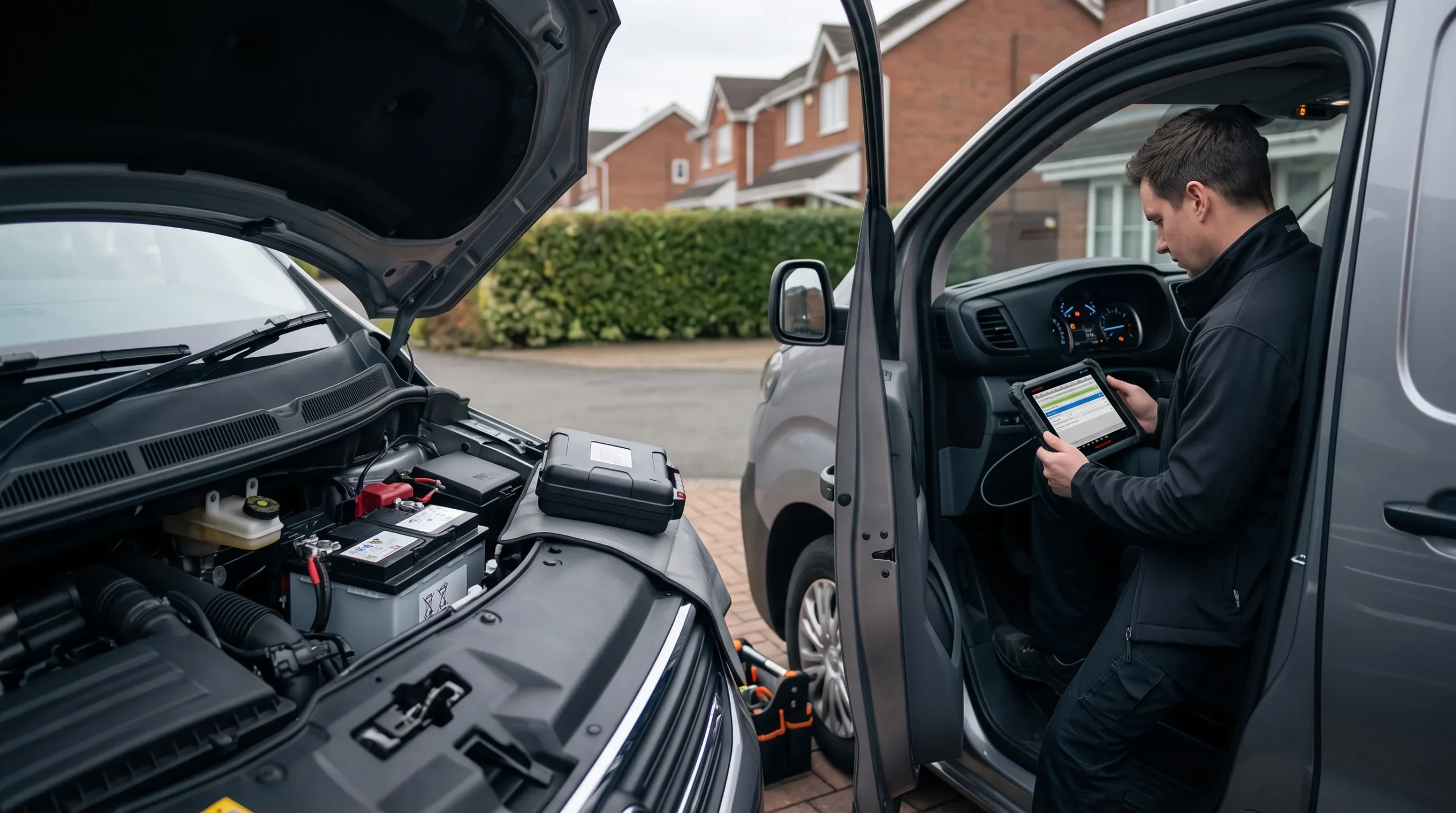
Battery’s brand new. Everything else on the dash looks normal. And there it is anyway, an AdBlue warning that wasn’t showing before anyone touched the battery at all. Confusing moment for most people, because the AdBlue system and the battery don’t seem like they should have anything to do with each other.
They actually do, more than you’d expect. Disconnecting the battery wipes stored values the ECU had been quietly relying on, AdBlue level readings, sensor calibration, sometimes a learned baseline for how the system expected things to behave. Reconnect everything and the ECU’s starting from scratch in places it wasn’t before, and that can throw up a warning even when nothing mechanical has actually changed.
We’re mobile, so if this has happened to you, wherever the vehicle’s sitting is generally where we can sort it.
Why Would a Battery Swap Affect the AdBlue System at All?
The ECU keeps a running memory of things that aren’t obvious from the outside. Learned sensor values, adaptation data, sometimes a rolling average of recent readings it uses to smooth out normal variation. Pull the battery, and depending on the vehicle, some or all of that gets cleared.
For the AdBlue system specifically, that can mean the level sensor needs to relearn where empty and full actually sit in your particular tank, since it’s not always a simple fixed number. It can also mean a quality sensor baseline resets, and until it’s taken a fresh reading and settled, the ECU sometimes treats that uncertainty cautiously, which shows up as a warning.
What Actually Causes the Warning to Appear
A few different things, and they don’t all need the same fix.
Lost calibration data is probably the most common. The level or quality sensor hasn’t actually failed, it’s just lost its reference point and needs to relearn it through a proper drive cycle or a reset procedure, depending on the manufacturer.
A fault that was already quietly present, but somehow not flagged before, sometimes gets picked up fresh the moment the ECU restarts clean. Nothing new has actually gone wrong. The battery disconnect just gave the system a reason to check everything properly again, and it found something that was there all along.
Disconnecting the battery mid dosing cycle is less common but does happen, usually if someone’s working on the vehicle for an unrelated reason and the AdBlue pump happened to be mid cycle at that exact moment. The system can be left in an incomplete state that needs clearing properly rather than just waiting out.
Voltage spikes during a poorly done jump start or an incorrect reconnection order can occasionally affect sensitive sensors too, though this is rarer and tends to come with other electrical symptoms alongside the AdBlue warning, not just the one light on its own.
How We Actually Work Out Which One It Is
We start with a full fault code scan, since what’s actually stored tells us a lot before anything else gets touched. If the code points to a level or quality reading that’s simply out of range rather than a hard sensor failure, that’s consistent with lost calibration, and a proper relearn procedure is usually all it takes.
If the code points to something more specific, a genuine sensor or wiring fault, we check that on its own merits rather than assuming the battery disconnect caused it. Sometimes it really is coincidence, a fault that was building up anyway and happened to surface right around the same time as the battery work.
We also check whether the pump was mid cycle when the disconnect happened, which usually shows up as a slightly different pattern in the stored data. If that’s what’s behind it, completing the cycle properly and confirming pressure’s holding normally usually resolves things without anything needing replacement at all.
Signs This Is Actually a Calibration Issue Rather Than a Real Fault
The timing is the biggest clue. A warning that appeared specifically after battery work, with no prior history of AdBlue trouble, points more toward lost calibration than a coincidental genuine failure. The fault often clears partially or fully after a reasonable drive, sometimes within a day or two, once the system’s had a chance to relearn on its own.
If the warning’s still there after a few days of normal driving, or it’s paired with other symptoms like reduced performance, that’s worth getting looked at properly rather than just waiting it out indefinitely.
A Van That “Broke” the Day After a New Battery
One of our technicians picked up a Transit where the owner was adamant the garage that fitted the new battery must have damaged something. Fair assumption, given the timing. Warning hadn’t been there before, battery got changed, warning appeared within a day.
Turned out the level sensor had simply lost its reference point and needed a proper relearn drive cycle, which the vehicle hadn’t been given a chance to complete since it had mostly been sitting on the driveway since the battery swap. A short supervised drive with the right scan tool monitoring the readings sorted it completely. Nothing had actually broken. The system just needed the chance to settle back in.
A second one wasn’t so simple though. A Citroën Relay where the warning appeared after a battery disconnect, and the owner assumed the same thing, nothing to worry about, it’ll sort itself out. Three weeks later it hadn’t, and a proper scan showed a genuine quality sensor fault that had nothing to do with the battery at all. Pure coincidence in timing. The sensor was already failing and would’ve thrown the warning eventually regardless of what happened with the battery.
Can You Just Wait It Out and See?
Sometimes, yes, particularly in the first day or two if it’s purely a calibration issue settling back in through normal driving. Worth giving it a reasonable chance before assuming the worst.
Not indefinitely though. If it’s still showing after several days of normal use, or the countdown warning’s appeared on top of the basic light, that’s past the point of just waiting and worth getting properly checked. Our guide on how long you can drive with an AdBlue fault covers roughly how much time you’re working with once that stage’s been reached.
Does This Ever Get Mixed Up With a Genuine Level Sensor Fault?
Quite easily, actually, since both can show a level related warning despite the tank looking fine. The difference is really about timing and history. A level sensor fault that shows up with no prior battery work behind it is more likely a genuine failure. Our guide on why the AdBlue warning stays on covers that distinction properly if your situation doesn’t line up neatly with a recent battery disconnect.
Could It Actually Be a Priming Issue Instead?
Worth ruling out if the vehicle was also run low on AdBlue around the same time as the battery work, since the two can coincidentally overlap. Our guide on AdBlue pump not priming covers that separate cause if pressure readings look off alongside the warning rather than just a level or quality code on its own.
How We Actually Fix It
Depends entirely on what the diagnosis actually turns up. If it’s lost calibration, we run the proper relearn or reset procedure for that specific manufacturer, sometimes needing a supervised drive cycle, sometimes a direct reset through the scan tool depending on the vehicle. If the pump was caught mid cycle, we complete that properly and confirm pressure’s holding before clearing anything.
If it turns out to be a genuine, unrelated fault that simply surfaced around the same time, we diagnose and fix that on its own terms rather than blaming the battery for something it didn’t actually cause. We don’t clear a fault code and call it done without confirming it’s actually staying cleared, since a code cleared too early just comes straight back once the ECU checks again.
Every job we carry out comes with a workmanship warranty, so if something related to our work gives trouble again, you’re covered.
Does the Vehicle Make a Difference Here?
Somewhat. Ford Transit vans seem to need a longer settling period after battery work before the level sensor fully relearns. Citroën and Peugeot Partner models we’ve dealt with sometimes need a direct scan tool reset rather than relying on a drive cycle alone to clear things properly.
Nissan and Land Rover systems tend to be more sensitive to a battery disconnect generally, sometimes throwing warnings in other systems too, not just AdBlue. Mercedes tends to handle a battery change without much fuss, provided the reconnection’s done in the right order.
Any Fault Codes Worth Knowing Here?
Codes in this situation tend to point at level or quality readings being out of expected range rather than a specific hard failure, which is consistent with lost calibration rather than a genuine broken part. P204F can show up here too, usually if dosing was interrupted mid cycle rather than purely a level or quality issue. Our wider guide on what an AdBlue system fault actually means is worth a read if your scan tool’s thrown up something we haven’t covered specifically here.
Does Cold Weather Make Any of This Worse?
Not directly tied to the battery disconnect itself, though if the battery work happened during cold weather and the fluid’s also thickened up, both issues can show up together and get confused for one another. Our guide on an AdBlue warning after a cold night covers that separate cold weather pattern if it’s relevant alongside everything else going on.
We Come to You, Properly
Not just a line in an advert. Call outs run across London and a wide stretch of the South East, the Midlands, and further out still, with a mobile technician carrying the equipment needed to diagnose and reset the system properly on site, wherever the vehicle actually sits.
London
Croydon, Newham, Waltham Forest, Redbridge, Kingston upon Thames, Lewisham, Islington, Haringey, and Havering are all covered, alongside the rest of the London area.
South East England and the Home Counties
St Albans, Slough, Sevenoaks, Loughton, Dartford, Epsom, Esher, Guildford, and Reading sit under our South East England coverage.
West Midlands
Out through the West Midlands, that’s Solihull, Dudley, Wolverhampton, Walsall, Birmingham, and Coventry.
Staffordshire
Stafford, Cannock, Lichfield, Stoke-on-Trent, and Tamworth too.
Warwickshire and Shropshire
Warwickshire coverage takes in Nuneaton, Warwick, Rugby, Leamington Spa, and Stratford-upon-Avon. Shropshire means Telford, Oswestry, Bridgnorth, and Shrewsbury.
Lincolnshire and the East Midlands
Peterborough, Stamford, Spalding, Market Deeping, Grantham, and Bourne round out our Lincolnshire coverage.
Further Out Still
Nottingham, Leicester, Derby, Leeds, Sheffield, York, Glasgow, and Edinburgh round things out.
Not seeing your area named above? Our nationwide coverage page and locations hub list everywhere else we reach.
FAQs
No, most battery changes don’t trigger anything at all. It depends on the vehicle and whether the ECU happened to lose calibration data that the AdBlue system was relying on.
A day or two of normal driving is reasonable, since a lot of calibration issues settle on their own during that window. Beyond that, worth getting it checked properly.
Sometimes, if it’s purely a relearn issue that completes through normal driving. Not something to rely on indefinitely though, since not every vehicle relearns that way without a proper scan tool procedure.
Not usually. This is a normal side effect of how some ECUs handle a power loss, not a sign anything was done incorrectly, though reconnecting things in the wrong order can occasionally contribute.
Not necessarily, no. Quite often the sensor’s fine and just needs to relearn its reference point, though a genuine fault can coincidentally surface around the same time.
Not reliably. If the underlying calibration hasn’t actually relearned properly, the warning tends to come straight back once the ECU checks again.
Mostly through the fault code itself and the timing. A reading that’s simply out of range with no prior AdBlue history points toward calibration. A specific hard fault code points toward something that needs proper repair.
A little. Some manufacturers handle power loss more gracefully than others, and a few need a direct scan tool reset rather than relying on a drive cycle to settle things back down.
Yes. Every job we carry out comes with its own workmanship warranty, so anything related to our repair causing further trouble is covered.
We come to you. Wherever the vehicle’s sitting is generally where we can carry out the diagnosis and any reset or repair needed.
Often within the hour if it’s a straightforward relearn or reset. A genuine unrelated fault that happened to surface at the same time can take a little longer depending on what’s found.

2 Comments
[…] and AdBlue wiring faults cover the most common actual cause in proper depth, and our guide on AdBlue warning appearing after a battery disconnect is worth reading if your fault showed up shortly after any battery or electrical […]
[…] after the codes are wiped. Disconnecting the battery isn’t a substitute. Our post on AdBlue warnings after a battery disconnect explains why that trick doesn’t always work and can add its own […]