
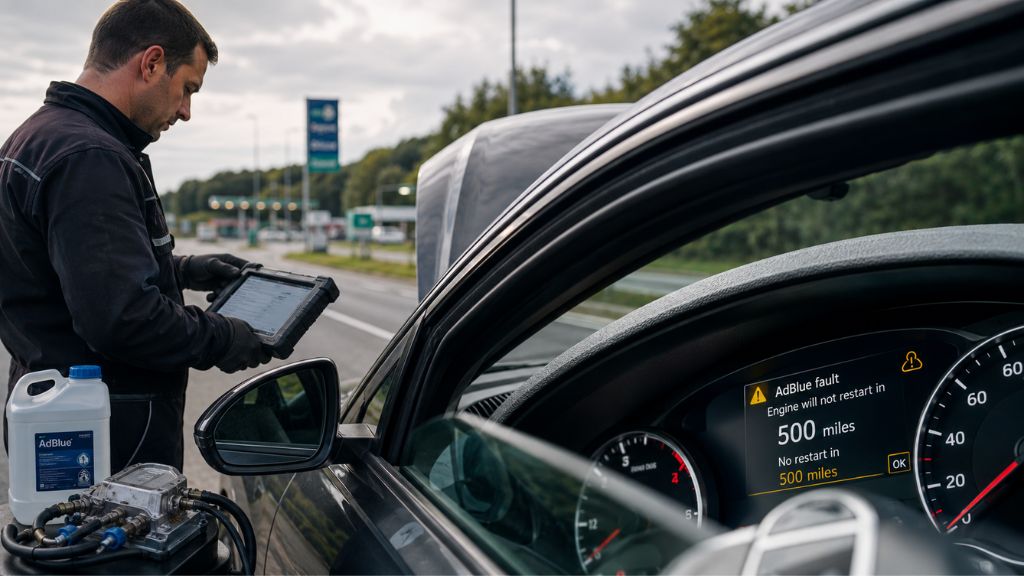
Most vehicles give you somewhere between 400 and 1,000 miles once an AdBlue fault triggers a countdown, though the exact number depends on the make and model. Some cars start the clock the moment the warning appears. Others give you a grace period first, a few days of just a light on the dash before any countdown actually begins. Either way, once it starts, it only moves in one direction, down, and once it hits zero, the engine won’t restart after you switch it off.
That’s the number people usually want first. But “how long can I drive” isn’t quite the same question as “is it safe to keep driving,” and the two deserve separate answers. So let’s go through what’s actually happening during that countdown, what affects how long you’ve got, and what happens once time runs out.
Can You Still Drive With the Warning Light On?
Yes, in the early stages. An AdBlue warning light on its own, without a countdown message alongside it, usually just means the ECU’s flagged something, low fluid, a sensor fault, whatever it is, and it wants attention. The car will generally drive completely normally at this point. No reduced power, no limp mode, nothing you’d actually feel from the driver’s seat.
That said, “can” and “should” aren’t the same thing. Every mile you drive with the warning ignored is a mile closer to the countdown actually starting, if it hasn’t already. Getting it looked at while it’s still just a light on the dash is nearly always simpler, and cheaper, than waiting for it to escalate.
What Happens Once the Countdown Starts?
This is where things change. Once the countdown kicks in, you’ll usually see a message along the lines of “engine will not restart in X miles.” From here, most vehicles let you keep driving completely normally right up until you switch the engine off. It’s not going to cut out on you mid-journey in most cases. The catch is what happens next: turn the key again, and it won’t start.
That’s the part that catches people out constantly. The car drives fine the whole way down the countdown, right up to the very last mile, so it’s easy to assume you’ve got more time than you actually do. Then you stop for fuel, or nip into a shop, switch off, and that’s it. Nothing happens when you try to start it again.
How Long Does the Countdown Actually Last?
It varies by manufacturer, and there isn’t one number that applies across every vehicle. As a rough guide, most sit somewhere between 400 and 1,000 miles once the countdown genuinely begins, though a handful of vehicles run shorter countdowns closer to 250 miles, and others stretch out further. Some manufacturers also build in multiple warning stages before the final countdown starts, so you might see an early light, then a stronger warning, then the actual countdown, spread across a longer overall window.
The safest approach is treating whatever number your dashboard’s showing as the real figure, rather than assuming it works the same as a mate’s car or something you’ve read online for a different make.
Typical AdBlue Countdown Ranges by Fault Type
There’s no single number that applies to every vehicle, but the table below gives a rough sense of what different faults typically look like once a countdown’s involved. Treat this as general guidance rather than a promise for your specific car, since your dashboard’s own countdown is always the accurate figure.
| Fault Type | Typical Countdown Range | Drives Normally Until Zero? |
| Low or empty AdBlue tank | 500 – 1,000 miles | Yes |
| Faulty level or quality sensor | 400 – 1,000 miles | Yes |
| Blocked or failing injector | 250 – 700 miles | Often reduced power beforehand |
| NOx sensor fault | 400 – 1,000 miles | Yes, usually |
| Frozen or crystallised AdBlue | 250 – 600 miles | Yes |
| Wiring or connector fault | 400 – 1,000 miles | Yes, usually |
| Countdown already at zero | 0 miles remaining | No, engine won’t restart |
Faults involving the injector or dosing system tend to run shorter countdowns and are more likely to bring reduced power or limp mode along with them, since the ECU’s reacting to a system that’s failing to dose properly rather than one that’s simply running low on fluid.
Fault Codes Often Linked to an AdBlue Countdown
If you’ve had a scan done, or you’re trying to work out what’s actually behind your countdown, these are among the codes we see most often triggering it: P20E8 (reductant pressure too low), P207F (reductant quality or performance), P204F (reductant system performance), P20EE (SCR NOx catalyst efficiency below threshold), P229F (NOx sensor signal stuck), P20BD and P20BA (reductant heater control circuit faults), P2047 (reductant injector circuit low), P204C (reductant tank sensor circuit low), P21AB (reductant level sensor intermittent), P2089 and P20BE (reductant heater performance faults), P2058 (reductant tank temperature range), and P2200 or P2201 (NOx sensor circuit or performance faults).
Different codes tend to correspond to different points in the countdown too. Pressure and dosing-related codes like P20E8 or P2047 often appear earlier, since the ECU’s picking up a functional problem with the system itself. Heater and temperature codes like P20BD or P2058 show up more in colder months, when crystallisation or freezing becomes a bigger factor. If you’ve got a code showing on your scanner and you’re not sure what it means for your specific countdown, send it across and we’ll tell you straight away what it’s likely pointing to and roughly how much time you’re probably looking at.
What Actually Determines How Long You’ve Got?
A few things play into it. The manufacturer and model matter most, since the countdown logic’s built into the ECU software and varies genuinely between brands, sometimes even between different engines from the same brand. What’s actually causing the fault matters too. Low fluid alone tends to behave differently to a sensor fault or a blocked injector, since the ECU’s reacting to different information in each case.
How you drive during the countdown can factor in as well, though this varies by vehicle. Some systems count down purely on mileage, others take driving conditions into account too. It’s not something worth relying on or trying to game though. The safest assumption is always that the number on your dashboard is accurate and dropping in real time.
Is It Safe to Keep Driving During the Countdown?
Mechanically, yes, in the sense that the countdown itself doesn’t damage anything and the car drives normally throughout. The risk isn’t really about safety on the road. It’s about getting caught out somewhere inconvenient once it hits zero, at a motorway service, on a job, halfway through a school run, wherever you happen to be when the engine won’t restart.
There’s also a legal angle worth knowing. The AdBlue system exists because of emissions regulations, and depending on what’s actually causing the underlying fault, continuing to drive with it unresolved for an extended period isn’t something we’d encourage, separate from the countdown issue entirely. Getting it diagnosed properly, rather than just watching the number drop, is the sensible move either way.
What Happens When the Countdown Reaches Zero?
The engine won’t restart once switched off. Not “runs badly,” not “limp mode,” it simply won’t turn over. This isn’t a mechanical breakdown in the traditional sense. It’s a deliberate ECU lockout, built in specifically because the emissions system isn’t compliant, and the manufacturer’s chosen to stop the vehicle running rather than let it continue indefinitely. We’ve covered this exact scenario in more depth in our guide on what happens when the countdown reaches 0 miles, worth a read if you’re already close to that point.
Topping the tank up at this stage generally won’t fix it on its own. Once the countdown’s fully run out, most vehicles need a proper diagnostic reset through the ECU before they’ll start again, not just a full tank of fluid.
Should You Wait It Out or Get It Fixed Early?
Fixed early, every time, and it’s not particularly close. Waiting until the countdown reaches zero means dealing with a full no-start, usually somewhere inconvenient, and potentially needing recovery just to get the vehicle to a point where it can be worked on. Sorting the fault while it’s still just a warning light, or early in the countdown, avoids all of that, and it’s very often a smaller job too, since the underlying issue hasn’t had time to affect anything else nearby.
If the fault’s tracing back to something specific, a blocked injector is a common one, our guide on blocked AdBlue injectors covers the symptoms and fix in detail. And if you’re just trying to work out what the warning actually means in the first place, our broader piece on AdBlue system faults walks through the full range of causes.
There’s also a cost angle worth thinking about here, beyond just convenience. A fault caught early, while it’s still just a warning light or in the first stretch of a countdown, is usually a smaller, cheaper job. Give it long enough, though, and a fault that started as one faulty sensor can end up affecting other parts of the system too, since components downstream are often working harder to compensate for whatever’s already gone wrong. What might have been a straightforward sensor replacement early on can turn into a bigger repair covering the injector or pump as well, simply because the underlying issue was left running for weeks or months longer than it needed to be.
How We Diagnose and Fix It, Wherever You Are in the Countdown
Whether you’re right at the start with just a warning light, deep into a countdown, or already locked out at zero, the approach starts the same way: a full diagnostic scan using the same OEM-level equipment a main dealer would use, to actually find the cause rather than guessing.
If you’re already at zero, our no-start countdown bypass gets you moving again fast, without a dealer appointment hanging over you. Where the cause is a specific failed part, a pump, injector, heater or sensor, our AdBlue repair service handles that directly, and our broader AdBlue fix service covers diagnostics and repair across the whole system if you’re not sure exactly what’s wrong yet.
For anyone who’d rather stop this becoming a repeat problem, particularly on an older or high-mileage vehicle, an AdBlue delete removes the SCR strategy from the ECU entirely, so there’s no countdown left to trigger in the first place. AdBlue removal takes a similar route. If you’d rather keep the system running as designed but just want the warnings and countdowns stopped, our AdBlue bypass handles that without fully disabling anything. And where the fault traces back specifically to a NOx sensor rather than AdBlue itself, our NOx sensor services cover that on its own.
Every job we do, whatever stage the countdown’s at, comes with a lifetime warranty for as long as you own the vehicle. We check the whole system rather than just clearing the immediate symptom, so you’re not back here again in a few months with the same warning light.
Mobile Engineers, Wherever You’re Based
A countdown doesn’t wait for a convenient time, and neither should the fix. Our mobile engineers come straight to you, home, workplace, roadside, wherever you are, carrying the same diagnostic and ECU tools a franchised dealer would use, minus the dealer pricing that comes attached to it.
We cover a genuinely wide stretch of the UK. Around London and the South East, we’re regularly out in Croydon, Reading, Guildford, Epsom, Dartford, Loughton, Sevenoaks, Slough and St Albans. North of the border, we’re in Edinburgh and Glasgow, and across Yorkshire you’ll find us in Leeds, Sheffield and York.
The Midlands keeps us busiest, taking in Coventry, Derby, Leicester, Nottingham, Birmingham and Grantham, alongside the wider West Midlands covering Walsall, Wolverhampton, Dudley and Solihull. We’re also across Shropshire, including Stoke-on-Trent and Tamworth, and Warwickshire, covering Rugby, Warwick and Nuneaton.
Further east, we’re regularly out across Lincolnshire, including Market Deeping, Stamford, Spalding and Peterborough.
Can’t see your area listed? Get in touch anyway, since we travel well beyond these towns fairly often, and same-day callouts are usually available across most of the UK if you book before midday.
Running a fleet rather than a single vehicle? Downtime costs more when it’s a van off the road, so it’s worth pairing any AdBlue work with a look at our HGV remapping service too, covering both economy and performance remapping alongside emissions fixes.
Frequently Asked Questions
It depends on the vehicle, but most give you somewhere between 400 and 1,000 miles once a countdown actually starts. Before the countdown begins, an unresolved warning light doesn’t have a fixed time limit, but it’s worth addressing early regardless.
Generally yes, in the early stages. Most vehicles drive completely normally with just a warning light showing, before any countdown or reduced power kicks in.
The engine won’t restart once you switch it off. It’s a deliberate ECU lockout rather than a mechanical failure, and it needs a proper diagnostic reset to resolve.
Unlikely. Most vehicles let you keep driving normally throughout the countdown. The issue is that the engine won’t restart once you turn it off, not that it’ll cut out while moving.
Sometimes, if caught early enough, the fault really is just low fluid. Once the countdown’s fully run out, most vehicles need an ECU reset regardless of the tank level.
Not mechanically dangerous in most cases, but there’s a real risk of getting stranded once the countdown hits zero, plus emissions compliance considerations worth taking seriously.
Yes, considerably. Most sit between 400 and 1,000 miles, but some run shorter, closer to 250 miles, and the exact logic is built into each manufacturer’s ECU software.
Sometimes, on certain vehicles, if caught before it hits zero. Once it’s fully run out, most vehicles need a proper diagnostic reset that isn’t something you can do from the driver’s seat.
It should be checked as soon as possible. Fixing it early is nearly always cheaper and simpler than waiting for a countdown to run out or a no-start to happen somewhere inconvenient.
The vast majority of Euro 6 diesels do, since it’s part of how manufacturers enforce ongoing emissions compliance. The exact mileage and warning stages vary by model.
Yes, and that’s usually the ideal time to get it sorted, before it escalates into a full no-start requiring recovery.
Get it looked at as soon as possible rather than continuing to drive on it. If it does reach zero before you can get help, avoid repeatedly trying to restart the engine and get in touch for a same-day fix where possible.
Warning On or Countdown Running? Get It Sorted Today
Whether you’ve just seen the light appear or you’re watching a countdown drop by the day, don’t wait for it to reach zero. Get a free, no-obligation quote and we’ll tell you exactly what’s going on and how quickly we can get to you. Browse our full AdBlue fix services, or call 0330 043 4431 to speak to an engineer now.

7 Comments
[…] Refilling the tank doesn’t stop it, because the level was never the issue. Our guides on how long you can drive with an AdBlue fault and the countdown to a no start explain how that works, and it differs between vehicles. If the […]
[…] light, that’s past the point of just waiting and worth getting properly checked. Our guide on how long you can drive with an AdBlue fault covers roughly how much time you’re working with once that stage’s been […]
[…] involved. The countdown behind it keeps ticking regardless of what the gauge shows. Our guide on how long you can drive with an AdBlue fault covers roughly how much time that buys you, though it varies by […]
[…] and 1,000 miles before the engine refuses to restart, though the exact figure varies. Our guide on how long can you drive with an AdBlue fault covers this in more detail, and if you’re already at zero and the vehicle won’t start […]
[…] and how much time you realistically have. If you are already seeing a countdown and need to know how long you can drive with an AdBlue fault, that covers the safe limits by vehicle […]
[…] not sure how much driving time you’ve actually got left before it escalates, our piece on how long can you drive with an AdBlue fault covers that in detail, and if the countdown’s already hit zero, what happens when it reaches […]
[…] fill in the gaps. Not sure how much time you’ve actually got left before things get worse? How long can you drive with an AdBlue fault covers what a countdown actually means and roughly how long different faults typically run. Already […]