
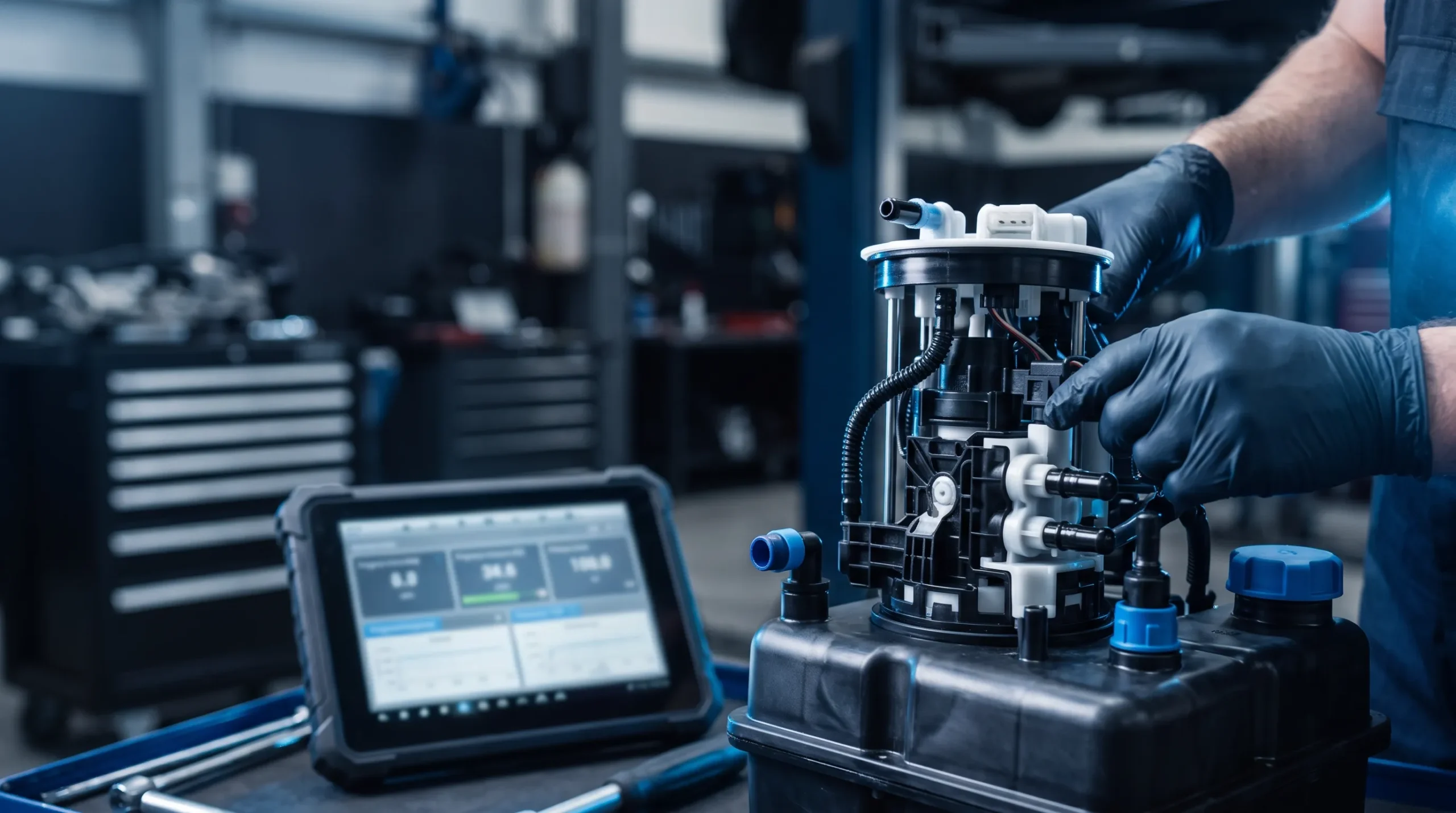
A new AdBlue pump that leaves the warning light on usually means the pump was never the real fault, or something was missed when it went in. The usual causes are a blocked or crystallised line or injector, a worn non return valve, air left in the system, a corroded or loose connector, contaminated fluid, or a control unit that was never told the part had changed. Any one of them can bring back the same pressure or dosing code the old pump gave.
Pumps get replaced first because the codes tend to point at them. A pressure fault or a dosing performance fault describes a symptom, and the pump is the part that is meant to build that pressure. It’s also the expensive part, which is why the second bill hurts. We’re mobile, so we usually meet these vans and cars on a driveway or in a yard, new pump fitted, light still on, and an owner wondering what else there is to replace.
“Why is the warning still on after a brand new pump?”
Because the code and the cause are two different things. The control unit watches pressure, flow and how the pump behaves. When pressure doesn’t reach the target it logs a fault. It has no way of knowing whether the pump is weak or whether something is stopping a healthy pump from doing its job.
Think of the pump as a person pushing water through a hose. If the hose is kinked, scaled up or leaking at a joint, swapping in a stronger person changes nothing. The new pump pushes against the same restriction and the same low reading comes back.
Four things account for most of the cases we see. A restriction somewhere in the line. A leak or an air pocket that stops pressure holding. An electrical problem feeding the pump. And a system that still needs a reset or adaptation after the part change. The sections below take them one at a time, and this table gives the short version first.
What the pump code is actually telling you
Pressure codes and dosing performance codes describe what the system measured and nothing more. P204F is a good example. It turns up on cars with a perfectly healthy pump, because poor dosing can start at the injector end of the line as easily as the tank end.
Codes that name the pump circuit directly, like a supply voltage or control circuit fault, sit closer to the pump. Even those can come from a loose plug or a corroded pin instead of the motor itself. Our guide on what an AdBlue system fault actually means covers how the different families of codes read.
Ordering a pump because the fault description says “pump” is an educated guess. Sometimes it’s right. It isn’t right often enough to skip testing the rest of the line first.
| Possible cause | What it often looks like | How we check it |
|---|---|---|
| Blocked or crystallised line or injector | Pressure builds slowly or never reaches target, white deposits at joints, warning back within days | Inspect lines, filter and injector inlet, then test flow |
| Air in the system | Pump runs but pressure never arrives, fault appears straight after the fitting | Prime and bleed the system, then retest pressure |
| Worn non return valve or leaking module seal | Pressure drops after the engine is off, fault returns most mornings | Pressure hold test, then check the valve and seal |
| Corroded or loose connector, weak supply | Fault comes and goes, pump cuts in and out | Measure voltage and earth at the pump plug under load |
| No reset or adaptation after the part change | Same warning stays on with no real fault found | Register the part, run the reset routine, clear codes, run the dosing test |
| Contaminated fluid | Pump noisy or failing again, fluid looks cloudy or smells wrong | Test the fluid, flush the tank and lines |
| Wrong or faulty new pump | Pressure stays off target after everything else checks out | Compare measured pressure to the specification, tested last |
“Could the old pump have been killed by something that’s still there?”
Yes, and this is the one that catches people out most. Pumps rarely just wear out. Something makes them work harder than they should, and that something is still in place when the new one goes in.
Crystallised urea is the most common cause. AdBlue dries into hard white deposits wherever it sits still, and a partly blocked line or injector makes the pump push against resistance every time it runs. Months of that wear the motor down. A new pump on the same blocked line starts the same slow decline on day one. Our guides on a blocked dosing line and a blocked injector show what that looks like, and the injector not spraying guide covers the end result when the nozzle itself gives up.
Contaminated fluid does similar damage faster. Water, diesel in the filler or the wrong fluid altogether can foul a pump quickly, and the tank and lines stay contaminated after the part is changed unless they’re flushed.
A poor electrical supply is the third. A pump running on a weak or noisy feed, from a tired earth or a corroded connector, can fail early. Connector corrosion is more common than most people expect on vans that work outdoors all winter.
“Was the new pump primed properly?”
Often not. A pump fitted dry, or with air in the line, spins without building pressure, and the control unit reads that as a pump fault. That’s the same message the old pump gave, so it looks like the repair failed. A pump running with no fluid around it also isn’t doing the new part any favours.
Priming means getting a solid column of fluid from the tank to the injector, with the air pushed out through a bleed point. Topping up the tank doesn’t do that. Our guides on a pump that won’t prime and a system that won’t prime after running empty go through the symptoms, and a pump that runs but builds no pressure covers the case where pressure never arrives at all.
“Does the car need to be told a new pump has been fitted?”
On many vehicles, yes. The control unit stores learned values and wear counters for the old pump. Some makes expect the part change to be registered with a diagnostic tool, then an adaptation or reset routine run afterwards. Skip that and the system can carry the old pump’s history forward, or keep the warning active until the routine is done.
Stored fault codes don’t always clear themselves either. A code logged before the repair can sit in memory, and some systems hold the countdown or warning until a clean dosing cycle completes after the codes are wiped. Disconnecting the battery isn’t a substitute. Our post on AdBlue warnings after a battery disconnect explains why that trick doesn’t always work and can add its own faults.
The routine varies a lot between manufacturers. A Mercedes, a Ford and a Land Rover can each want a different sequence, which is one reason a generic reset sometimes fails.
Connectors and wiring get disturbed during the job
Changing a pump means unplugging the harness, and the plug is often old, brittle and sitting somewhere damp. A connector that isn’t fully clicked home, a bent pin or a seal nudged out of place can cause an intermittent supply fault that looks exactly like a bad pump.
On many vehicles the pump sits in a tank module that also carries the level sensor, the temperature sensor and the heater. If one of those plugs wasn’t reconnected properly, the system throws a different fault, and owners sometimes blame the new pump for it. Our guides on the tank temperature sensor fault, the P20BD heater circuit code and wiring faults cover those.
Fuses and relays belong on the same list. A pump that cuts in and out, or never gets full power, can be down to a tired relay or a corroded fuse holder, with nothing wrong inside the pump at all.
“What if the new pump itself is the problem?”
It happens, just less often than people fear. A pump can be faulty out of the box, or be the wrong part number for that vehicle. Cheaper aftermarket units don’t always match the original pressure behaviour, and a pump that builds slightly different pressure from what the control unit expects can trip a fault with nothing actually broken.
We test the new pump last, after air, restrictions, voltage and the reset steps have been ruled out. Condemning a part someone has just paid for is a big call, so it needs evidence. That means measured pressure against target, the supply voltage at the pump under load, and a clean prime that still fails.
Seals matter here as well. A tank module has an O ring or gasket that has to seat evenly. A pinched seal leaks or draws in air, and on the scan tool that can look like a weak pump.
A second fault hiding behind the first
Sometimes the pump really was faulty, and the car also had another problem underneath. The first fault gets all the attention, and once it’s fixed the second shows up in its own right. A heater circuit fault, a level sensor problem or a NOx sensor issue can sit quietly behind a more urgent pressure code. Our guide on why the warning stays on with a full tank and the one on level sensor faults are good places to start if the new code looks like one of those, and our NOx sensor services page covers that side.
Not every system logs everything at once, so a clear scan before the repair doesn’t guarantee a clear one after. It’s worth asking whether the scan was repeated once the new pump was in. If the new code is different from the old one, that’s progress. The first problem is gone and the next one is now visible. Our guide on why an AdBlue fault keeps coming back covers repeat faults more generally.
How we work out what’s really going on
We start with a full scan, reading stored and pending codes alongside the live data. Pressure against target, pump duty cycle, tank temperature and the pump supply voltage tell us far more than the code description does.
Then we go through the system in order. Supply voltage and earth at the pump connector come first, because a weak supply is quick to check and easy to miss. Next the connectors and harness, looking for corrosion or a plug that isn’t seated. Then the lines, filter and injector for crystals and restriction. Then the non return valve and the module seals for leaks. After that comes a proper prime with the air bled out. Only then do we check whether a reset, adaptation or coding step is missing. We finish with the dosing test and clear the codes.
If pressure holds and the dosing test passes, we confirm it stays that way before we leave. If it fails, we know which stage it failed at, and that tells us where to look next. We don’t swap parts and hope, and before we replace anything we show you what the measurements said.
A van on its second pump in a fortnight
Here’s how it usually goes. A panel van gets an AdBlue warning with a pressure code. The garage fits a new pump, clears the fault and the owner drives off. Two days later the light’s back, and the countdown to a no start with it.
When we arrive, the scan shows the same pressure code. The pump’s supply voltage is fine and the new pump runs. But the injector inlet is clogged with crystals, and a connector further down the line has green corrosion on two pins. Both were there before the first pump was ordered, and both would have worn the new one out within months. Clear the injector, replace the connector, prime the system properly, run the reset, and the pressure holds.
The owner paid for a part that was never the problem. That pattern sits behind most of these calls, which is why we test before recommending anything.
Should you go back to the garage that fitted it?
Worth a phone call, yes. Ask what tests were done before the pump was ordered, whether the system was primed and bled afterwards, whether a reset or adaptation was run, and whether they rescanned once it was fitted. A decent garage can answer those quickly, and the answers tell you whether the diagnosis was thorough or a best guess.
If the answers are thin, a second opinion before another part goes on is cheaper than a third pump. Keep the old pump if you still have it. It can show wear or damage that points back to the real cause.
“Is it safe to keep driving while this gets sorted?”
For a short while, usually. The warning gives you a countdown, and when it runs out some vehicles won’t restart. Refilling the tank doesn’t stop it, because the level was never the issue. Our guides on how long you can drive with an AdBlue fault and the countdown to a no start explain how that works, and it differs between vehicles. If the counter is already low, don’t switch the engine off somewhere inconvenient.
Does the make of vehicle matter?
A bit. In our experience Ford Transit vans show up with repeat pump faults often, partly because so many work long multi drop days close to empty. Citroën and Peugeot Partner models can need a particular reset sequence after parts change. Nissan and Land Rover systems tend to be fussy about adaptation, and Mercedes can be unforgiving of a prime that was rushed. Our overview of AdBlue problems by manufacturer lists more.
Before you pay for a third pump
If a new pump hasn’t cleared the fault, don’t buy another one yet. Book a proper diagnosis first. Our AdBlue repair service starts by testing the whole system from the tank to the injector, and we come to wherever the vehicle is parked, whether that’s a driveway, a depot or a layby. You can see the wider range of work under AdBlue Fix.
Every job carries a workmanship warranty. If something we repaired gives trouble again, we put it right.
Where we come out to
London
Our London AdBlue repair coverage takes in Croydon, Newham, Waltham Forest, Redbridge, Kingston upon Thames, Lewisham, Islington, Haringey, Havering, Enfield, Westminster, Tower Hamlets, Kensington & Chelsea, Lambeth, Sutton, Southwark, Camden, Merton, Hammersmith & Fulham, Greenwich, Hounslow, Barking & Dagenham, Barnet, Bexley, Brent, Bromley and Ealing.
South East England and the Home Counties
St Albans, Slough, Sevenoaks, Loughton, Dartford, Epsom, Esher, Guildford and Reading all sit under our South East England page.
West Midlands and Staffordshire
Across the West Midlands we cover Solihull, Dudley, Wolverhampton, Walsall, Birmingham and Coventry. In Staffordshire that’s Stafford, Cannock, Lichfield, Stoke-on-Trent and Tamworth.
Warwickshire and Shropshire
Warwickshire includes Nuneaton, Warwick, Rugby, Leamington Spa and Stratford-upon-Avon. In Shropshire we cover Telford, Oswestry, Bridgnorth and Shrewsbury.
Lincolnshire, the East Midlands and further north
Lincolnshire takes in Peterborough, Stamford, Spalding, Market Deeping, Grantham and Bourne. Further out we reach Nottingham, Leicester, Derby, Leeds, Sheffield, York, Glasgow and Edinburgh.
Not seeing your area? Our nationwide coverage page and the locations hub list everywhere else.
FAQs
The pump usually wasn’t the real fault, or something else was missed during the job. A blockage, a leak, air in the line, a bad connector or a missing reset can all bring the same code back.
On many vehicles it does. Some makes expect the part change to be registered with a diagnostic tool and an adaptation run afterwards. Others also need the old fault codes cleared before the warning goes.
It’s possible if the blockage is still there. A pump pushing against a crystallised line or injector wears quickly, so the restriction needs clearing before or alongside the pump.
Yes. Measured pressure against target and the supply voltage at the connector tell you far more than the fault description does, and they cost a lot less than a part.
Not when the fault is pressure or dosing related. The level was never the problem, so the countdown keeps running whatever the gauge shows.
Occasionally it clears a stored code, but the fault comes straight back if the cause is still there. It can also trigger new faults on some vehicles.
Often within the hour once a technician is on site. A blocked injector or a corroded connector adds time, and so does a missing adaptation routine.
Yes. We’re mobile, so we come to wherever it’s parked.
