
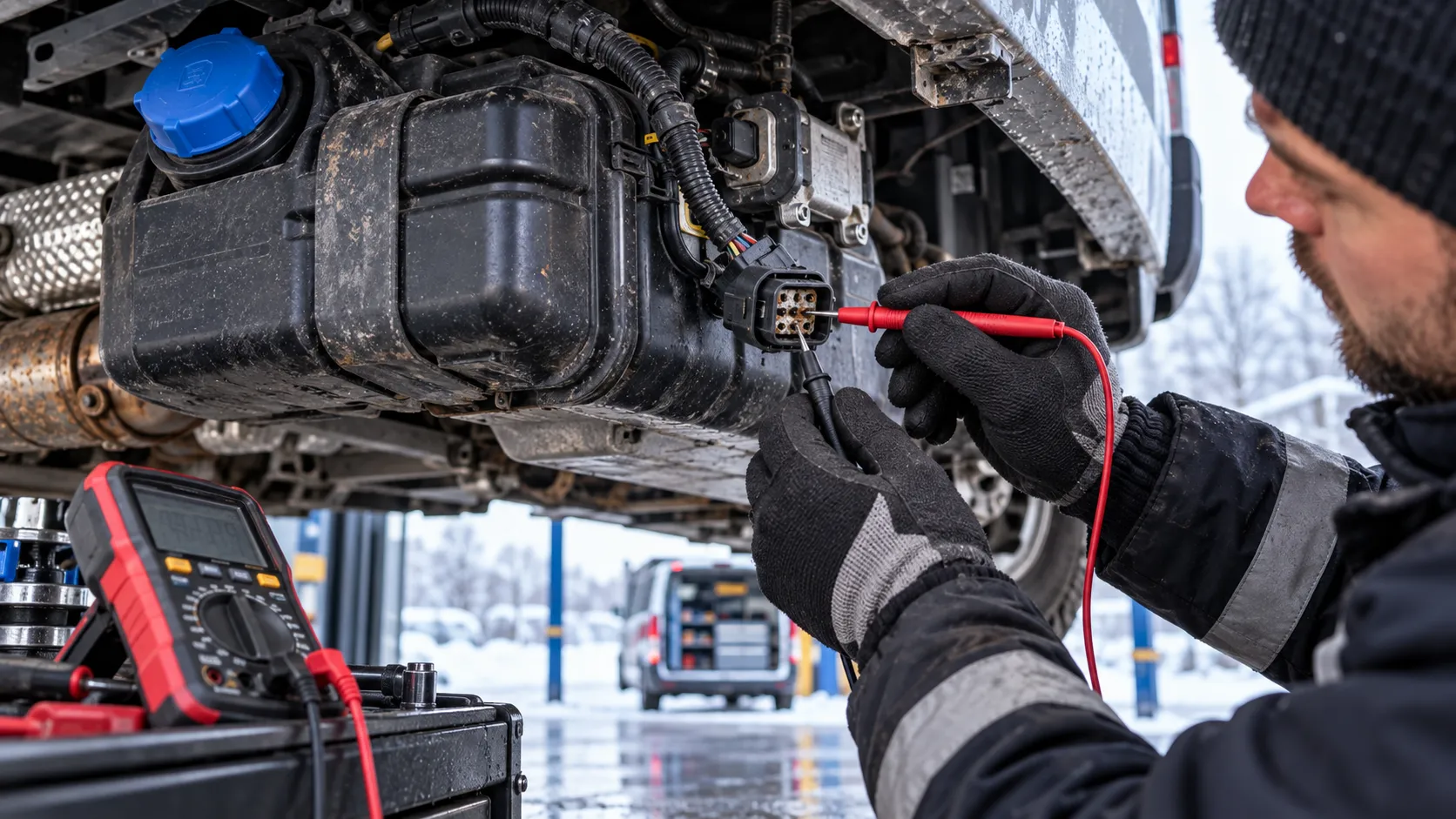
P20BD points to an open circuit somewhere in the AdBlue heater control system, which means the ECU is sending a signal to the heater and getting nothing back. Not low voltage, not a weak signal, nothing at all. That’s the difference between this code and a lot of the other AdBlue codes people search for. It’s not telling you the fluid’s low or contaminated, it’s telling you a specific electrical path has broken completely.
The heater itself isn’t some optional extra either. AdBlue freezes at around minus eleven degrees Celsius, and UK winters get there more often than people think, especially overnight in places like the Midlands, the North, and anywhere rural. Most SCR systems built since the early 2010s have a heater built into the tank, the delivery lines, or both, specifically so the fluid doesn’t turn solid the first cold night it sits parked. When P20BD shows up, that heater’s effectively offline, and depending on the time of year, that can turn into a bigger problem fairly fast.
We’ll go through what actually causes this fault, what you’ll notice before and after it’s stored, how we diagnose it on the vehicle, and how our mobile service handles it without you having to get the car anywhere near a garage.
What Does an Open Circuit Actually Mean Here
Worth clearing this up because it trips a lot of people up. An open circuit isn’t the same as a short circuit or a circuit that’s just underperforming. Open means the ECU can’t complete the electrical loop at all, so from its point of view, the heater simply isn’t there. That’s different from a heater that’s working but slowly, or one that’s drawing too much current.
Because it’s an all or nothing signal, P20BD tends to point at a handful of specific things rather than a vague “something’s off with the heater” situation. That actually makes it a bit easier to diagnose properly, once you know where to look.
What Causes the Circuit to Open
A failed heater element is the most straightforward cause, and honestly the one we see most often. The heating element itself, whether it’s in the tank, wrapped around the supply line, or built into the pump module depending on the vehicle, can burn out internally over years of heat cycling. Once the element itself has failed open, no current gets through regardless of what the rest of the wiring’s doing.
Damaged or corroded wiring is a close second. AdBlue heater wiring often runs near the underside of the vehicle, exposed to road salt, moisture, and general wear, and a break or corroded connection anywhere along that run will read exactly the same as a failed heater to the ECU. We’ve found more than one case where the heater itself was completely fine and the fault was sitting in a corroded connector a few inches away.
A blown fuse or failed relay in the heater circuit is another common one, and it’s honestly one of the quicker things to rule out during diagnosis, since it doesn’t require pulling anything apart to check.
Connector corrosion specifically deserves its own mention here, separate from general wiring damage, because it’s so common on vehicles that see a lot of wet weather or get driven on gritted roads through winter. A connector that looks fine from the outside can have enough internal corrosion to break the circuit completely, and it’s an easy thing to miss without actually testing continuity through the plug itself.
Less often, the fault sits with the ECU’s own driver circuit for the heater output. This is rarer, but it does happen, and it’s part of why a proper diagnosis checks the signal at both ends rather than assuming the heater element is automatically to blame.
Symptoms You Might Notice
The AdBlue or engine management light coming on is usually the first sign, and depending on the vehicle, you might get a specific dashboard message referencing the AdBlue or emissions system rather than just a generic warning symbol.
Cold weather tends to make this fault more obvious, for what should be an obvious reason. If the heater isn’t working, the fluid can genuinely freeze overnight in cold conditions, and a frozen AdBlue system can cause its own separate set of dosing and pressure faults on top of the original heater code. A few drivers tell us the car seemed completely fine through autumn and only started throwing warnings once the first proper cold snap hit, which lines up with exactly what you’d expect from a heater fault that was already there but hadn’t been tested by cold weather yet.
Reduced engine performance can follow if the system decides the AdBlue supply is compromised, since from the ECU’s perspective, a system that might freeze is a system that might not be able to dose properly.
Is This Something You Can Keep Driving With
For a while, generally yes, particularly outside of genuinely cold weather. The engine itself isn’t at risk from a heater fault on its own. What changes things is the season. In summer, a heater fault might sit there for weeks without causing any secondary issues at all. Come winter, that same fault can lead to frozen AdBlue, which brings its own dosing and pressure problems layered on top, and potentially a restart countdown if the system decides emissions compliance can’t be guaranteed.
Our advice is simple enough. Don’t panic if it’s July, but don’t ignore it either, because whatever’s wrong with the heater circuit now is still going to be wrong with it in December.
How We Diagnose It
We start with a full fault code scan to confirm P20BD is actually what’s stored, along with checking for any related codes that might point toward frozen fluid, low pressure, or dosing issues sitting alongside it.
From there we test the heater circuit directly, checking for continuity from the ECU connector through to the heater element itself, section by section, rather than assuming the fault sits at one end or the other. That’s really the only way to actually pin down whether it’s the element, the wiring, a connector, a fuse, a relay, or the ECU driver circuit itself.
If the wiring and connectors check out clean, we test the heater element’s resistance directly. An element that’s failed open will typically show no continuity at all, which is a pretty clear result once you’re actually measuring it rather than guessing.
Common Related Fault Codes
| Fault code | What it typically points to |
| P20BD | AdBlue heater control circuit open |
| P203F | Reductant heater performance |
| P2040 | Reductant heater “A” control circuit low |
| P2041 | Reductant heater “A” control circuit high |
| P20B8 | Reductant heater “B” control circuit malfunction |
Which exact code your car stores depends on the manufacturer’s own coding and which specific heater circuit is affected, since a lot of vehicles have more than one heater element across the tank, lines, and injector.
Why Cold Weather Makes This So Much Worse
It’s worth spending a bit more time on this, because it’s the part most drivers don’t realise until it’s already caused a second problem. AdBlue isn’t like screenwash or coolant, where a bit of freezing at the edges doesn’t do much. Once it freezes solid in a line or around the injector tip, nothing can move through that section until it thaws, and depending where the blockage is, that can stop dosing completely regardless of whether the injector itself is working fine.
Manufacturers built heaters into these systems specifically to stop that from happening, which is exactly why a fault here matters more than it might look on paper. A car with a healthy heater circuit barely notices a cold night. A car with P20BD stored is essentially running through winter with that protection switched off, and the first hard frost is when it tends to catch people out, often with a completely separate sounding fault on top of the original heater code.
Mobile AdBlue Repair, Wherever You Are
This is exactly the kind of fault where a mobile visit makes more sense than a trip to a garage. Our technicians come to you with the diagnostic equipment needed to properly trace the heater circuit on site, whether that’s at home, at work, or wherever the car happens to be sitting when the warning light comes on. No need to arrange a tow or juggle your day around dropping the car off somewhere.
All of our AdBlue repair work, heater circuit faults included, is backed by our workmanship warranty, so you’re covered if anything related to the repair itself needs revisiting. We’ll always explain exactly what we’ve found and what needs doing before any work starts, rather than just diving in.
Areas We Cover
We run a mobile AdBlue repair and diagnosis service across a wide stretch of the UK, and every area we cover has its own dedicated page with local details. Across London and the South East, that includes Kingston upon Thames, Lewisham, Islington, Haringey, Havering, Waltham Forest, Redbridge, Newham, St Albans, Slough, Sevenoaks, Loughton, Dartford, Epsom, Esher, Guildford, Reading and Croydon, with our wider South East England and London pages covering the region more broadly.
In the Midlands, we cover Solihull, Dudley, Wolverhampton, Walsall, Tamworth, Stoke on Trent, Nuneaton, Warwick, Rugby, Leamington Spa, Stratford upon Avon, Stafford, Cannock, Lichfield and Birmingham, alongside our West Midlands and Warwickshire region pages.
Further out, we cover Shropshire towns including Telford, Oswestry, Bridgnorth and Shrewsbury, our Shropshire region page, and East Midlands and Lincolnshire towns like Peterborough, Stamford, Spalding, Market Deeping, Grantham and Bourne, covered more broadly by our Lincolnshire page.
Further north we cover Leicester, Derby, Coventry, Sheffield, Leeds, York, Nottingham, Glasgow and Edinburgh. If you don’t see your exact area listed, our full locations page covers everywhere we currently operate.
Related AdBlue Guides
A few other articles cover ground that connects directly to this fault. Our piece on AdBlue malfunction warnings after a cold night goes into what happens once fluid actually does freeze, which is often the next stage after a heater fault like this one goes unaddressed. If you’re dealing with a broader electrical issue, our guide on AdBlue wiring faults covers the wider wiring side of the system beyond just the heater circuit. Our article on why the AdBlue level sensor warning stays on is worth a read if you’re getting a level related warning alongside this one, and our P204F fault code guide covers a different but related code if you’ve seen more than one stored at once. Our general explainer on AdBlue problems is a useful starting point too if you’re trying to work out where a specific fault fits into the bigger picture.
Quick Answers About the P20BD AdBlue Fault Code
Usually yes in the short term, especially outside of cold weather, but the underlying fault won’t fix itself, and the risk goes up considerably once temperatures drop and the fluid’s actually exposed to freezing conditions.
No, this isn’t a fluid level issue at all. Topping up won’t touch an open heater circuit, and if the fluid’s already partially frozen because of it, adding more won’t clear that either.
The vast majority of SCR equipped diesels built from the early 2010s onward do, since manufacturers needed a way to stop the fluid freezing in cold climates. A few older or unusual setups may differ, which is part of why proper diagnosis matters rather than assuming based on the fault code alone.
You generally can’t tell from the dashboard alone. Both produce the same P20BD code, since the ECU only sees that the circuit’s open, not where along that circuit the break actually is. That’s exactly what proper diagnosis on the vehicle is for.
If the car’s parked outside most nights, which is genuinely most cars, a heated garage a few nights a week won’t make much difference. The fault needs fixing rather than working around with parking habits.
It depends entirely on where the break actually is. A blown fuse or a corroded connector is a relatively quick fix. A failed heater element usually means replacing that specific component, which takes a bit longer but is still very much a workable mobile repair in most cases.
That depends on the vehicle and exactly which part’s failed. We’ll always let you know upfront once we’ve confirmed the cause, so there are no surprises about what happens next.
Heater circuits often fail quietly, since the heater’s simply not being asked to do much of anything through warmer months. The first proper cold night is often the first real test the circuit’s had in a while, which is exactly when a fault that’s technically been there for weeks finally gets noticed.
Either works. If the fault hasn’t progressed to frozen fluid or a restart countdown, driving to us is fine, but a lot of customers prefer the mobile option simply because it means no time off work arranging drop off and collection.
Not dangerous to you as a driver, no, but it does raise the chance of a frozen system causing further faults, reduced performance, or eventually a restart countdown if the ECU decides emissions compliance can’t be maintained.
No. Once the code’s stored, the underlying electrical fault is still there regardless of the season. It might stop causing obvious symptoms once it’s warmer, but the circuit itself needs actually repaired.
That depends on your location and how booked up we are that day, but we always aim to get to AdBlue faults quickly, particularly once a customer told us the warning light’s already on.
Book a Mobile AdBlue Diagnosis
If your dashboard’s showing P20BD or a related AdBlue warning, get in touch through our contact page and we’ll arrange a mobile visit to trace the fault properly, wherever the car happens to be. Getting it sorted before the next cold snap is always the better time to deal with it.

1 Comment
[…] owners sometimes blame the new pump for it. Our guides on the tank temperature sensor fault, the P20BD heater circuit code and wiring faults cover […]