
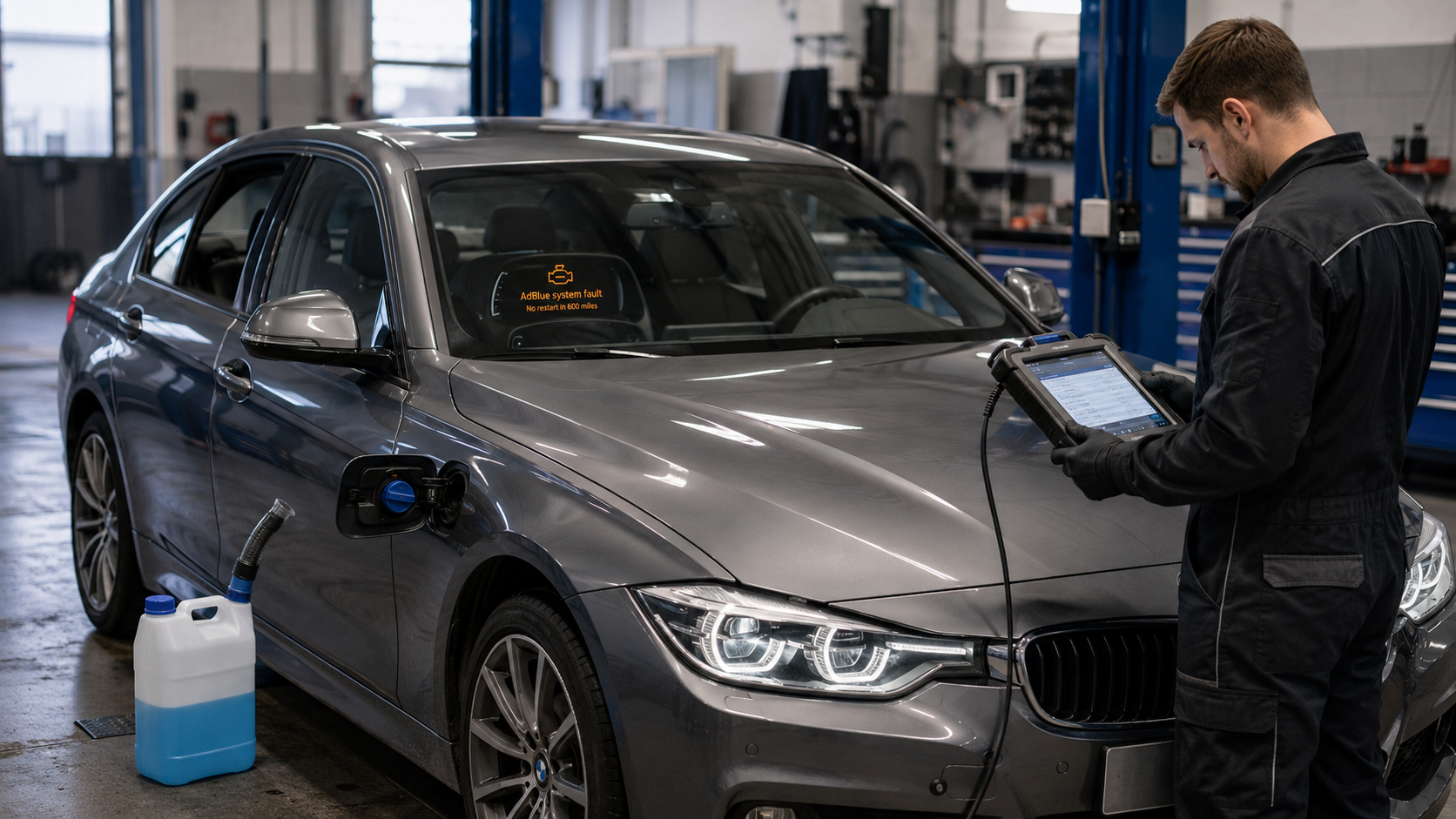
Bit of a maddening one, this. You’ve filled the tank, you watched the pump cut off on its own, maybe you even double-checked with the dipstick or the gauge. And the warning’s still sat there on the dash like it didn’t get the memo.
Short answer, because I know that’s what you actually want first: if the tank’s genuinely full and the light’s still on, it’s almost never about the fluid. It’s the car misreading its own tank, a sensor, a wire, or the software isn’t talking to the ECU properly. The AdBlue itself is usually fine. The car just doesn’t know that yet.
That’s the annoying part. Topping up again does nothing, because there’s nothing wrong with the level. And driving around for a week “to see if it clears” tends to end with either limp mode or a car that won’t restart and ask us how we know.
So What’s Actually Causing It?
The level sensor’s given up
This is the one we see on the ramp most often, by a fair margin. There’s a sensor sitting inside the AdBlue tank whose whole job is telling the ECU how much fluid is left. Problem is, it’s sitting in a tank of a fairly aggressive chemical, and over time it corrodes, gets coated in crystallised urea, or just wears out. Once that happens, it can report “empty” even while you’re staring at a full tank. We tend to see this crop up more once a car’s past the 60-80k mile mark, though it’s not a hard rule we’ve had it happen earlier on cars that sit a lot.
It’s actually the NOx sensor, not AdBlue at all
Here’s the bit most drivers don’t realise: the NOx sensor has nothing to do with fluid level. It sits in the exhaust and checks that nitrogen oxide output is where it should be, which tells the car the SCR system is doing its job. If that sensor throws a fault, the ECU can’t confirm emissions are in range so it lights up an AdBlue-related warning even though your tank’s completely fine. If you’ve pulled a fault code and seen something like P20EE or P203F, that’s your NOx sensor circuit, not your fluid.
Wrong AdBlue, or contaminated AdBlue
AdBlue has to sit within ISO 22241 spec; it’s a pretty tightly controlled mix of urea and deionised water, and it doesn’t take much to throw it off. A splash of diesel in the wrong filler neck, or a cheap unbranded top-up that’s not quite the right concentration, can set a fault off almost straight away. Honestly, most of the contamination cases we see trace back to someone topping up from a loose canister at a garage forecourt rather than a sealed bottle.
The ECU just hasn’t caught up yet
Sometimes it really is this boring. A few vehicles need a proper drive cycle, sometimes 20-30 minutes of continuous driving, not just a supermarket run before the dash clears itself after a refill. Occasionally it needs a manual reset on a diagnostic tool. If the light disappears within a day or so of normal driving, that was probably all that was going on.
Frozen or gunked-up AdBlue line
AdBlue freezes around -11°C, which is why most systems have a small heater built into the tank and lines. When that heater packs in, or the line gets partially blocked with crystallised residue, the system can’t draw fluid properly even with a full tank sitting right there. The car flags a fault rather than risk running the SCR system dry.
Working Out Which One You’ve Got
You don’t need a diagnostic bay to narrow it down. A few tells:
- Light went off, then came back within a couple of days — that’s a sensor fault, not a one-off blip
- Started right after topping up somewhere unfamiliar — worth checking for contamination
- Only seems to happen in cold snaps — probably a frozen or failing line heater
- There’s an engine or emissions light on alongside it — leans NOx sensor, not level sensor
- Dash is showing a mileage countdown before restart is disabled — this one’s genuine, not cosmetic, and it’s worth booking in sooner rather than later
If none of that lines up cleanly, get an OBD scan done. It’ll pull the actual stored code instead of you guessing off a warning symbol that, frankly, tells you almost nothing on its own.
Can I Just Keep Driving Like This?
For a bit, yes. But most SCR-equipped diesels are built to nag you progressively reduced power first, then eventually blocking restart once you switch off. It’s not a bluff. We get calls fairly regularly from people who left it “one more week” and ended up needing a recovery truck instead of a garage slot. Cheaper and less stressful to sort it while it’s still just a light on the dash.
What We Actually Do About It
We run a full OBD scan first, every time the warning light tells you something’s wrong, the stored code tells you what. From there we’re checking:
- Level sensor reading against the actual tank fluid
- NOx sensor circuit and live emissions data
- Whether the AdBlue itself is contaminated or off-spec
- Heater and line function
- ECU logs, in case it’s just a reset that never went through
Most of this is a same-day fix once we’ve got the code sensor swaps in particular don’t take long. And we’ll always show you what actually came back on the scan before we start any work. No “it’s probably the sensor, let’s just replace it and see.”
Keeping This From Happening Again
- Buy from a sealed, ISO 22241-certified bottle rather than a loose canister it’s a small cost difference and it matters
- Try not to run the tank right down to empty repeatedly; it puts extra strain on the pump and sensor
- If it’s been properly cold and the car’s mostly done short trips, give it one longer run helps the heater and line do their job
- Don’t sit on a recurring warning hoping it’ll fix itself. It rarely does, and it tends to get pricier the longer it’s ignored
AdBlue Fault FAQs
Almost always a sensor, wiring, or software fault rather than an actual fluid issue. The level sensor, NOx sensor, or ECU may be misreading the system even though the AdBlue tank is genuinely full.
Yes. Once the ECU cannot confirm the correct AdBlue level or emissions performance, many vehicles can reduce engine power and may eventually prevent a restart if the fault remains unresolved.
It depends on the vehicle and which sensor has failed. A level sensor replacement is usually cheaper than a NOx sensor, which forms part of the exhaust emissions system. A diagnostic scan should come first so you know which component actually needs attention.
Sometimes a drive cycle or manual reset can clear a false warning on certain vehicles. However, if there is an underlying sensor, wiring, or dosing fault, the warning will usually return until the actual problem is diagnosed and repaired.
Not simply because the warning light is on. However, ignoring an unresolved AdBlue or emissions fault can result in reduced power or a restart lockout, and an unresolved emissions-related issue may also cause problems during an MOT test.
Using AdBlue that meets ISO 22241 specifications can help reduce the risk of contamination and crystallisation-related problems. However, it cannot prevent every sensor fault, as sensors and other SCR components can still fail through normal wear or electrical issues.
If the warning’s still showing and you know for a fact the tank’s full, it’s worth getting it looked at before it turns into limp mode territory. [Book a diagnostic with FixAdBlue] and we’ll tell you exactly what the scan finds before anything gets touched.

5 Comments
[…] turns out to be contributing to a tank full warning that won’t clear, which our guide on an AdBlue fault with a tank full warning still showing covers […]
[…] or two, short trips and cold spots move up the list. If the warning comes back together with a tank-full warning that refuses to clear, there may be a level sensor problem tangled up in it. And if it’s the kind of fault that keeps […]
[…] at you from the dash. We’ve written specifically about this exact scenario in our guide on AdBlue fault with a tank full warning still on, because it’s one of the most common reasons people end up searching for answers online in […]
[…] tank, or a dosing fault that keeps re-triggering regardless of how full the tank is. Our piece on AdBlue fault: tank full, warning still on covers this exact pattern in more depth, and our guide on AdBlue level sensor faults explains why […]
[…] because it can report an empty tank when it’s full. We’ve written about exactly this in AdBlue fault but tank is full: why is the warning still showing? and AdBlue level sensor fault: why does the warning stay […]