
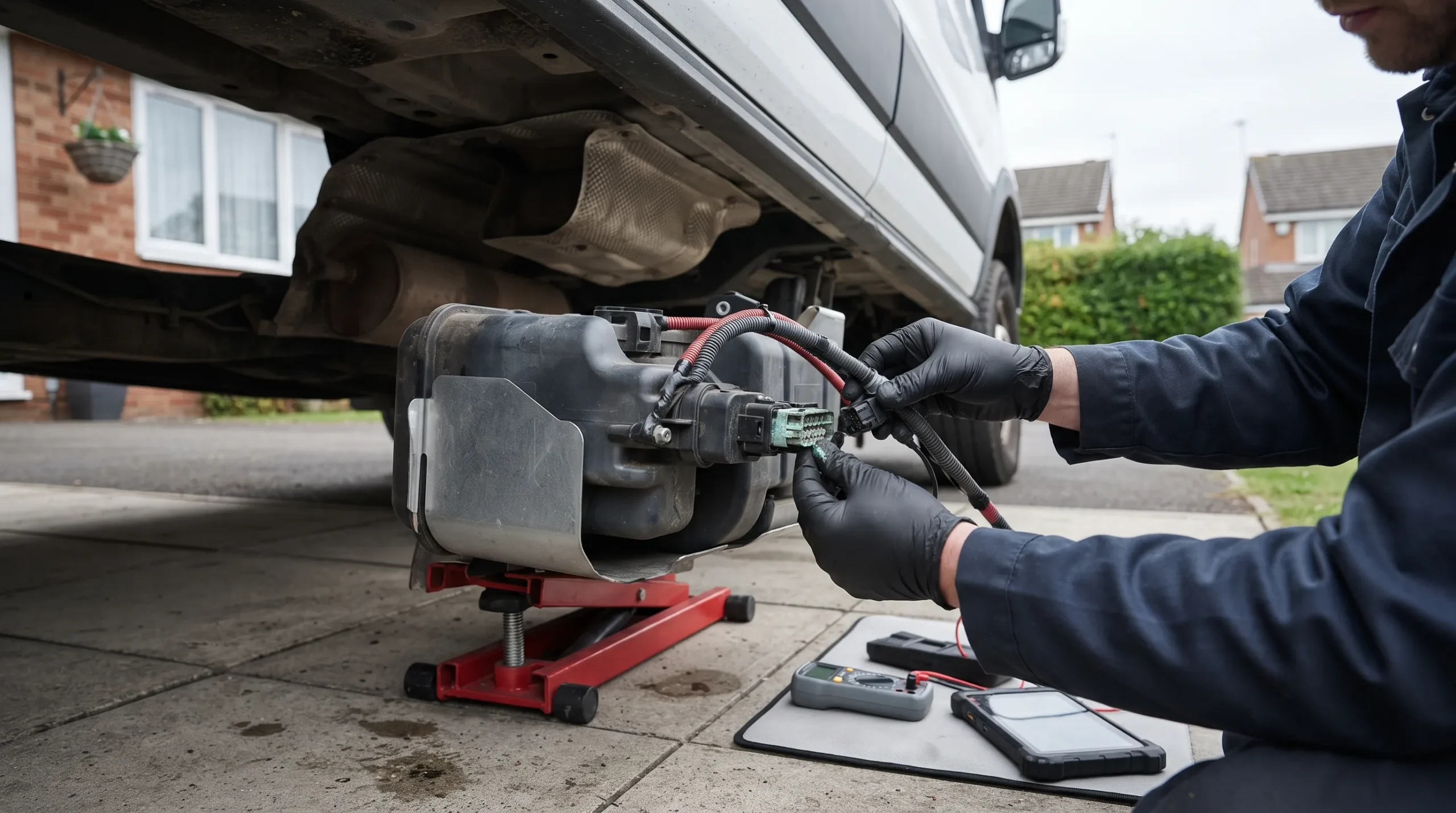
An AdBlue tank module communication fault means the module sitting inside or on top of the tank, the one handling the level, temperature and quality sensors and often the heater circuit too, has stopped talking to the rest of the vehicle properly. Not a sensor reading that’s simply wrong. A breakdown in the actual signal reaching the ECU at all, or arriving corrupted, delayed, or dropping out here and there.
That distinction matters, genuinely. It changes where the fault actually sits. A sensor reporting a bad number is one problem. A module that’s gone quiet, or only gets through to the ECU some of the time, is a different one entirely, and it often needs a different kind of diagnosis to catch properly.
We’ll go through what the tank module actually does, what tends to cause the communication itself to break down, what you’ll notice before things escalate, and how we confirm it on the vehicle rather than guessing which part’s at fault.
What Does the Tank Module Actually Do?
Think of it as the control centre sitting right at the tank. Most modern SCR systems bundle the level sensor, temperature sensor, quality sensor and sometimes the tank heater into one combined unit. A single module manages all of it and reports back to the main ECU over the vehicle’s data network, rather than through separate individual wires for each function.
That bundling is efficient when it works. It also means a single communication problem at the module can knock out several readings at once. Level, temperature and quality all going dark together, rather than one isolated sensor quietly dropping out on its own. That pattern, several related readings failing at the same time, is often the first real clue that this is a module or wiring issue rather than one sensor dying in isolation.
What Actually Causes a Communication Fault
Wiring and connector corrosion is the cause we see most often, by a clear margin. The module’s connector sits in an exposed, damp spot near the tank, picking up road spray, salt and general grime year after year. A corroded pin, or a connector that’s not seated quite right, produces exactly the kind of intermittent, drops in and out signal that looks like a module failure even when the module itself is completely fine.
A genuinely failed module is a real cause too. Just less common than people tend to assume walking in the door. The internal electronics can fail outright after years of vibration, heat cycling and general wear, and at that point no amount of wiring repair brings it back. The module itself needs replacing when that’s genuinely what’s happened.
Low battery voltage or a weak charging system causes communication dropouts that have nothing to do with the module or its wiring at all. These modules, like most control units on modern vehicles, need a stable voltage supply to communicate reliably over the data network. A battery that’s tired, or an alternator not quite keeping up, can produce intermittent communication faults that come and go with engine speed or electrical load. Confusing the picture considerably if nobody’s checked supply voltage first, which happens more than it should.
Water ingress into the connector or the module housing itself is another genuine cause, particularly on vehicles that see a lot of wet weather or underbody washing without proper reassembly afterward. Moisture getting where it shouldn’t disrupts the electrical connection even without visible corrosion having set in yet, which is part of why this one catches people out.
A software or CAN bus related issue sits further down the list of likely causes, but it does happen occasionally. Usually after other electrical work’s been carried out on the vehicle without the system being properly recalibrated or reset afterward. Worth mentioning if you’ve had other work done recently, even work that seemingly had nothing to do with AdBlue.
Symptoms You Might Notice
The AdBlue warning light is usually first. Often paired with a dashboard message that’s vaguer than a typical single sensor fault, since the ECU’s lost contact with several readings at once rather than just one.
Multiple readings disappearing together is the real giveaway here, and it’s worth paying attention to. Level, temperature and quality warnings showing up in close succession, or all at once, points toward the module or its connection rather than one sensor failing on its own.
An intermittent fault that clears itself temporarily, especially after a battery disconnect, a jump start, or simply driving for a while, often points toward a wiring, connector, or voltage related cause rather than a module that’s genuinely failed outright. Worth remembering that pattern, since it tells you something useful before anyone’s even opened the bonnet.
Reduced engine performance tends to follow if the fault persists. The ECU treats lost communication with the tank module as grounds to assume it can’t verify proper dosing anymore. A restart countdown often appears from there, the same familiar pattern most AdBlue faults eventually settle into once the vehicle’s confidence in its own readings runs out.
Can You Keep Driving With This Fault?
For a while, generally yes, particularly if the fault’s intermittent and no countdown message has shown up yet. The engine itself isn’t being damaged by a communication fault at the tank module on its own.
That said, an intermittent fault caused by corrosion or a failing connection rarely gets better by itself. It tends to get more frequent over time, as the corrosion spreads or the connection degrades further bit by bit. Getting it looked at while it’s still occasional is a lot easier than waiting for it to become constant, and cheaper too in most cases.
How We Diagnose a Tank Module Communication Fault
We start with a full fault code scan. Communication faults often store a specific code referencing the module or the data network itself, distinct from the individual sensor fault codes, and that alone narrows down where to look first.
From there we check the wiring and connector directly, since this is by far the most common actual cause we find. We’re looking for corrosion, moisture, a connector that’s not seated properly, or damage anywhere along the loom running to the module. It’s a methodical check, not a quick glance.
We also check supply voltage at the module, confirming the battery and charging system are actually delivering what the module needs to communicate reliably. Skip this step, and a battery or alternator problem gets mistaken for a module fault every single time, which wastes money on a part that was never the real issue.
If wiring and voltage both check out clean, we test the module itself directly to confirm whether it’s genuinely failed or communicating correctly once the other variables have been properly ruled out first.
Module Fault, Sensor Fault, or Wiring Fault? Why It’s Easy to Mix Up
A failed module, a corroded connector, and a genuinely dead sensor inside the module can all produce a strikingly similar warning picture from the driver’s seat. The real difference only becomes clear once someone’s actually tested the wiring, the voltage supply and the module separately, rather than assuming the first likely looking cause is the right one.
We had a van in recently where the dashboard was flashing up level, temperature and quality warnings more or less at random. Sometimes all at once, sometimes clearing completely for a day or two before coming back again without warning. The previous garage had already quoted for a full module replacement, parts and labour, the lot. Turned out the module was working perfectly fine the whole time. The connector behind it had corroded just enough to interrupt the signal intermittently, and a proper connector repair, nothing more dramatic than that, cleared every single one of those warnings for good.
Does This Happen the Same Way on Every Vehicle?
The underlying mechanism stays consistent across any SCR equipped diesel, though module location, connector design and how exposed it is to road spray and underbody washing varies quite a bit by manufacturer. We see this fault across a genuinely wide mix of vehicles, and our guides on specific manufacturers, including Ford Transit, Citroën, Peugeot Partner, Nissan, Land Rover and Mercedes, cover how AdBlue faults tend to show up on each of those specifically.
A Couple More Things Worth Knowing
Does it matter how old the vehicle is? A bit, yes, though not in the way most people assume. Age alone doesn’t cause this. Years of accumulated road salt and underbody exposure does, so a ten year old van that’s spent its life on gritted winter roads is a more likely candidate than a brand new one, regardless of make.
Can a dealer diagnose this properly? Usually, though it can take longer and cost more than it needs to if the diagnostic approach jumps straight to the module rather than checking wiring and voltage first. Plenty of vehicles we see have already had a module ordered in by a dealer before anyone actually tested the connector behind it.
Related AdBlue Guides Worth Reading
Quite a few of our other guides connect closely with this fault, since a tank module communication problem can present in several different ways depending which reading drops out first. Our articles on AdBlue connector corrosion and AdBlue wiring faults cover the most common actual cause in proper depth, and our guide on AdBlue warning appearing after a battery disconnect is worth reading if your fault showed up shortly after any battery or electrical work.
Individual sensor faults get their own detailed coverage too. See our guides on AdBlue level sensor faults and why the warning stays on and AdBlue tank temperature sensor faults, both worth checking if one specific reading’s behaving oddly rather than several at once.
Our broader guides on what an AdBlue system fault actually means and how to fix it, why an AdBlue fault keeps coming back and how long you can actually drive with an AdBlue fault all give useful wider context if you’re still working out what’s going on. If cold weather’s a factor for you, our guide on AdBlue malfunction warnings after a cold night is worth a look, and our piece on the P204F AdBlue fault code covers a related dosing code that can show up alongside communication issues on some vehicles.
Our broader AdBlue problems explained guide and our piece on AdBlue problems by manufacturer both give wider context if you’re still narrowing down exactly what’s going on with yours. Our article on whether AdBlue crystallisation can be repaired is worth reading too, if crystallisation turns out to be contributing to a tank full warning that won’t clear, which our guide on an AdBlue fault with a tank full warning still showing covers specifically.
Mobile AdBlue Repair, Wherever You Are
This is exactly the kind of fault that suits a mobile visit rather than a trip to a garage. Properly tracing a wiring or connector issue, checking supply voltage, and testing the module itself, all of that takes the right diagnostic kit more than it takes a workshop bay. Our technicians bring that straight to you, whether that’s at home, at work, or wherever the vehicle happens to be sitting when the warning light comes on.
All of our AdBlue repair work, module and wiring faults included, is backed by our workmanship warranty, so you’re covered if anything related to the repair itself needs revisiting afterward. We’ll always explain exactly what we’ve found and what needs doing before any work starts, no surprises halfway through.
Areas We Cover
We run a mobile AdBlue repair and diagnosis service across a wide stretch of the UK, and every area we cover has its own dedicated page with local details. Across London and the South East, that includes Harrow, Brent, Barnet, Haringey, Enfield, Waltham Forest, Redbridge, Newham, Barking and Dagenham and Havering.
Further across the city, we cover Bexley, Greenwich, Lewisham, Bromley, Sutton, Merton, Wandsworth, Hammersmith and Fulham, Kensington and Chelsea, Lambeth, Southwark, Tower Hamlets, Hackney, Islington, Camden, Westminster, Ealing, Hounslow and Kingston upon Thames.
Beyond Greater London, we cover St Albans, Slough, Sevenoaks, Loughton, Dartford, Epsom, Esher, Guildford, Reading and Croydon, with our wider South East England and London pages covering the region more broadly.
In the Midlands, we cover Solihull, Dudley, Wolverhampton, Walsall, Tamworth, Stoke on Trent, Nuneaton, Warwick, Rugby, Leamington Spa, Stratford upon Avon, Stafford, Cannock, Lichfield and Coventry, alongside our West Midlands and Warwickshire region pages.
Further out, we cover Shropshire towns including Telford, Oswestry, Bridgnorth and Shrewsbury, our Shropshire region page, and East Midlands and Lincolnshire towns like Peterborough, Stamford, Spalding, Market Deeping, Grantham and Bourne, covered more broadly by our Lincolnshire page.
Further north we cover Birmingham, Leicester, Derby, Sheffield, Leeds, York, Nottingham, Glasgow and Edinburgh. If you don’t see your exact area listed, our full locations page covers everywhere we currently operate.
AdBlue Tank Module FAQs
No, and this trips a lot of people up. Wiring or connector corrosion causes this far more often than a genuinely failed module does. Proper diagnosis checks the wiring and supply voltage before any decision’s made about the module itself.
Because the tank module often bundles level, temperature and quality sensors into one unit reporting back over a shared connection. A communication problem at that shared point can knock out several readings together, which is itself a useful clue pointing away from a single sensor fault.
Yes, genuinely. These modules need a stable voltage supply to communicate reliably, and a tired battery or a struggling alternator can produce intermittent communication faults that have nothing to do with the module or its wiring at all.
Sometimes it clears temporarily, particularly if the cause is intermittent corrosion or a loose connection. But it tends to come back, and it usually gets more frequent over time rather than resolving on its own for good.
Not reliably without the right access and testing equipment. Confirming whether it’s corrosion, a wiring fault, low voltage, or a genuine module failure needs proper diagnostic testing rather than a visual look under the car.
Yes, genuinely one of the better candidates for it. Our technicians carry the diagnostic kit needed to test wiring, voltage and the module itself on site in most cases, no workshop visit needed.
Not if the actual cause was properly identified and fixed rather than just a part swapped based on a guess. That’s exactly why we check wiring and voltage before even considering the module itself.
Yes, the same principle applies to any diesel vehicle running SCR emissions control, HGVs included, regardless of size or use.
Once the cause is confirmed, most wiring or connector repairs are same day. A full module replacement, if that turns out to genuinely be needed, can take a little longer depending on parts availability.
Yes, particularly if a battery was disconnected or other electrical work was carried out without the system being properly checked afterward. Our guide on AdBlue warning after a battery disconnect covers that specific situation in more depth.
A bit, yes, mainly because road salt accelerates the corrosion that causes most of these faults in the first place. Vehicles that do a lot of winter driving on gritted roads tend to see connector issues sooner than ones that mostly stay off salted roads.
Book a Mobile AdBlue Diagnosis
If your dashboard’s showing an AdBlue warning and you suspect a tank module or communication issue, get in touch through our contact page and we’ll arrange a mobile visit to trace the fault properly, wherever the vehicle happens to be. Catching an intermittent fault early is almost always easier, and cheaper, than waiting for it to become constant.
