
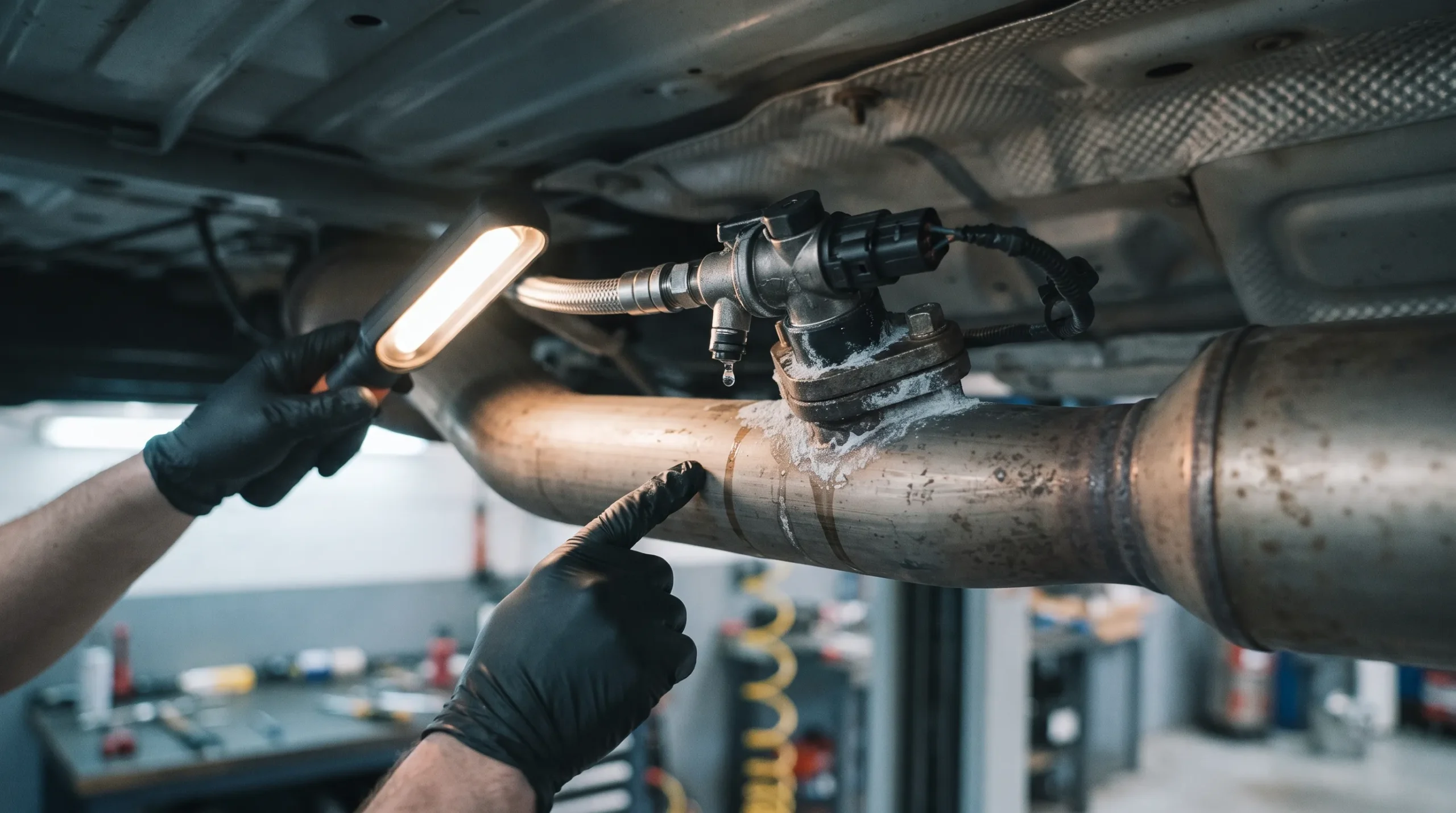
An AdBlue injector leaking means fluid’s escaping from the injector, or from the seal where it meets the exhaust, instead of landing in the exhaust stream in the precise dose the system needs. Flip side of a blocked injector, really. Not too little AdBlue getting through. Fluid getting out where it shouldn’t, and the exhaust still ends up short changed either way.
This one tends to show itself more than most AdBlue faults do. A leak leaves evidence behind. A blockage doesn’t. Handy, but it still matters exactly where the fluid’s coming from, the seal, a crack in the housing, a mounting that’s worked loose, because each one needs a different fix.
So here’s the rundown. What causes an injector to leak, what you’ll spot before it turns into a bigger job, and how we pin down where the fluid’s actually coming from instead of just swapping the whole unit and hoping.
What Causes an AdBlue Injector to Leak
A worn or perished seal tops the list by a mile. The injector sits against the exhaust through a small rubber or composite seal, and that seal lives in extreme heat with constant vibration shaking it for years on end. Eventually it hardens, splits, or flattens out past the point where it can hold anything back. Fluid starts creeping past from there.
A cracked injector housing is the nastier version of the same story. Heat up, cool down, heat up, cool down, every single time the engine runs, and that thermal cycling puts real strain on the casing year after year. A hairline crack can open up that lets fluid out straight from the body itself, no seal involved.
Loose mounting catches people out, especially after other work’s been done nearby. Wasn’t torqued back down right after a repair? Shaken loose bit by bit from vibration? Even a gap you’d barely notice is enough for AdBlue to weep out slowly over weeks.
Crystallised urea around the seal can, oddly enough, cause a leak instead of a blockage. Build up unevenly and it stops the seal sitting flush, leaving a small gap fluid escapes through even while the injector’s spray function carries on working fine.
Connector corrosion sits lower down the list but turns up now and then. Usually once moisture that’s already got past a failing seal finds its way into the electrics too.
What You Might Notice
White crystalline buildup or visible residue near the injector or exhaust is often the first thing anyone spots, and it’s a clue most other AdBlue faults never give you. Get underneath and have a look, and staining or crystal deposits around the housing point straight to a leak rather than a blockage.
A faint smell, people describe it as mildly ammonia like, sometimes shows up around the exhaust if the leak’s bad enough. Not every case though, so don’t bank on your nose catching it.
The AdBlue warning light usually follows once the system clocks that dosing accuracy’s drifted. Fluid escaping before it reaches the exhaust means less AdBlue’s landing where it should than the ECU planned for, even with the pump and everything else behind it working just fine.
Burning through AdBlue faster than usual is a quieter sign some drivers pick up on before any light even comes on. Topping up more often lately, with nothing else about how you drive changing? That’s worth a second look.
Reduced engine performance can creep in if it’s left too long. The ECU eventually treats dosing it can’t trust as a reason to pull the engine back rather than risk emissions it can’t verify.
Can You Keep Driving With a Leaking Injector?
For a bit, generally yes, especially if the leak’s small and nothing’s shown on the dash yet. Driving itself doesn’t damage the engine from AdBlue escaping at the injector.
It won’t sort itself out though. A worn seal or a growing crack gets worse with every heat cycle and every mile of vibration. A weep you’d barely notice today turns into something far more obvious over a few weeks or months. Catching it early is what keeps the job small.
How We Diagnose a Leaking Injector
First, a visual check, since this fault tends to show itself more than most. Crystalline residue, staining, damp patches around the housing and its mounting, all of it usually points us straight toward roughly where the fluid’s coming from.
Next we pin down exactly where along the injector it’s escaping. A seal leak, a cracked housing, and a loose mounting each need their own fix, even though they can look fairly alike at a glance. We run a full fault code scan at the same time, since the stored code helps confirm how far off the dosing’s drifted.
If nothing’s obvious from the visual check, we test torque and mounting integrity directly. Sometimes that loose fitting is the whole story, no crack, no failed seal, nothing else going on.
Leaking Injector or Blocked Injector? Two Opposite Problems
Worth untangling, since both sit at the injector but need completely different fixes. A blocked injector restricts flow, so too little AdBlue gets through. A leaking injector has the opposite problem. Fluid’s escaping before it ever gets the chance to be delivered correctly. Our guide on AdBlue injector not spraying covers the blockage side, if that turns out to be closer to what you’re dealing with.
A Job That Sticks in Mind
Had a van in not long ago where the driver had noticed a faint, lingering ammonia smell for a few weeks before any light came on. By the time it reached us, crystalline buildup was sitting visibly around the seal area. Testing showed the seal had hardened and started letting fluid weep past, slowly, enough to throw dosing off without yet turning into a proper leak. A new seal sorted it completely, and the bill came in well under what a full injector swap would’ve cost.
Does This Happen the Same Way on Every Vehicle?
The underlying cause holds steady across any SCR equipped diesel, though seal design and how exposed the injector is to heat and vibration shifts from one manufacturer to the next. Our guides on specific manufacturers, including Ford Transit, Citroën, Peugeot Partner, Nissan and Land Rover, cover how AdBlue faults tend to show up on each of those, if you’re trying to work out whether your own model’s a likely candidate.
Related AdBlue Guides Worth Reading
Blockage rather than a leak? Our guide on AdBlue injector blocked symptoms, causes, and repair goes into that side properly. Crystallisation shows up often enough around this fault that our piece on whether AdBlue crystallisation can be repaired is worth a look too, since it’s the same process that can both block a line and quietly stop a seal sitting flush.
Mobile AdBlue Repair, Wherever You Are
A fault like this suits a mobile visit well. Pinning down where a leak’s coming from, and fitting the right seal or part, takes the right access and the correct parts on hand more than it takes a workshop bay. Our technicians bring both straight to you, at home, at work, wherever the vehicle happens to be sitting when you spot the problem.
All of our AdBlue repair work, injector leaks included, comes with our workmanship warranty, so you’re covered if anything about the repair itself needs revisiting later. We’ll always walk you through what we’ve found and what needs doing before anything starts.
Areas We Cover
We run a mobile AdBlue repair and diagnosis service across a wide stretch of the UK, and every area we cover has its own dedicated page with local details. Across London and the South East, that includes Kingston upon Thames, Lewisham, Islington, Haringey, Havering, Waltham Forest, Redbridge, Newham, St Albans, Slough, Sevenoaks, Loughton, Dartford, Epsom, Esher, Guildford, Reading and Croydon, with our wider South East England and London pages covering the region more broadly.
In the Midlands, we cover Solihull, Dudley, Wolverhampton, Walsall, Tamworth, Stoke on Trent, Nuneaton, Warwick, Rugby, Leamington Spa, Stratford upon Avon, Stafford, Cannock, Lichfield and Coventry, alongside our West Midlands and Warwickshire region pages.
Further out, we cover Shropshire towns including Telford, Oswestry, Bridgnorth and Shrewsbury, our Shropshire region page, and East Midlands and Lincolnshire towns like Peterborough, Stamford, Spalding, Market Deeping, Grantham and Bourne, covered more broadly by our Lincolnshire page.
Further north we cover Leicester, Derby, Sheffield, Leeds, York, Nottingham, Glasgow and Edinburgh. Can’t spot your area on this list? Our full locations page covers everywhere we currently operate.
A Couple More Things
Does the vehicle’s age make this more likely? A little, though it’s really down to accumulated heat cycles rather than age on paper. A van that’s clocked a lot of stop start town driving over the years is a more likely candidate than a newer one with far fewer engine hours behind it, whatever the registration plate says.
Can you tell from inside the car? Not easily. It’s all happening down at the exhaust, well out of sight and earshot from the driver’s seat. The warning light, a changed smell near the vehicle, or AdBlue disappearing faster than it used to. That’s about all you’ll get without actually looking underneath.
AdBlue Injector Leak FAQs
Often, yes. A worn seal’s the usual culprit, and swapping just the seal is a far smaller job than replacing the entire injector, as long as the housing itself hasn’t cracked.
For a short while, yes, though a small leak rarely stays small. Getting it checked while it’s minor keeps things simple.
No. That just masks the lost fluid for a while. The leak’s still there, and dosing stays off until the real cause gets fixed.
A leak tends to leave evidence, residue, crystals, staining. A blockage usually shows nothing beyond the warning light and reduced dosing.
Sometimes, if you can get underneath and there’s visible crystal buildup or staining. Pinning down exactly where it’s coming from still needs a proper look though.
Yes, it suits this one well. Our technicians carry what’s needed to confirm the cause and sort the repair on site in most cases.
Not if the real cause got caught in the first place. Crystallisation around the seal contributing to the original failure? Dealing with that alongside the new seal stops it happening again.
Yes, same principle, any diesel running SCR emissions control, HGVs included.
Once the cause is confirmed, most seal jobs are the same day. A full injector swap, if the housing’s actually cracked, can take a bit longer depending on parts.
Book a Mobile AdBlue Diagnosis
Spotted crystalline residue, a faint smell, or an AdBlue warning and think it’s a leaking injector? Get in touch through our contact page and we’ll get a mobile visit booked in to confirm what’s going on, wherever the vehicle’s sitting. Catch a leak early and the fix stays simple.
