
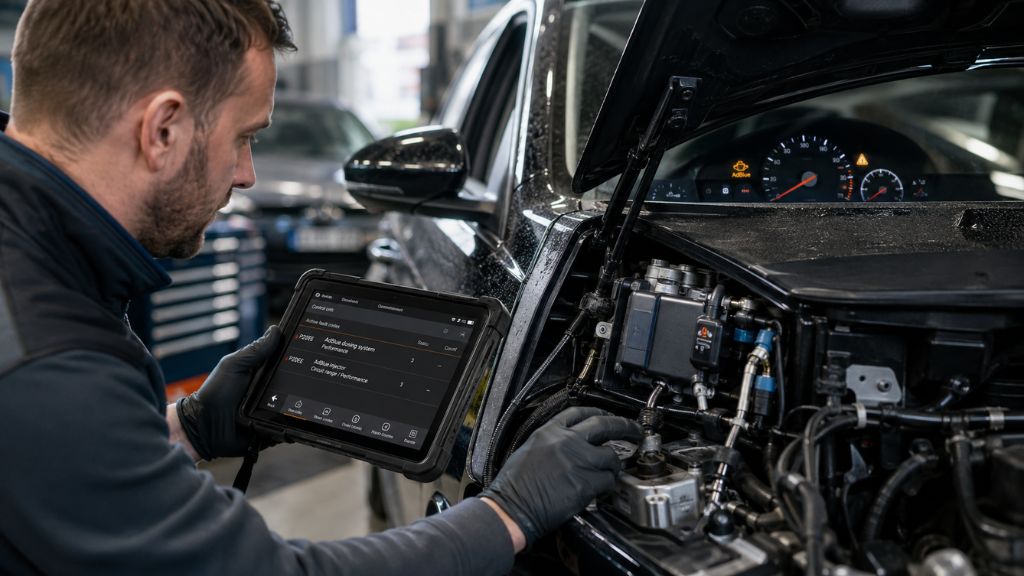
If your AdBlue warning’s back on the dash after already being “fixed” once, here’s the honest answer: only the symptom got dealt with the first time round, not the actual cause. A part gets swapped, the light goes off, everyone’s pleased for a few weeks, and then the same warning turns up again like nothing ever happened. That’s usually the sign of something upstream or downstream of the repaired part never getting checked properly. Could be the ECU strategy itself. Could be a related sensor nobody looked at. Could be something feeding into the original fault that got missed entirely the first time.
If you’ve had this “fixed” once, maybe twice, and you’re reading this because it’s happened again, you’re probably past wanting a general explanation. You want to know why it keeps happening to you specifically. So let’s actually get into the real reasons a fault returns, what a proper repair needs to cover to make it stop, and how you’d know whether your last fix was ever going to hold in the first place.
Why Faults Keep Returning: A Quick Overview
Before going into detail on each one, here’s a snapshot of the most common reasons an AdBlue fault comes back, and roughly how often we see each one in practice.
| Cause | How Common | Typically Missed By |
| Fault never properly diagnosed | Very common | Basic scan tools, rushed jobs |
| Symptom fixed, root cause ignored | Very common | Standard garages, quick part swaps |
| ECU fault strategy not reset | Common | Anyone not going into the ECU itself |
| Cheap or wrong-spec parts fitted | Common | Budget repairs, generic aftermarket parts |
| Contaminated or incorrect AdBlue fluid | Less common, but persistent | Repairs that skip a full system flush |
| NOx sensor fault mistaken for AdBlue fault | Occasional | Repairs that only look at the AdBlue side |
Most of the time it’s not one single thing on this list. It’s two or three of them stacking up together, which is exactly why a fault can survive one, or even two, previous repair attempts.
The Fault Wasn’t Actually Diagnosed Properly the First Time
This one’s the big one, by some distance. AdBlue warnings are annoyingly vague by design. The dashboard just says something’s wrong, not what, so it’s entirely possible to replace the wrong part, or the right part for the wrong reason, and still watch the warning disappear temporarily. Clearing a fault code resets the countdown regardless of whether the actual cause got fixed or not.
A rushed diagnosis, especially one done with basic tools rather than proper OEM-level kit, misses this constantly. The part that got replaced might genuinely have been faulty. Just not the only thing wrong, or not the actual root cause of why it failed in the first place. We’ve gone into just how broad that initial warning can be in our guide on AdBlue system faults, which is worth a read if you’re trying to understand why “AdBlue fault” on its own tells you almost nothing.
Only the Symptom Was Replaced, Not the Root Cause
Even with a spot-on diagnosis, stopping at “replace the failed part” leaves the door wide open for the exact same fault to return. Take a blocked injector. Replace it, sure, but if nobody’s worked out why it blocked in the first place, a failing heater letting fluid crystallise, say, or fluid that was already contaminated, the brand new injector’s sitting in exactly the same conditions that killed the old one. We’ve covered this pattern specifically in our piece on blocked AdBlue injectors, where the injector itself is often the symptom, not the cause.
Same logic applies to sensors, pumps, wiring, all of it. Replacing a part without asking why it failed is a bit like patching a leaky pipe without checking why it cracked. Might hold for a while. Doesn’t actually solve anything.
The ECU Strategy Itself Was Never Addressed
Here’s the bit most standard garages skip entirely, and it’s a genuinely big reason faults come back even after a technically correct part’s been swapped. The ECU doesn’t just react to hardware sitting in front of it. It runs a strategy, a set of internal rules for how it reads sensor data, how quickly it flags something as faulty, and what triggers a countdown. If that strategy’s running overly sensitive, or it’s been quietly logging months of fault patterns from a slowly failing component, just swapping the physical part doesn’t necessarily wipe any of that clean.
Properly sorting a recurring fault usually means going into the ECU itself, not just the hardware, clearing the underlying fault history and confirming the strategy’s genuinely starting fresh rather than carrying baggage forward from whatever just failed. It’s a big part of why a job done properly tends to actually hold, and a job that’s just a part swap sometimes doesn’t.
Cheap or Incorrect Parts
Not every replacement part’s created equal, and honestly, this is one of the more common causes of repeat faults, particularly after a repair done on the cheap. Aftermarket parts vary hugely. A sensor or injector that’s slightly out of spec for your specific vehicle can trigger the identical warning within weeks of being fitted, sometimes faster than the original part even took to fail. Looks like the fault’s “come back.” What’s actually happened is a different, lower-quality version of the same part just failed too.
It’s a big reason we stick to proper OEM or OEM-equivalent parts as part of our AdBlue repair service, rather than whatever’s cheapest and quickest to get hold of.
Contaminated or Incorrect AdBlue Fluid
If the fluid itself isn’t genuine AdBlue or DEF, or it’s picked up contamination somewhere, a dirty tank, a grubby filling nozzle, moisture getting in, it can keep causing sensor and injector problems no matter how many parts get replaced around it. In cases like this, the fault genuinely will keep coming back, because the real cause is sitting in the tank rather than in any one component. A full system flush as part of a proper AdBlue fix is often needed alongside any part replacement here, not as an alternative to it.
The Fault’s Actually a NOx Sensor, Not AdBlue
Because the NOx and AdBlue systems are so tightly wired together, a failing NOx sensor can throw up warnings that look exactly like a genuine AdBlue fault. Fix the AdBlue side and leave the NOx sensor alone, and the warning just comes straight back, from a completely different source. Looks identical to a recurring AdBlue fault from the driver’s seat. Really it’s a separate but related problem that was never touched. Our NOx sensor services covers this specifically, and it’s always worth ruling out if an AdBlue repair hasn’t actually held.
How Often Should This Genuinely Happen?
Honestly, not very often at all, assuming the original repair was done properly. A correctly diagnosed, correctly repaired AdBlue fault, right parts, ECU strategy properly cleared, should hold for the life of the component, or considerably longer. If you’re onto your second or third repair for what feels like the same fault, that’s a strong sign the underlying cause was never actually found the first two times round, rather than genuinely bad luck with parts.
What to Ask Before Getting It Fixed Again
Booking another repair after a fault’s returned? Worth asking a few direct questions before anyone touches the vehicle. Was a full diagnostic scan actually carried out, or was the part swapped purely based on the previous fault code? Is the part being fitted genuine OEM or OEM-equivalent, and where’s it actually coming from? Will the ECU fault history be properly cleared as part of the job, not just the current warning cleared and left at that? And has anyone actually looked into why the original part failed, rather than just replacing it and hoping?
A specialist who’s confident in their diagnosis should answer all of that without hesitating. If all you’re getting back is “we’ll replace it and see how it goes,” that’s often exactly how a fault ends up back on your dashboard for a third time.
How We Actually Stop It Coming Back
Every job starts the same way here, whether it’s a first-time fault or someone’s third attempt at fixing the same one: a full diagnostic scan using OEM-level equipment, checking the whole system rather than just whatever’s currently throwing a code. Fluid quality, sensor readings across the board, dosing performance, wiring integrity, all of it, not just the part that looks obviously guilty.
Where a component genuinely needs replacing, our AdBlue repair service fits proper OEM or OEM-equivalent parts, not the cheapest option going. Where the ECU strategy itself needs sorting, that gets rewritten properly as part of the job rather than left as an afterthought. Fluid contamination issue? A full flush’s included through our broader AdBlue fix service. And if a fault’s already escalated into a countdown or full lockout by the time you reach us, our no-start countdown bypass gets you moving again without waiting on a dealer slot.
For vehicles with a genuinely persistent history of recurring faults, particularly older or higher-mileage ones where a fresh part just isn’t holding long-term, it’s sometimes worth looking at something more permanent. An AdBlue delete removes the SCR strategy from the ECU entirely, so there’s nothing left to keep failing the same way. AdBlue removal does something similar. Prefer to keep the system running as designed but just want the recurring warnings gone? Our AdBlue bypass is worth talking through too.
Every repair we do carries a lifetime warranty for as long as you own the vehicle, which is honestly as much a reflection of how thoroughly we diagnose faults as anything else. We don’t particularly want to see the same car back in a few months, and neither do you.
AdBlue Repairs in London
A lot of the recurring faults we see come from vehicles that were originally patched up quickly, roadside or at a general garage, rather than properly diagnosed the first time. That’s especially common across London, where a fast fix to get moving again often takes priority over a proper root-cause diagnosis, understandably, given how disruptive an AdBlue fault can be in the middle of a working week.
If you’re based in London and this is your second or third time dealing with what feels like the same warning, it’s worth having it looked at properly rather than booking the same quick fix again. Our mobile engineers cover the whole of Greater London, bringing the same OEM-level diagnostic and ECU tools a franchised dealer would use, and most jobs are sorted at your home or workplace within the hour, without a dealer appointment or a tow anywhere.
More on AdBlue Faults
If you’re still trying to piece together your specific situation before deciding what to do, a few of our other guides might help fill in the gaps. Not sure how much time you’ve actually got left before things get worse? How long can you drive with an AdBlue fault covers what a countdown actually means and roughly how long different faults typically run. Already at zero miles? What happens when the countdown reaches 0 miles explains exactly what you’re dealing with and what happens next. Suspect it’s the injector specifically? Our guide on blocked AdBlue injectors goes into the symptoms and causes in more depth.
Mobile Engineers, Wherever You’re Based
Getting a recurring fault properly sorted doesn’t need a trip to a dealer, or another rushed job at a general garage hoping this time’s different. Our mobile engineers come to you directly, home, workplace or roadside, carrying the same OEM-level diagnostic and ECU tools a franchised dealer would use, without the dealer pricing attached.
Beyond London and the South East, where we also cover Croydon, Reading, Guildford, Epsom, Dartford, Loughton, Sevenoaks, Slough and St Albans, we travel a lot further afield too. North of the border, that’s Edinburgh and Glasgow. Across Yorkshire, Leeds, Sheffield and York.
The Midlands keeps us busiest outside London, covering Coventry, Derby, Leicester, Nottingham, Birmingham and Grantham, plus the wider West Midlands taking in Walsall, Wolverhampton, Dudley and Solihull. We’re also across Shropshire, including Stoke-on-Trent and Tamworth, and Warwickshire, covering Rugby, Warwick and Nuneaton.
Further east, we’re regularly across Lincolnshire, including Market Deeping, Stamford, Spalding and Peterborough.
Can’t spot your area on that list? Get in touch anyway, since we travel well beyond these towns fairly often, and same-day callouts are usually available across most of the UK if you book before midday.
Running a fleet rather than a single vehicle? Recurring faults hit harder when it’s a van off the road repeatedly, so it’s worth pairing any AdBlue work with a look at our HGV remapping service too.
Frequently Asked Questions
Usually because only the symptom, such as a failed part, was replaced without addressing the actual root cause. The underlying issue could be an ECU strategy problem, contaminated AdBlue fluid, or a related sensor that was never properly checked.
No, not if the original repair was diagnosed and completed properly. A correctly diagnosed and repaired fault should normally remain resolved for the expected life of the component. Repeated returns usually suggest that the underlying cause was not fully identified.
Yes, in some cases. Lower-quality aftermarket parts may not meet the required specification and can fail prematurely. This can make it appear that the original fault has returned when the replacement component has developed its own problem.
Often, yes. Depending on the vehicle and fault, the ECU may need diagnostic procedures after a component has been replaced, including clearing stored faults or carrying out required adaptations and resets. The exact procedure varies by manufacturer.
Yes. If the AdBlue fluid is contaminated or incorrect, it can continue causing problems with sensors, the dosing system or other SCR components regardless of how many parts are replaced. The fluid and system may need to be properly drained, inspected and flushed.
If the same fault or symptom returns within weeks or months, it can be a sign that the underlying cause was not fully addressed. A proper repair should involve a full diagnostic assessment rather than simply replacing the most obvious component.
Yes. The NOx sensors and SCR system work closely together, so a NOx sensor problem can trigger emissions and AdBlue-related warnings. If the sensor is not checked during an AdBlue repair, the warning may appear to have returned after the original repair.
Generally, yes, particularly if the same repair has already been attempted without resolving the problem. A fresh diagnostic assessment from an AdBlue specialist can help identify the underlying issue that may have been missed during the previous repair.
An AdBlue delete is intended to disable the vehicle’s SCR/AdBlue strategy, so related faults may no longer be triggered in the same way. However, modifying an emissions-control system can have legal and compliance implications, particularly for vehicles used on public roads, so it is not the appropriate solution for every vehicle.
It depends on the actual cause identified during diagnosis. We confirm a fixed price after assessing the fault rather than guessing which component needs replacing. This helps avoid replacing the same part again when another underlying issue is responsible.
With us, yes, provided the original repair was carried out by our team and the issue falls within the terms of the repair warranty. It is also why we focus on diagnosing the underlying cause rather than simply replacing the most obvious part.
Yes. Book before midday and we’ll usually aim to reach you the same day, whether you’re at home, at work or roadside. We provide mobile AdBlue fault diagnosis and repair across Greater London and also cover wider areas of the UK.
Fault Keeps Coming Back? Let’s Actually Fix It This Time
If you’ve had this repaired before and you’re back here again, don’t just book the same fix a third time. Get a free, no-obligation quote and we’ll properly diagnose what’s actually causing it. Browse our full AdBlue fix services, or call 0330 043 4431 to speak to an engineer now.

7 Comments
[…] try, that’s the loudest sign nobody has found the root cause yet. We also have a second guide on why an AdBlue fault keeps returning if you want another angle on the same […]
[…] any of this sounds familiar, it’s worth reading our related guide on why does my AdBlue fault keep coming back, since connector corrosion is one of the recurring causes we cover […]
[…] this isn’t the first time you’ve had this fault fixed on the same Transit, our guide on why an AdBlue fault keeps coming back is worth reading, since incomplete diagnosis, treating the symptom rather than the injector, sensor […]
[…] A reset does have a place, but only after the real fault has been fixed. If you’ve been through this already, read why does my AdBlue fault keep coming back after a reset? and why does my AdBlue fault keep coming back? […]
[…] this isn’t the first time you’ve had this fault fixed on the same vehicle, our guide on why an AdBlue fault keeps coming back is worth reading, since the NOx sensor versus injector confusion described above is one of the most […]
[…] returning after multiple cold snaps have already passed, it’s worth reading our explainer on why an AdBlue fault keeps coming back, since a recurring fault is a different situation to a one-off cold morning […]
[…] actually reset properly. We’ve gone into this in a lot more depth in our guide on why an AdBlue fault keeps coming back, which is worth reading if this is your second or third time dealing with the same […]