
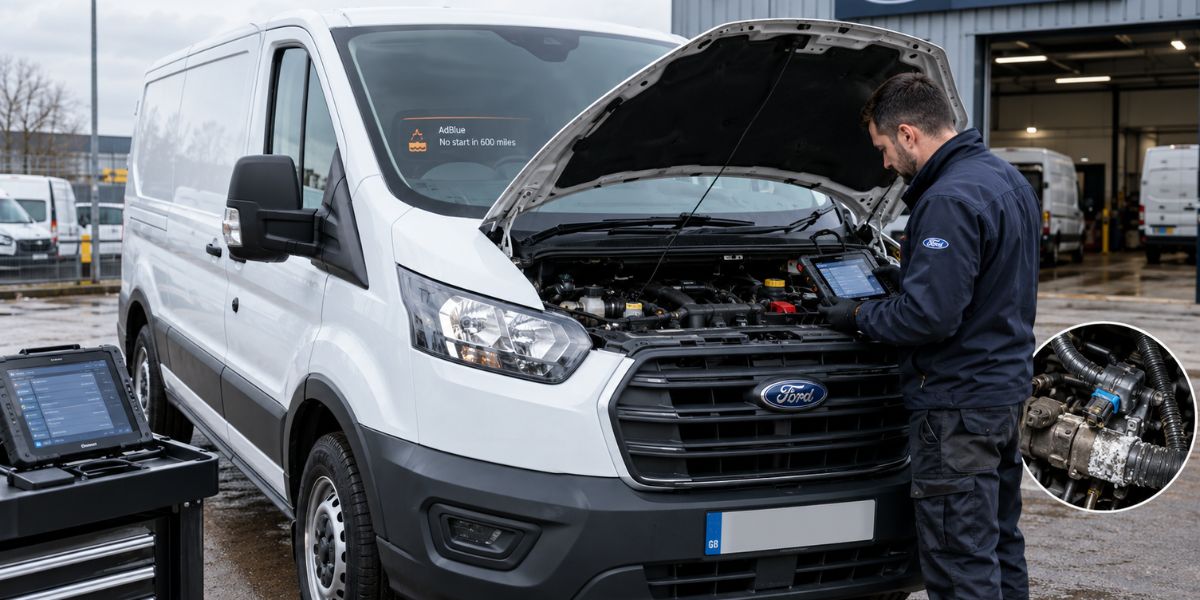
A Ford Transit AdBlue warning almost always traces back to one of three things: the dosing injector, the level or quality sensor, or a NOx sensor reading outside the range the ECU expects. Ford’s system is fairly unforgiving once a fault’s confirmed. Most Transits give you a 500-mile countdown to no-start, and if you miss that window, the vehicle needs a specific reset procedure just to buy you another short run before it locks out again.
If you’re running a Transit or Transit Custom for work and this warning’s just appeared, here’s what’s genuinely behind it, what the countdown actually does once it hits zero, and how to get it fixed properly rather than fighting the same fault every few weeks.
How the Transit’s Countdown Actually Works
This is worth understanding before anything else, because it catches a lot of Transit drivers out. Once the ECU confirms an AdBlue fault, most models start a 500-mile countdown to no-start. Reach zero, and the fault code that follows, commonly P241D, means the engine won’t restart at all.
Here’s the part that surprises people. Fixing the underlying fault after the vehicle’s already reached no-start isn’t the end of it. Ford’s diagnostic tools apply a specific reset for the no-start condition, but that reset only grants another short window, often around 31 miles, before the same lockout returns if the fault isn’t genuinely resolved. So if you’ve had a repair done and you’re still getting locked out every few dozen miles, that’s the reset procedure working exactly as designed. It means whatever caused the original fault hasn’t actually been fixed yet.
Common Causes on the Transit
A faulty or damaged dosing injector. The injector doses AdBlue into the exhaust in carefully controlled amounts, typically confirmed with a dosing test looking for a specific volume within a narrow tolerance. Damage to the injector or its wiring is a genuine, recurring cause on the Transit, including physical damage from rodents chewing through the connecting cable, which is more common than people expect on vans that sit parked for periods between jobs.
Level or quality sensor faults. The tank sensor tells the ECU how much AdBlue is present and whether it’s the correct concentration. A failing sensor reports incorrect data regardless of what’s actually in the tank, and it’s one of the most common reasons a Transit throws a countdown warning even after a full refill.
NOx sensor faults. The Transit uses NOx sensors before and after the SCR catalyst to confirm the system’s actually reducing emissions. A sensor reporting efficiency below the expected threshold triggers a fault, and it isn’t always the sensor itself at fault, an under-dosing injector or a genuinely failing catalyst can produce the same reading.
Wiring damage. As mentioned above, damaged wiring to the injector or sensors is a well-documented cause on the Transit specifically. It’s worth checking physically, not just electronically, particularly on vans that spend time parked outdoors or in yards.
Soot or contamination affecting sensor readings. A NOx sensor covered in soot, sometimes following an unrelated EGR or DPF issue, can report inaccurate readings that look like a sensor failure when the sensor itself may be undamaged once cleaned.
Reading the Countdown Message and Fault Codes
Transit drivers typically see a dash message stating a specific mileage remaining before no-start, counting down as you drive. Codes worth knowing include P204F (reductant system performance), P20EE (SCR NOx catalyst efficiency below threshold), P220E (AdBlue injector-related fault, sometimes linked to wiring damage) and P241D, which specifically relates to the no-start condition once the countdown’s expired. Our dedicated guide on the P204F AdBlue fault code breaks down what that one means in more detail if it’s what you’re seeing.
If you’re not sure what the warning symbol on your dash actually is, our broader guide on AdBlue system faults covers the range of messages this system produces across different manufacturers.
Why the Injector Dosing Test Matters
Proper diagnosis on a Transit involves confirming the injector’s actual dosing output during a controlled test, checking it delivers close to the expected volume within a narrow tolerance, alongside confirming AdBlue pressure to the injector is correct. This matters because a NOx catalyst efficiency fault can be caused by an injector that’s under-dosing even slightly, and that’s easy to miss if a technician only reads the fault code and assumes the sensor or catalyst is at fault without actually testing the injector’s output.
Why the Warning Sometimes Won’t Clear After a Top-Up
This is a common frustration on the Transit. Owners report topping up well beyond what the light suggested was needed, sometimes finding the tank won’t even take a full refill, only for the countdown to return within a relatively short distance afterward. When that happens repeatedly, it’s rarely still about fluid level. It points toward a sensor giving an inaccurate reading of what’s actually in the tank, or a dosing fault that keeps re-triggering regardless of how full the tank is. Our piece on AdBlue fault: tank full, warning still on covers this exact pattern in more depth, and our guide on AdBlue level sensor faults explains why the sensor side specifically causes this.
Can You Reset It Yourself?
Not reliably, and this is where a lot of Transit owners run into real trouble. Disconnecting the battery is a common attempt, but it rarely clears an AdBlue fault properly and can introduce unrelated issues. Cheaper generic diagnostic tools sometimes can’t perform the specific reset the Transit needs after a no-start condition, which is part of why some owners find themselves stuck even after fixing the actual fault, correctly diagnosed and repaired but still locked out because the reset procedure itself needs the right equipment.
If your countdown’s already reached zero, our no-start countdown bypass is built specifically for this, getting you moving again properly rather than leaving you stuck in repeated short-window lockouts.
What This Costs to Fix Properly
Costs vary considerably depending on whether it’s a sensor, an injector, or something more involved like catalyst work. A NOx sensor replacement typically runs into several hundred pounds depending on the part and labour involved, while a straightforward sensor fault costs less. We’ll always confirm a fixed price once we’ve actually diagnosed the vehicle, including a proper injector dosing test, rather than guessing based on the fault code alone.
How We Diagnose and Fix a Ford Transit AdBlue Fault
We start with a full diagnostic scan checking the injector’s actual dosing output, NOx sensor readings before and after the catalyst, and the physical condition of the wiring, since damage from rodents or general wear is a genuine and recurring cause on this platform. That combination matters more on a Transit than simply reading a single fault code and ordering the obvious part.
Where the injector’s genuinely at fault, whether that’s the part itself or damaged wiring feeding it, that’s handled through our AdBlue repair service using proper OEM or OEM-equivalent parts. Where a NOx sensor’s confirmed faulty, our NOx sensor services covers that directly, and our broader AdBlue fix service handles diagnostics and repair across the whole system where more than one component’s involved. If your countdown’s already expired and you’re stuck in repeated short-window lockouts, our no-start countdown bypass resolves that properly.
For older or higher-mileage Transits with genuinely persistent AdBlue trouble, particularly fleet vehicles where repeated repairs aren’t holding, it’s sometimes worth discussing an AdBlue delete or AdBlue removal, both of which remove the system from the equation permanently. Our AdBlue bypass is worth a look too if you’d rather keep the system running as designed but stop the recurring warnings. Every repair carries a lifetime warranty for as long as you own the vehicle.
If this isn’t the first time you’ve had this fault fixed on the same Transit, our guide on why an AdBlue fault keeps coming back is worth reading, since incomplete diagnosis, treating the symptom rather than the injector, sensor and wiring together, is one of the most common reasons a Transit repair doesn’t hold.
For a broader view across other manufacturers, our guide on AdBlue problems by manufacturer is worth a look, and our general explainer on AdBlue problems explained covers the basics. If you’re running a mixed fleet, our guides on Nissan AdBlue faults, Land Rover AdBlue warning lights and Mercedes AdBlue system faults cover those platforms too.
Ford Transit Repairs in London
Transit and Transit Custom vans are everywhere across London’s trade, delivery and courier fleets, and the mix of short city journeys and extended parking between shifts is exactly the pattern that contributes to both injector issues and physical wiring damage. It’s one of the most common AdBlue callouts we get across the capital.
Our mobile engineers cover the whole of Greater London, bringing OEM-level diagnostic equipment capable of running a proper injector dosing test and checking wiring condition, not just reading a code and guessing. Most London jobs are sorted at your home, workplace or depot within the hour, which matters considerably more when it’s a working van off the road rather than a personal car.
Mobile Engineers Across the UK
Beyond London and the South East, where we also cover Croydon, Reading, Guildford, Epsom, Dartford, Loughton, Sevenoaks, Slough and St Albans, we travel a lot further too. North of the border, Edinburgh and Glasgow. Across Yorkshire, Leeds, Sheffield and York.
The Midlands keeps us busiest outside London, covering Coventry, Derby, Leicester, Nottingham, Birmingham and Grantham, plus the wider West Midlands taking in Walsall, Wolverhampton, Dudley and Solihull. We’re also across Shropshire, including Stoke-on-Trent and Tamworth, and Warwickshire, covering Rugby, Warwick and Nuneaton.
Further east, we regularly cover Lincolnshire, including Market Deeping, Stamford, Spalding and Peterborough.
Can’t see your area listed? Get in touch anyway, since we travel well beyond these towns fairly often, and same-day callouts are usually available across most of the UK if you book before midday. Running a Transit fleet? Our HGV remapping service is worth pairing with any AdBlue work, and you can read more about our mobile AdBlue removal and repair coverage across the UK.
Frequently Asked Questions About Ford Transit AdBlue Faults
Common causes include a faulty or damaged dosing injector, an inaccurate level or quality sensor, or a NOx sensor fault. Wiring damage, including cables damaged by rodents, can also cause AdBlue-related faults on Ford Transit models.
A confirmed AdBlue fault can typically trigger a countdown of around 500 miles. If the vehicle reaches a no-start condition, a specific diagnostic reset may provide a further short driving window, often around 31 miles, but this should only be relied on after the underlying fault has been properly repaired.
This can happen when the diagnostic reset is carried out without the underlying fault being fully resolved. The vehicle may temporarily leave the no-start condition, but if the original fault remains, the lockout can return when the recovery window expires. The correct reset procedure needs to be completed alongside a genuine repair.
P241D relates to the Ford Transit AdBlue no-start condition after the countdown has expired. It requires the appropriate diagnostic reset procedure rather than simply clearing the stored fault code.
Yes. Rodents can damage wiring while a van is parked, including cables connected to the AdBlue injector and related components. Damaged wiring can interrupt communication or power and trigger AdBlue fault codes.
Sometimes, if low fluid was genuinely the cause. If the warning remains after the tank has been correctly topped up or returns shortly afterwards, the problem may involve the level or quality sensor, dosing system or another SCR component.
The cost depends on the fault found during diagnosis. A sensor fault may cost less than an injector replacement, while NOx sensor repairs can run into several hundred pounds depending on the vehicle and part required. A fixed repair price can be confirmed once the fault has been diagnosed.
No. An independent specialist with suitable diagnostic and reset equipment can diagnose and repair many Ford Transit AdBlue faults, including faults that require the correct no-start reset procedure.
The Transit may continue to drive for a limited distance while the countdown is active. However, the fault should be diagnosed before the countdown reaches zero, particularly if the van is needed for daily work or regular business use.
An AdBlue delete changes or disables the vehicle’s emissions-control strategy rather than repairing the underlying fault. It can also have legal, emissions-testing and warranty implications, so the vehicle should be properly diagnosed and repaired where possible.
Yes. Book before midday and we will usually aim to reach you the same day across Greater London. Repairs can be carried out at a suitable home, workplace or depot location, subject to availability.
Ask whether the diagnosis includes an injector dosing test, NOx sensor readings and a wiring inspection rather than relying on the fault code alone. These checks can help identify the actual cause before a replacement component is ordered.
Ford Transit AdBlue Warning On? Get It Diagnosed Properly
Whether it’s a countdown running or you’re already locked out, don’t keep resetting without fixing the actual cause. Get a free, no-obligation quote and we’ll tell you exactly what’s going on. Browse our full AdBlue fix services, or call 0330 043 4431 to speak to an engineer now.

6 Comments
[…] vibration shifts from one manufacturer to the next. Our guides on specific manufacturers, including Ford Transit, Citroën, Peugeot Partner, Nissan and Land Rover, cover how AdBlue faults tend to show up on each […]
[…] fault across a genuinely wide mix of vehicles, and our guides on specific manufacturers, including Ford Transit, Citroën, Peugeot Partner, Nissan, Land Rover and Mercedes, cover how AdBlue faults tend to show […]
[…] are more prone than others, and we’ve written specific guides for owners of Mercedes, Land Rover, Ford Transit, Citroën, Peugeot Partner and Nissan vehicles, plus a page on BMW […]
[…] bit. Ford Transit vans show up with this often, probably just down to how many of them get run close to empty on long […]
[…] fault across a genuinely wide mix of vehicles, and our guides on specific manufacturers, including Ford Transit, Citroën, Peugeot Partner, Nissan, Land Rover and Mercedes, cover how AdBlue faults tend to show […]
[…] or how exposed the tank and filter are to contamination over time. Our vehicle specific guides for Ford Transit, Citroën, Peugeot Partner, Nissan, Land Rover and Mercedes cover the more common patterns per make […]