
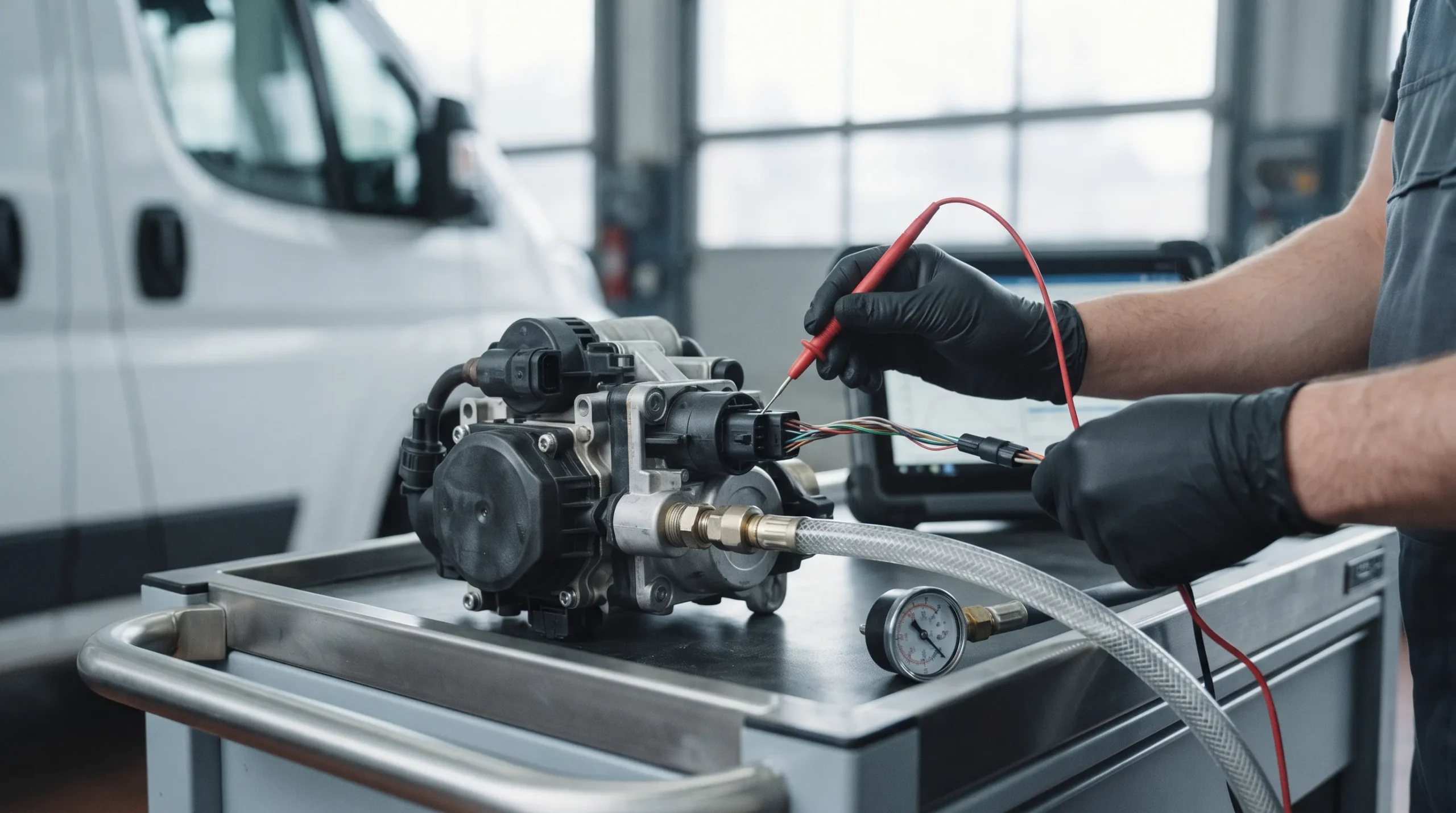
An AdBlue pressure sensor fault means the sensor watching pressure inside the dosing system has stopped sending the ECU a reading it trusts. Could be flat. Could be jumping around erratically. Could just be drifting outside what’s normal. It’s not the same thing as a failing pump or a blocked line, even though all three can throw up a strikingly similar warning on your dash.
That distinction’s worth getting right from the start, because this fault gets treated as a pump problem by default more often than it should, and the two need completely different fixes.
Here’s what this sensor’s doing, what tends to make it pack in, what you’ll notice first, and how we work out whether it’s really the sensor or something else hiding further down the system.
What the Pressure Sensor Monitors
Picture it sitting inside the dosing module, keeping a constant check on how much pressure the pump’s building in the AdBlue line. The ECU leans on that reading to confirm dosing’s happening at the right pressure for a spray that’s accurate and consistent at the injector. Too low, and the spray pattern falls apart. Too high, and the system can’t trust the dose it’s sending out either.
When that reading stops matching what the ECU expects, impossibly low, impossibly high, bouncing around from one moment to the next, the system logs a fault. Better that than dosing blind on a number it can’t rely on.
What Causes a Pressure Sensor to Fail
Internal wear tops the list, and honestly, it’s a pretty normal part of the sensor’s life. It’s sitting inside a system that’s constantly cycling pressure, year after year, and eventually the diaphragm or circuitry inside just gives out and stops reporting the way it should.
Connector corrosion causes a lot of what looks like sensor failure, when the sensor itself hasn’t done anything wrong. The connector sits somewhere exposed to moisture and road spray, picking up grime over time, and a corroded pin throws out a signal that mimics a dead sensor convincingly enough to fool most people.
Crystallised urea near the sensor’s mounting point is a cause that’s specific to this part of the system. Build up nearby, and it can interfere with an otherwise perfectly healthy sensor’s ability to take an accurate reading.
A real pump problem can throw the reading off too, just indirectly. Struggling pump, abnormal pressure, and the sensor’s simply telling the truth about it. Swap the sensor in that case and you’ve fixed nothing, because it was never broken in the first place.
Then there’s wiring damage along the harness between sensor and ECU. Intermittent signal, sometimes a dead one, and it gets blamed on the sensor constantly when the real fault’s sitting in the cable feeding it.
What You’ll Notice
An AdBlue or emissions warning light, usually first. Often worded around a system or pressure fault rather than a generic quality message, depending on how your dashboard phrases things.
Inconsistent dosing can show up before the light even does, and it’s easy to miss without the right equipment, since it doesn’t always change how the car drives day to day.
Leave it long enough, and a restart countdown shows up. Same pattern every AdBlue fault tends to follow eventually.
Reduced power sometimes arrives earlier here than with a straightforward level warning, since the ECU’s lost a reliable way of confirming dosing pressure specifically, not just whether the tank’s got enough fluid in it.
Can You Still Drive With This Fault?
For a while, yes, especially before any countdown message shows up. The engine’s not being harmed by this on its own, not in these early stages. Still, get it looked at soon rather than letting it ride. Whatever’s behind it, the sensor, the wiring, a real pump problem, it won’t sort itself out by sitting there.
How We Work Out What’s Wrong
We pull the full fault code history first, not just whatever’s active right now, checking whether the reading’s flagged low, high, or just erratic. Narrows things down before we’ve even opened the bonnet.
Then we test the sensor’s real output against known good values. Trusting the stored code alone tells you almost nothing. This step’s what separates a sensor that’s truly dead from one that’s accurately reporting a real pressure problem sitting elsewhere.
Wiring and the connector get checked carefully too, since corrosion here looks exactly like a dead sensor from the dashboard’s point of view. Skip that step, swap the sensor, and the fault just comes straight back.
Only once the sensor and wiring both check out clean do we test how the pump’s actually performing, since a struggling pump can produce this exact fault while the sensor itself stays completely blameless.
The Fault Codes You Might See
P2025 and P2026 usually point straight at the pressure sensor circuit, reading too low or out of range depending on your manufacturer’s own coding. P2BA7 and P20C2 lean more toward system pressure performance than a plain sensor failure, often turning up alongside a pump related code when the pump’s the real issue. P203E and P203F occasionally show where a heater element built into the sensor assembly’s packed in, since some designs need to reach a certain temperature before they’ll read accurately at all.
A code reader tells you there’s a pressure fault stored. It won’t tell you whether that’s the sensor, the wiring, or the pump behind it, which is exactly why we test each one on its own rather than guessing from the code alone.
Does This Fault Behave Differently in Winter?
A bit, yes, though not for the reason most people assume. Cold weather itself doesn’t make the sensor more likely to fail, but it can make an existing fault harder to ignore. AdBlue thickens slightly as temperatures drop, and a system already running at the edge of its expected pressure range can tip into fault territory faster on a cold morning than it would in summer. If your warning first showed up after a cold night, it’s worth mentioning that timing when you book a visit, since it can point us toward checking the heater elements and insulation alongside the sensor itself.
Could This Affect Your MOT?
Potentially, yes, if the test lands while the fault’s live. AdBlue systems sit within the emissions setup checked as part of a diesel’s MOT, and a dashboard warning tied to dosing can get flagged during that inspection. One more reason not to let this ride all the way to your next test date.
Pressure Sensor Fault or a Failing Pump?
These two look almost identical from behind the wheel, which is exactly why they get mixed up so often. A pump fault means the system can’t build the pressure it needs, full stop. A sensor fault means the pressure might be perfectly fine, but nobody trusts the part reporting on it anymore. Our guide on AdBlue pump no pressure covers the pump side in detail, worth a read if that sounds closer to your situation.
A Job Worth Mentioning
Had a car come to us with a pressure sensor that’d already been replaced somewhere else, fault back within a fortnight. Tested the new sensor. Working exactly as it should. Turned out the real issue was corrosion on the connector feeding it, something the previous repair never checked at all. Cleaned it, sealed it properly, fault gone for good, and that already replaced sensor stayed exactly where it was.
There’s a wider lesson in that one. Replacing the part named in the warning doesn’t always mean the fault’s actually been dealt with. If whatever caused it, moisture, a loose connector, a crack in the housing, never gets found, a brand new part just fails for the exact same reason the old one did.
Does the Manufacturer Change Anything?
Same underlying principle across any SCR equipped diesel, though sensor placement and how exposed the connector is to moisture and grime shifts by make. Guides on specific vehicles, including Ford Transit, Citroën, Peugeot Partner, Nissan, Land Rover and Mercedes, cover how this tends to show up on each one if you’re trying to narrow things down for your own vehicle.
A Few Guides Worth Reading Next
Our article on AdBlue pump no pressure goes deeper into the pump side of a pressure problem, and our piece on whether AdBlue crystallisation can be repaired explains the crystallisation cause mentioned above in more detail. Our broader AdBlue problems explained guide and AdBlue problems by manufacturer article both give wider context if you’re still figuring out what’s wrong with yours.
Cold weather involved somewhere? Our guide on AdBlue malfunction warnings after a cold night covers that angle, and AdBlue connector corrosion digs further into the wiring side of exactly this fault.
Mobile AdBlue Repair, Wherever You Are
This one suits a mobile visit well. Testing a sensor’s real output, checking the wiring behind it, confirming pump performance if it comes to that, all doable with the right kit on site rather than needing a workshop bay. Our technicians bring everything they need straight to you, at home, at work, wherever the car happens to be sitting when that light comes on.
Every repair we do, pressure sensor faults included, comes backed by our workmanship warranty, so you’re covered if anything needs revisiting later. We’ll always walk you through what we’ve found before touching anything.
Areas We Cover
We run a mobile AdBlue repair and diagnosis service across a wide stretch of the UK, and every area we cover has its own dedicated page with local details. Across London and the South East, that includes Kingston upon Thames, Lewisham, Islington, Haringey, Havering, Waltham Forest, Redbridge, Newham, St Albans, Slough, Sevenoaks, Loughton, Dartford, Epsom, Esher, Guildford, Reading and Croydon, with our wider South East England and London pages covering the region more broadly.
In the Midlands, we cover Solihull, Dudley, Wolverhampton, Walsall, Tamworth, Stoke on Trent, Nuneaton, Warwick, Rugby, Leamington Spa, Stratford upon Avon, Stafford, Cannock, Lichfield and Coventry, alongside our West Midlands and Warwickshire region pages.
Further out, we cover Shropshire towns including Telford, Oswestry, Bridgnorth and Shrewsbury, our Shropshire region page, and East Midlands and Lincolnshire towns like Peterborough, Stamford, Spalding, Market Deeping, Grantham and Bourne, covered more broadly by our Lincolnshire page.
Further north we cover Leicester, Derby, Sheffield, Leeds, York, Nottingham, Glasgow and Edinburgh. Can’t spot your area on this list? Our full locations page covers everywhere we currently operate.
AdBlue Pressure Sensor FAQs
No. This is about pressure, not fluid level, and the two trigger completely separate warnings. A full tank sitting right alongside this fault just confirms it’s not a level issue.
You might clear the light for a bit, but if the real cause, sensor, wiring, pump, hasn’t been fixed, it’s back the moment the ECU runs its checks again.
Sometimes, depending on your vehicle’s age, mileage and the emissions component warranty terms. Worth a quick call to your dealer, though plenty of drivers end up with us once that’s already lapsed.
Not directly, but a pump that’s quietly struggling while getting blamed on the sensor can keep getting worse the whole time nobody’s looking at it, turning a small job into a bigger one.
Once the actual cause is confirmed, most sensor and wiring repairs are on the same day. A pump replacement, if that turns out to be the real culprit, can take a little longer depending on the part.
Book a Mobile AdBlue Diagnosis
Dashboard showing an AdBlue warning and you think it’s the pressure sensor? Get in touch through our contact page and we’ll get a mobile visit booked to confirm what’s going on, wherever the car’s parked. Diagnose it right the first time, and you’re not paying for parts that were never the problem.
