
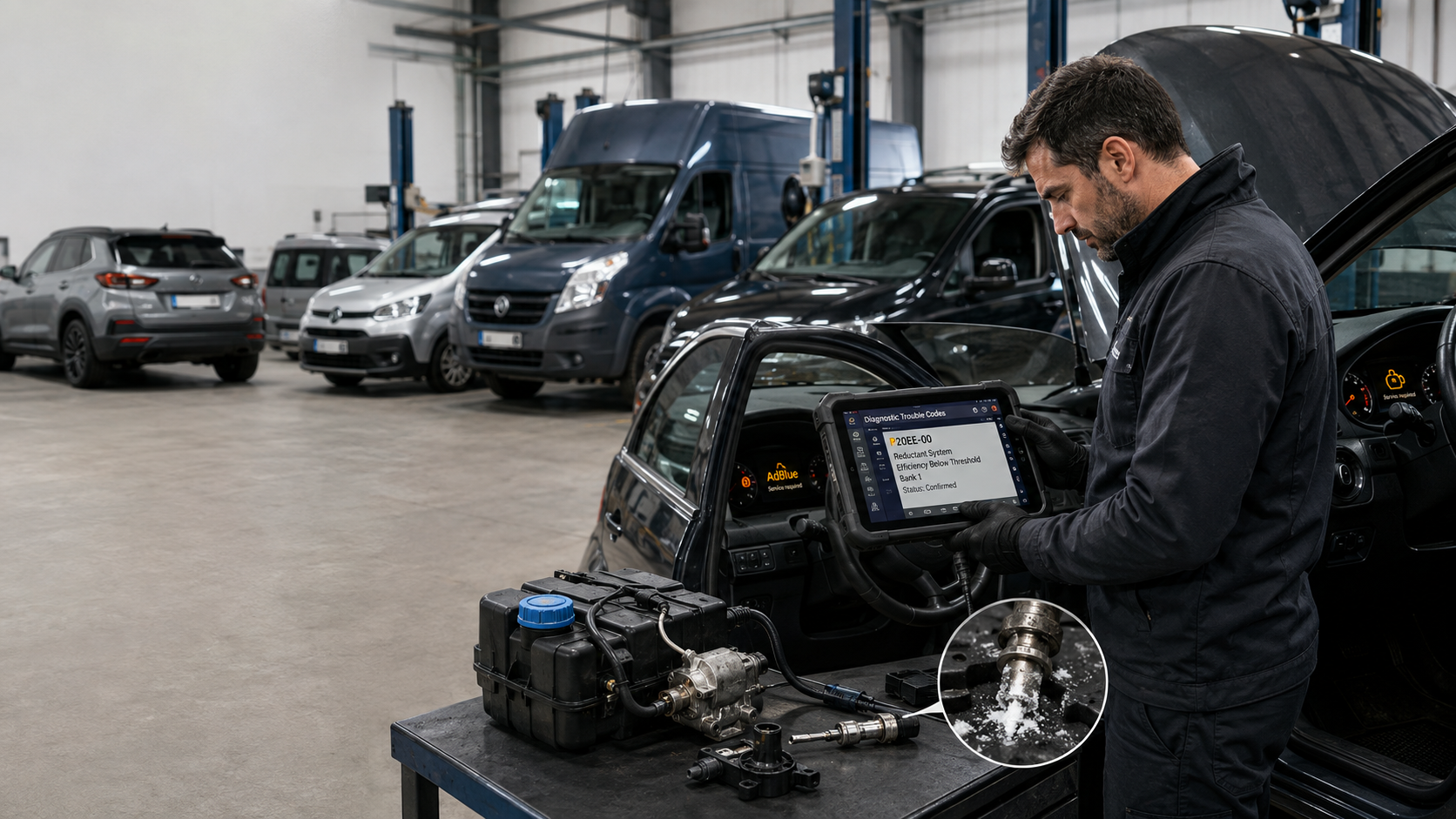
Do AdBlue problems vary between manufacturers? Yes, quite a bit. Every SCR system does the same core job injecting AdBlue into the exhaust to cut nitrogen oxide emissions but the warning messages, the parts most likely to fail, and how the ECU handles a fault differ from brand to brand. A Peugeot dashboard message won’t necessarily match what a Mercedes shows for the same underlying issue, and the components that tend to cause trouble aren’t identical across manufacturers either.
That matters if you’re currently staring at a countdown or a limp-mode warning trying to work out what’s actually going on. This guide runs through the common patterns manufacturer by manufacturer, explains what’s usually behind them, and covers the options repair or a permanent ECU-level fix once you know what you’re dealing with.
Do AdBlue Problems Vary by the Manufacturer?
The core SCR technology is broadly similar, but warning messages, common failure points and how the ECU responds to a fault differ by manufacturer and model generation. Peugeot and Citroën often behave similarly, sharing a platform, while Mercedes and Ford run different system layouts with their own typical fault patterns and thresholds.
AdBlue Problems on Peugeot
Peugeot diesels the 3008, 5008, 308 and various van models give a countdown warning once AdBlue drops below a threshold. Straightforward enough. It gets more complicated when the warning sticks around after a top-up, which usually means something else is going on.
Common causes include a faulty NOx sensor, an AdBlue pump or tank sender issue, and crystallised fluid in the lines or injector more likely if the vehicle’s sat unused for a while or the tank’s previously run dry. Depending on the model and engine, the exact wording can vary, so “AdBlue system fault” and “add AdBlue soon” aren’t necessarily the same level of urgency.
A genuine low-level warning clears with a top-up. A sensor or pump fault won’t, and if the message keeps returning, that’s the point to get the fault codes read rather than keep adding fluid.
AdBlue Problems on Citroën
Citroën shares much of its underlying engineering with Peugeot both sit under Stellantis so symptoms on the C4, C5 Aircross, Berlingo and related vans often look similar. Warning behaviour and common fault points tend to overlap closely.
That said, model year and engine variant still affect which SCR generation is fitted, so don’t assume every Citroën behaves identically. Typical issues: tank or pump faults, NOx sensor problems, crystallised fluid blocking the injector line. As with Peugeot, topping up when the actual fault is a sensor or delivery problem won’t hold the warning comes back, sometimes within days.
AdBlue Problems on Ford
Ford’s diesel range Transit, Ranger, and older Focus and Mondeo diesels have run AdBlue/SCR for years. Ford’s warnings are reasonably direct, but it’s still worth separating a genuine low-fluid alert from a system fault message, because they’re not the same thing.
A low-fluid warning clears with a top-up. A system fault can stem from a NOx sensor reading outside expected range, an injector not delivering fluid properly, or a pump losing pressure. On Transit vans especially, which rack up higher mileage under harder use, sensor and pump wear tends to show up more often than on lighter-use cars.
AdBlue Problems on Mercedes-Benz
Mercedes is where diagnostics get more involved. On models like the C-Class, E-Class, Sprinter and Vito, the AdBlue system sits more tightly integrated with the wider engine management software than on some other brands, and getting the full picture usually needs manufacturer-level diagnostic access rather than a generic scan.
Warnings typically escalate in stages with an early alert, a countdown, then a starting restriction if left but exact thresholds vary by model and generation. NOx sensor faults come up repeatedly here too, alongside pump and heater circuit issues. Given the added complexity, this is a brand where proper diagnostics matter more than most before deciding what to do next.
AdBlue Problems on Vauxhall
Vauxhall diesels, including the Insignia, Astra and Vivaro, run fairly typical countdown-style AdBlue warnings, escalating toward a starting restriction if ignored.
Beyond low fluid, the pattern’s familiar: NOx sensor faults, tank sender or pump issues, occasional crystallisation after periods of inactivity. Newer Vauxhalls share engineering with Peugeot and Citroën under Stellantis, though older models predate that relationship and can behave differently.
AdBlue Problems on DS Automobiles
DS Automobiles, as a premium PSA/Stellantis offshoot, shares much of its AdBlue/SCR architecture with Peugeot and Citroën. Models like the DS 7 Crossback follow a similar warning and countdown structure.
DS is a lower-volume brand in the UK, which can make it harder to find someone locally who’s dealt with the specific fault before another reason proper diagnosis matters rather than guessing based on a more common model.
AdBlue Problems on Renault
Renault diesels Kadjar, Megane, Master vans use AdBlue/SCR with the usual countdown pattern. Renault’s messaging can be less explicit than some brands about distinguishing low fluid from an actual fault, which catches owners out: they top up, the light stays on, and they’re not sure why.
If that’s happened, look at a NOx sensor issue, an injector or pump fault, or a stored fault code that a top-up was never going to clear.
AdBlue Problems on Nissan
Nissan’s AdBlue-equipped diesels, including certain Qashqai, X-Trail and NV300/NV400 variants, follow a broadly similar warning structure: low fluid, escalating countdown, then restricted starting. Nissan’s SCR uptake came later and was more limited than brands like Peugeot or Ford, so genuine system faults get discussed less often, but they do happen.
When a fault does show up, it lines up with the wider pattern: sensor faults, delivery issues, or occasionally contaminated fluid.
AdBlue Problems on Volkswagen
VW’s diesel range Golf, Passat, Tiguan, Transporter, Crafter has run AdBlue/SCR for years, and shared platforms mean similar systems turn up across Audi, SEAT and Škoda too. Warnings follow the standard escalation.
NOx sensor faults and pump issues come up often, and crystallisation can be a factor on vehicles doing a lot of short journeys. What applies to an older Golf doesn’t automatically apply to a newer model the SCR generation fitted can differ.
Common AdBlue Problems by Manufacturer
| Manufacturer | Typical Warning/Symptom | Possible Cause | What the Driver Should Do |
| Peugeot | Countdown persists after top-up | NOx sensor, pump, crystallisation | Get fault codes read before assuming |
| Citroën | Similar to Peugeot, shared platform | Tank/pump fault, sensor issue | Diagnose rather than keep topping up |
| Ford | Escalating warning, especially on Transit | Injector, pump, sensor wear | Check for mileage-related wear |
| Mercedes | Layered warning sequence | Integrated system fault, sensor | Use manufacturer-level diagnostics |
| Vauxhall | Standard countdown pattern | Sensor, tank sender, crystallisation | Confirm fault codes first |
| DS Automobiles | Similar to Peugeot/Citroën | Shared PSA-group faults | Get diagnosed by someone who knows the platform |
| Renault | Ambiguous low-fluid vs fault messaging | Sensor, injector, stored fault code | Don’t rely on repeated top-ups |
| Nissan | Less frequent but similar pattern | Sensor, delivery fault, contamination | Diagnose rather than assume it’s rare |
| Volkswagen | Standard escalation across group models | NOx sensor, pump, crystallisation | Check which SCR generation is fitted |
Treat this as a general guide, not a guarantee the same message on two vehicles from the same manufacturer can have different causes depending on age and engine.
Is It Just Low AdBlue or Is There a Fault?
Topped up and the warning’s gone? That was a genuine low-fluid alert. Still there, or back within a short distance? You’re dealing with something else:
- Low AdBlue level — resolved by topping up, nothing more.
- Contaminated or poor-quality fluid — non-standard AdBlue or fluid stored incorrectly can trigger faults even at correct levels.
- Pump fault — struggling to maintain pressure or deliver fluid correctly.
- Injector problem — fluid not being injected as expected.
- NOx sensor fault — the most common cause across every manufacturer above.
- SCR efficiency fault — the system isn’t reducing emissions effectively, even when components test fine individually.
- Wiring or electrical fault — corrosion or damage, more common on older or high-mileage vehicles.
- ECU/software issue — less common, but a stored fault or glitch can cause a false warning.
- Crystallisation — solidified AdBlue blocking lines, usually from inactivity or a tank run dry.
What Does the AdBlue Countdown Mean?
The countdown tells you how much distance or how many starts remain before the vehicle restricts starting entirely as a built-in emissions safeguard, not a fault by itself.
The wording varies. “Add AdBlue” means exactly that. “AdBlue system fault” or “emissions fault” points to something beyond fluid level. “Starting impossible in X miles” is the final warning, and once it hits zero, the vehicle typically won’t restart until it’s addressed. Don’t leave it that late, sorting it before the vehicle’s stuck is always the easier route.
How Are AdBlue Problems Diagnosed?
- Read the stored fault codes — see what the ECU’s actually flagged (codes like P20E8, P204F or P229F point to specific parts of the system).
- Identify which part of the system the fault relates to — SCR efficiency, NOx sensor, delivery, or wiring.
- Check the relevant components directly — live sensor data, pump pressure, injector function — rather than assuming from the code alone.
- Test before replacing. A NOx sensor code doesn’t always mean the sensor’s actually failed; a connector or wiring fault can throw the same code.
- Address the actual cause, not just clear the warning — clearing a code without fixing what triggered it means it comes straight back.
A generic OBD scan pulls basic codes on most vehicles but won’t always give the full picture — particularly on brands like Mercedes, where the system’s more tightly woven into other vehicle electronics.
Can You Still Drive With an AdBlue Warning?
In the early stages low fluid or the start of a countdown yes, though topping up soon is sensible. Once it shifts to a fault message or the countdown’s close to zero, treat it as urgent. Keep driving past that point and the vehicle will restrict starting, usually at the worst possible time.
There’s no single mileage figure that applies across every manufacturer, so go by what your own dashboard’s telling you.
I Added AdBlue but the Warning Is Still There — What Now?
One of the most common situations drivers hit. Usually means:
- The fault isn’t caused by low fluid at all
- A fault code is stored and hasn’t cleared on its own
- There’s a sensor, pump, injector or NOx sensor issue
- The AdBlue itself is contaminated
- There’s a wiring or electrical fault somewhere in the system
The next step is getting the actual fault codes read not adding more fluid that clearly isn’t the problem.
How Are AdBlue Problems Fixed?
Correct diagnosis comes first, always identifying exactly which component or circuit is causing the fault before any work starts. From there, there are two broad routes.
Repair means fixing the failed part directly a pump, injector, heater circuit or tank sensor while the SCR system stays active and doing its job. This is the option that keeps the emissions system fully functioning as designed.
Removal, delete or bypass works differently: it’s a software-level change at the ECU that removes the failing strategy causing the fault, rather than replacing the part that keeps triggering it. This is the route FixAdBlue specialises in reprogramming the ECU so the countdown, limp mode and recurring warnings stop, without needing to keep replacing sensors or pumps that fail again down the line.
It’s worth being upfront about what this involves: disabling or removing SCR monitoring changes how the vehicle’s emissions system operates for road use, and that has legal and emissions implications depending on how and where the vehicle’s driven. Anyone offering this work should be able to explain that clearly rather than presenting it as a routine repair with no trade-offs.
AdBlue Problems in the UK: What Drivers Should Know
AdBlue/SCR systems exist to meet emissions standards, and how they’re functioning has a bearing on MOT and legal road use, since emissions testing is part of the MOT process. Whether you go down the repair route or a software-level fix, get the vehicle properly diagnosed first — replacing a NOx sensor or pump on a guess, when the actual fault is something else entirely, wastes money.
This matters even more for fleet and commercial operators, where a van sat waiting for a garage slot or a part to arrive is losing money every day it’s off the road.
Need Help With an AdBlue Fault?
If you’re dealing with a countdown that won’t clear, a warning that’s come back after topping up, or a van that’s dropped into limp mode, FixAdBlue’s mobile engineers come to you anywhere across the UK home, work, or roadside and diagnose the actual cause before recommending anything. Every job’s backed by a lifetime warranty, with same-day callout usually available if you book before midday.
To get a fast, accurate quote, have this ready:
- Vehicle make and model
- Engine and year
- The exact warning message or countdown reading
- Fault code, if you’ve already had one read
- Your postcode
Whether it turns out to be a straightforward AdBlue repair, a NOx sensor fault, or something better solved with a permanent AdBlue delete, get in touch and we’ll talk you through the options honestly before any work starts.
Frequently Asked Questions
Clear answers to common questions about AdBlue warnings, SCR faults, NOx sensors, diagnostics and repairs.
If the warning persists after topping up, the cause usually isn’t fluid level. Common reasons include a NOx sensor fault, a pump or injector problem, or a stored fault code that needs addressing at the source rather than a fluid top-up.
Yes. NOx sensors monitor emissions before and after the catalyst, and a faulty reading can trigger an AdBlue or SCR warning even with normal fluid levels. It’s one of the most common fault points across different manufacturers.
It means the vehicle has detected a problem beyond simple low fluid, potentially a sensor, pump, injector or wiring issue. This needs proper diagnosis rather than another fluid top-up.
It depends on the stage of the warning. Early alerts may allow continued driving, but as the countdown progresses toward a starting restriction, the available window narrows. Follow your dashboard’s specific guidance rather than assuming a fixed distance.
An AdBlue countdown indicates how much distance or how many starts remain before the vehicle restricts starting. It can be triggered by low fluid or an unresolved SCR fault and is a built-in safeguard rather than a random glitch.
Yes. Crystallised AdBlue can restrict injector lines or parts of the tank system, particularly on vehicles that have sat unused or previously run the tank very low. This can trigger warnings even after fresh AdBlue has been added.
Not significantly on many newer models, since Peugeot and Citroën share much of the same Stellantis platform and SCR architecture. However, older models and different engine variants can still behave differently and may require model-specific diagnostics.
It depends entirely on what’s actually wrong. A sensor fault can cost far less to repair than a pump or injector replacement. Ford Transit vans can also experience component wear depending on mileage, usage and operating conditions.
This generally indicates that the AdBlue countdown has reached its limit and the vehicle is preventing a restart until the underlying issue is addressed. Mercedes-specific diagnostics are usually needed to identify the actual cause.
Yes. Once the countdown reaches its limit, many manufacturers can restrict the vehicle from starting as part of the SCR system’s built-in safeguard. The exact warning stages and thresholds vary between makes and models.
It can clear a genuine low-fluid warning, but it won’t fix a sensor, pump, injector or wiring fault. If the warning returns quickly after topping up, that usually points to an underlying system fault that needs diagnosis.
A proper diagnostic scan can identify stored fault codes and help point toward the affected component. However, a basic generic OBD scan may not capture the complete picture on more complex SCR systems, so manufacturer-level diagnostics can sometimes be necessary.
No. Replacing parts before confirming the fault can mean paying for a component that wasn’t actually responsible. A proper diagnosis should be carried out first so the sensor, pump, injector, tank or wiring issue can be identified accurately.
Yes. Because the AdBlue/SCR system is responsible for reducing NOx emissions, an underlying fault can trigger a broader emissions warning alongside an AdBlue-specific message.
Get professional diagnostics as soon as a warning persists after a top-up, returns repeatedly, or escalates toward a starting restriction. Earlier diagnosis can help identify a simpler fault before the vehicle becomes immobilised.
Still got a question about your vehicle? Ask a technician directly.
Contact Us →
6 Comments
[…] have a page on BMW systems. For the bigger picture, our guides on AdBlue problems explained and AdBlue problems by manufacturer show how common this kind of fault is across the market, and our system fault guide explains the […]
[…] This isn’t usually an expensive repair on its own, but it’s one that gets missed by generalist garages because the symptoms so closely resemble a genuine AdBlue system fault. That’s often how drivers end up replacing a perfectly good sensor when the actual issue was a corroded £20 connector. For a broader look at how different faults present, see AdBlue problems explained and AdBlue problems by manufacturer. […]
[…] a broader view across other manufacturers, our guide on AdBlue problems by manufacturer is worth a look, and our general explainer on AdBlue problems explained covers the basics. If […]
[…] and the Vauxhall Combo, and owners of those see very similar AdBlue behaviour. Our guide to AdBlue problems by manufacturer compares Peugeot, Citroën, Ford, Mercedes and more. Running a mixed fleet? We’ve written up […]
[…] can see a full breakdown of AdBlue problems by manufacturer including which faults are most common on specific […]
[…] a broader view across different manufacturers, not just Land Rover, our guide on AdBlue problems by manufacturer is worth a look, and our general explainer on AdBlue problems explained covers the basics if […]