
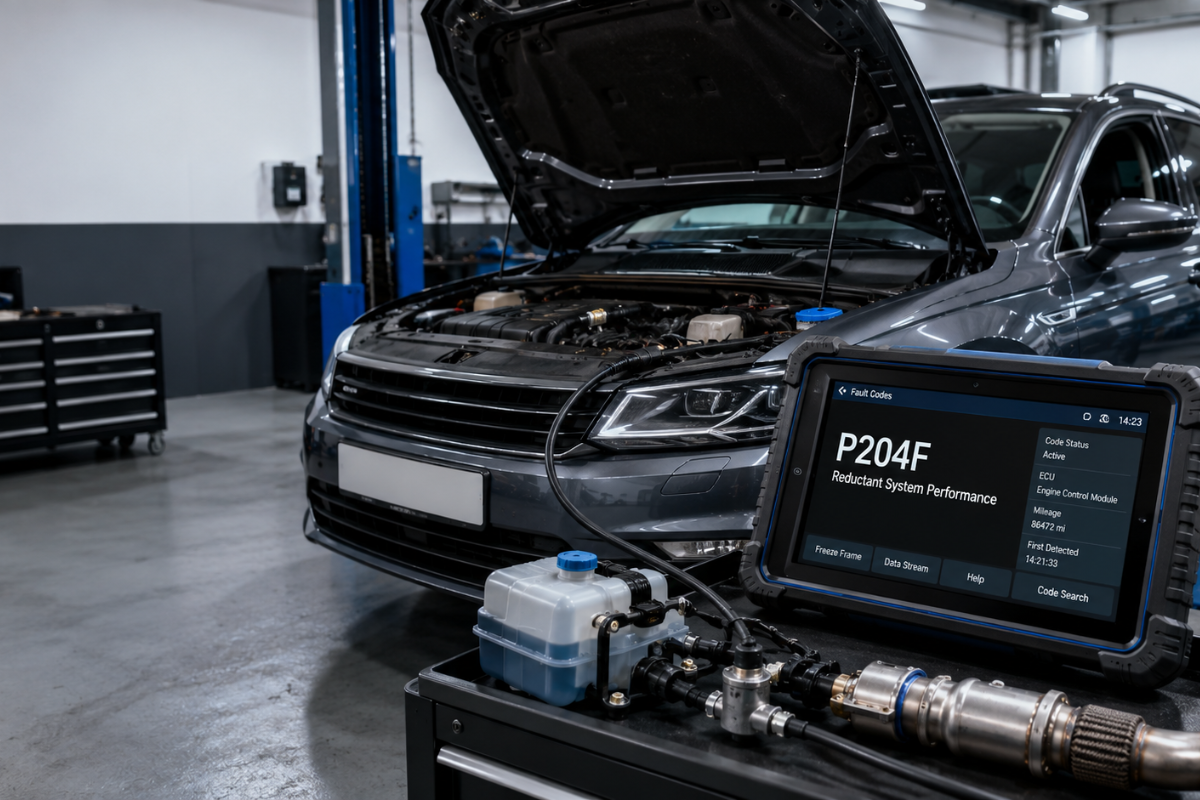
Seeing P204F on a scanner doesn’t tell you much about what needs fixing. It’s a reductant system performance code, which is a fancy way of saying the AdBlue side of your SCR system isn’t doing what the engine computer expects without saying why. That’s the frustrating bit. The code confirms something’s wrong; it doesn’t point at the pump, the injector, a sensor, or anything else specifically.
For anyone driving a diesel around London, this fault turns up more often than it probably should. Stop-start traffic, short cold journeys, and the daily grind through ULEZ zones all put extra strain on AdBlue components, and P204F is one of the more common results. Below is what the code means, what tends to cause it, how a proper diagnosis works, and what to check yourself before you spend money on parts.
What Does P204F Actually Mean?
P204F stands for Reductant System Performance. It’s a generic OBD-II code, which means the ECU has decided the AdBlue (also called DEF diesel exhaust fluid) dosing system isn’t behaving the way its internal model says it should.
Here’s the short version of how the system’s meant to work: AdBlue gets injected into the exhaust stream just ahead of the SCR catalyst, where it reacts with NOx and turns it into nitrogen and water vapour. For the ECU to be satisfied that’s happening properly, a few things need to line up: the pump has to build the right pressure, the injector has to dose the correct amount, and the NOx sensors on either side of the catalyst need to confirm the reaction’s actually taking place.
P204F sits at system level, not component level. It fires when that overall performance drifts outside what’s expected, which is precisely why the code alone won’t tell you if it’s the pump, the injector, a sensor, some wiring, or the catalyst itself. Two vehicles can throw the exact same code and need completely different repairs.
Symptoms Worth Paying Attention To
What you’ll actually notice depends a lot on the manufacturer, but the usual suspects are:
- An AdBlue or SCR warning light on the dash
- A general engine or emissions light showing up alongside it
- A countdown message warning that the engine won’t restart after a set number of miles
- Reduced power, or the vehicle dropping into limp mode
- The warning coming straight back after you’ve cleared it
- Other AdBlue-related codes stored next to P204F pressure, quality, or NOx sensor codes are the common companions
Some vehicles give you a fair bit of warning before anything serious happens. Others move to limp mode fairly quickly. If you’re seeing any combination of the above, it’s worth booking a proper scan rather than hoping it sorts itself out.
What’s Actually Causing It
Because P204F is a performance code and not a “this part has failed” code, several different faults can trigger it. The list below covers what’s typically responsible; it’s not a case of picking whichever sounds most likely and ordering the part.
The pump. It has to build and hold consistent pressure. One that’s under-pressuring, or losing pressure intermittently under load, is one of the most common contributors to this fault.
A blocked or crystallised injector. AdBlue crystallises when it dries out or gets exposed to heat, and it happens more on vehicles doing lots of short, stop-start journeys which describes a fair chunk of London driving. A partially blocked injector can’t dose accurately, and that throws the whole system’s readings off.
Blocked lines or filters. Crystallised urea or debris restricting flow between the tank and injector produces symptoms that look identical to a pump fault, even though the pump’s working perfectly well.
Poor-quality or contaminated fluid. AdBlue that’s been diluted or doesn’t meet ISO 22241 standards throws off the dosing calculations. It’s one of the easier things to rule out early.
A faulty NOx sensor. The system compares readings from before and after the catalyst to confirm dosing’s actually working. If a sensor’s reading is wrong, the ECU can log it as a reductant performance issue even though the pump and injector are fine.
Wiring or electrical faults. Corrosion or a poor connection at a sensor or pump connector feeds the ECU bad data, and that produces symptoms that look mechanical even when they’re not.
SCR catalyst problems. Less common, but a degraded or contaminated catalyst can stop NOx conversion happening properly even when dosing itself is spot on.
Software or adaptation issues. If a part’s been replaced recently without the correct reset or adaptation carried out afterwards, the ECU can keep logging a fault even though the physical component is fine.
How a Proper Diagnosis Actually Works
A decent diagnosis doesn’t start by guessing from the code description. It works through the system:
- Full scan across the vehicle’s ECUs
- Check stored and pending codes, not just the active one
- Pull freeze-frame data to see the conditions when the fault logged
- Look for related AdBlue/SCR codes sitting alongside P204F
- Check AdBlue level and fluid quality
- Test the pump under load
- Check injector dosing accuracy
- Inspect for crystallisation around the injector, lines and heater
- Compare live data from both NOx sensors
- Inspect wiring and connectors
- Test the wider SCR system
- Run adaptation or reset procedures if a part’s already been swapped
The bit worth remembering here: a fault code tells you which system has a problem, not which part caused it. Skipping straight to a pump or sensor replacement without confirming that against live data is exactly how faults come back within a fortnight.
What You Can Check Yourself
A few things any driver can look at before booking anyone:
- Confirm the tank’s actually full sounds obvious, but it’s the first thing to rule out
- Check for leaks around the tank, filler neck, or lines
- Look for white, crusty buildup around the filler cap
- Note exactly what the dashboard’s showing, including any countdown wording
- Check whether other codes have appeared alongside P204F
Beyond that, you’re into territory that needs proper equipment. Pressure-testing a pump or comparing NOx sensor data isn’t something you can do reliably with a basic reader, and there’s not much point guessing at mechanical work on the SCR system without that confirmation first.
How P204F Gets Fixed
There’s no single fix here; it comes down to what the diagnosis actually confirms.
| Confirmed problem | Typical repair |
| AdBlue pump fault | Repair or replacement, once confirmed |
| Blocked injector | Cleaning or replacement |
| Blocked lines | Clearing crystallisation, or line repair |
| Contaminated fluid | Drain and refill with compliant AdBlue |
| NOx sensor fault | Replacement after live-data confirmation |
| Wiring fault | Wiring or connector repair |
| Catalyst problem | Further testing, replacement if confirmed |
Fitting an expensive part on the strength of what the code description implies, without checking it against live data first, is probably the single most common way people end up paying twice.
Clearing the Code Doesn’t Fix the Fault
Clearing a stored code wipes it from the ECU’s memory. That’s all it does. It doesn’t touch whatever caused it in the first place so if the pump, injector, sensor or wiring is still off, the same fault tends to log again within a few drive cycles, sometimes sooner.
Same story with a no-start countdown. Resetting it buys you a bit of time. It doesn’t make the underlying cause disappear, and the countdown usually comes back.
Can You Still Drive the Vehicle?
Depends entirely on the vehicle, so treat any blanket answer with a bit of caution. Some cars carry on running with just a warning light for a while. Others move into limp mode fairly quickly. Some display a countdown to a full no-start.
Because manufacturers handle this so differently, it’s not worth assuming your vehicle falls into the “it’ll be fine for now” category. Get it scanned and find out which situation you’re actually in.
P204F Compared With Other Reductant Codes
A handful of codes look similar on a scanner but point at different things:
| Code | General description |
| P204F | Reductant System Performance |
| P20E8 | Reductant Pressure Too Low |
| P20EE | SCR NOx Catalyst Efficiency Below Threshold |
| P207F | Reductant Quality / Performance |
| P2047 | Reductant Injector Circuit Low |
Descriptions shift slightly between manufacturers and diagnostic tools. If your scan pulled up more than one of these together, mention that when you book a diagnosis it’s genuinely useful information rather than just noise.
Why the No-Start Countdown Exists
Manufacturers build in a warning period before an unresolved AdBlue fault stops the engine restarting. It’s a regulatory requirement, essentially diesel vehicles are meant to actively discourage drivers from running around indefinitely with a broken emissions system rather than just flashing a light forever.
If you’re seeing a countdown alongside P204F, don’t just top up the tank and hope. That only helps if low fluid was ever actually the cause. If it’s a pump, injector, sensor, or wiring fault behind it, clearing the countdown without fixing that just delays the same problem.
Getting P204F Looked At in London
London’s driving conditions are genuinely harder on AdBlue systems than most of the country. Constant stop-start traffic, frequent cold starts, and high daily mileage for taxis, vans and fleet vehicles all push dosing components and NOx sensors harder than steady motorway miles would. It’s also worth knowing that a malfunctioning SCR system can affect a vehicle’s Euro 6 compliance relevant if you’re driving through the ULEZ zone regularly.
FixAdBlue’s London coverage is mobile, so a technician comes to your postcode rather than the other way round — home, work, or roadside, across Central, North, South, East and West London, with same-day appointments often available depending on when you book. The diagnostic happens on-site, and it’s done properly against live data before anything’s quoted, rather than working backwards from what the fault code says.
For anyone just outside Greater London, AdBlue removal in Croydon, AdBlue removal in Reading and AdBlue removal in Guildford fall under the same South East England coverage.
FixAdBlue’s mobile technicians also work further afield, and the same diagnose-first approach to a fault like P204F applies wherever you’re based:
- South East England: Croydon, Reading, Guildford, Market Deeping
- Midlands: Birmingham, Coventry, Derby, Leicester, Nottingham, Grantham
- Yorkshire: Leeds, Sheffield, York
- Scotland: Edinburgh, Glasgow
- Also covered: Peterborough, Spalding, Stamford
The full list of areas is on the locations page if your town isn’t named above.
Which FixAdBlue Service Actually Applies
Once a P204F fault’s been properly diagnosed, which service is relevant depends entirely on what’s actually confirmed:
If it’s a specific component that’s failed pump, injector, heater, wiring, AdBlue Repair covers component-level repair once that’s confirmed against live data, rather than a blanket parts swap.
If you’re still at the “warning light’s on and I don’t know why” stage, AdBlue Fix covers mobile, same-day diagnosis carried out on-site.
Where the issue traces back to sensor readings specifically rather than the dosing hardware, NOx Sensor Services is the relevant one.
For dosing faults that keep recurring on an older vehicle, AdBlue Bypass offers a reversible option without a full strip-down.
Where repair genuinely isn’t economical, AdBlue Delete and AdBlue Removal are the software-based or component-level alternatives worth noting that FixAdBlue’s own service pages describe this route as intended for off-road and specialist vehicles, with the legal position discussed with the customer before anything’s booked.
Keeping It From Happening Again
A few habits that genuinely reduce how often this comes up:
- Stick to AdBlue that meets ISO 22241 quality standards unbranded or diluted fluid isn’t worth the saving
- Check the filler cap area occasionally for crystallisation
- Don’t sit on an AdBlue warning hoping it clears itself
- Check for leaks periodically, especially on higher-mileage vehicles
- Follow the manufacturer’s service schedule for the SCR system
- If a fault keeps coming back after clearing it, get it diagnosed properly rather than resetting it again
P204F AdBlue fault questions, answered straight
The questions drivers actually ask when a P204F fault appears — no jargon, no sales pitch.
It means the ECU has detected that the AdBlue/SCR system isn’t performing within expected limits. It’s a system-level code, so on its own it won’t tell you whether the pump, injector, a sensor or the wiring is responsible.
It’s worth acting on rather than ignoring. Left alone, it can lead to reduced power, limp mode, or eventually a no-start countdown. The cause is usually straightforward to pin down once the system is properly diagnosed.
Most often, the cause is a faulty pump, a blocked or crystallised injector, blocked lines, contaminated AdBlue, a faulty NOx sensor, or a wiring issue. Occasionally, the catalyst itself can be involved. Which one applies needs confirming rather than guessing.
Low fluid tends to trigger different warnings, but poor-quality or contaminated AdBlue can affect dosing accuracy and contribute to this fault. It’s worth checking the fluid level and quality early regardless.
Yes. A pump that isn’t holding the correct pressure is one of the more common causes, although it needs a pressure test to confirm rather than assuming from the fault code alone.
Yes. Crystallisation can block the injector and stop accurate AdBlue dosing, which can cause the ECU to log a performance fault. It can be particularly troublesome on vehicles that spend a lot of time doing short journeys.
Yes. If either NOx sensor is giving an incorrect reading, the ECU can interpret that as the reductant system underperforming even when the dosing hardware itself is working correctly.
Only if low or poor-quality fluid was actually the cause. If the problem is the pump, injector, sensor or wiring, topping up the tank won’t fix it and the warning will likely return.
The stored code can be wiped, but that doesn’t change whatever caused it. If the underlying issue is still there, expect the same fault to log again.
It depends on the vehicle. Some carry on with just a warning for a while, while others can enter limp mode or start a countdown fairly quickly. Don’t assume it’s safe to ignore — get the vehicle scanned and the cause checked.
Yes, on vehicles built with that safeguard. If the fault isn’t resolved within the allowed period, the engine can refuse to restart once the vehicle has been switched off.
It starts with a full scan and a check of stored and related fault codes. The pump, injector, NOx sensors, wiring and other relevant components can then be tested against live data rather than assuming the fault from the code description alone.
Still got a question about your vehicle? Ask a technician directly.
Contact Us →
8 Comments
[…] properly controlled, and the ECU starts logging efficiency faults. You might see a code like P204F, which points at reduced SCR […]
[…] codes and dosing performance codes describe what the system measured and nothing more. P204F is a good example. It turns up on cars with a perfectly healthy pump, because poor dosing can start […]
[…] knowing P204F specifically, which often points to dosing performance problems that an air lock can easily cause […]
[…] guide on the P204F AdBlue fault code covers a closely related injector circuit code if that’s what’s actually showing on […]
[…] P204F AdBlue fault code explained […]
[…] relates to the no-start condition once the countdown’s expired. Our dedicated guide on the P204F AdBlue fault code breaks down what that one means in more detail if it’s what you’re […]
[…] one of the most common AdBlue codes across all manufacturers, our dedicated guide on the P204F AdBlue fault code covers exactly what it means and how it’s typically resolved. Send us whatever code is […]
[…] P20EE, P204F […]