
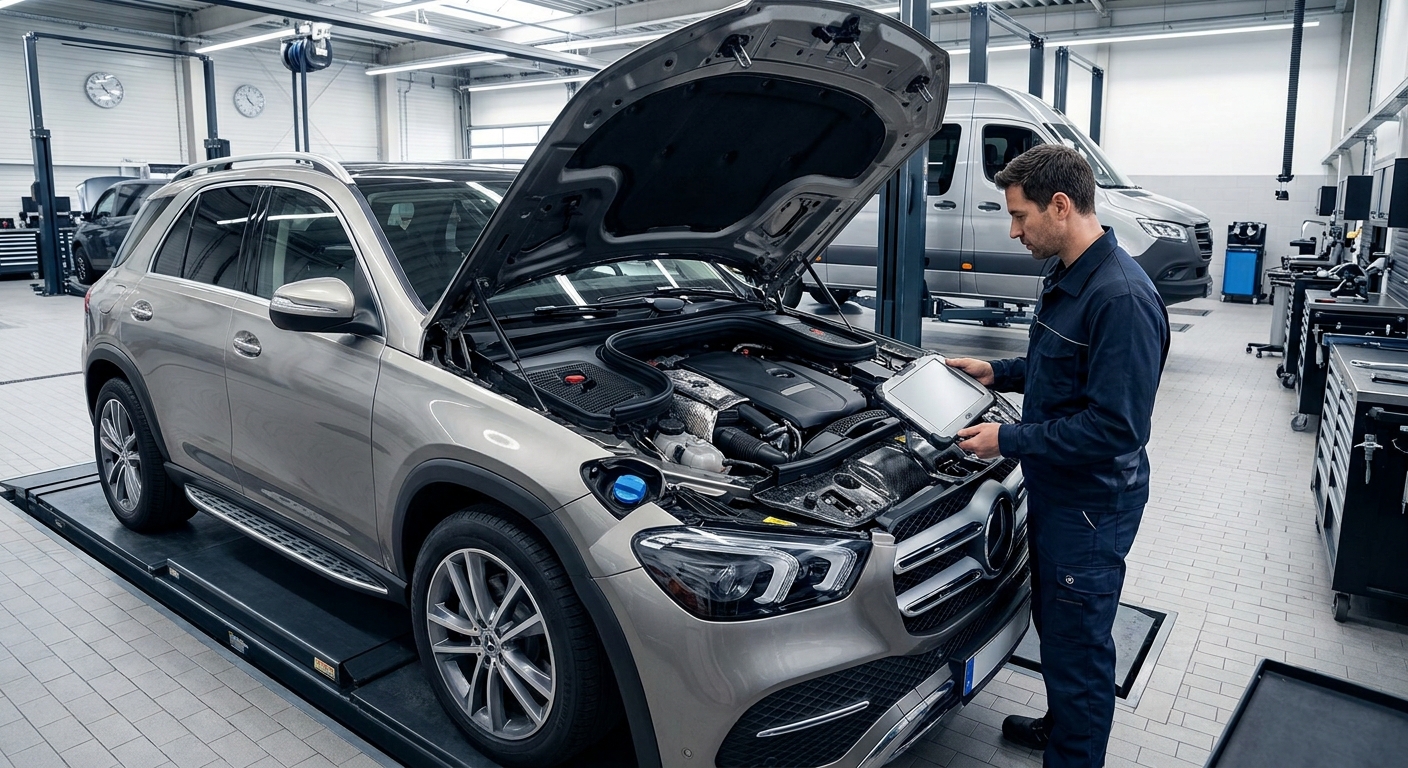
A Mercedes AdBlue system fault means the engine management system has detected a problem within the SCR (Selective Catalytic Reduction) emissions system and the vehicle will count down to a no-restart lockout if the fault is not resolved. Mercedes diesel vehicles fitted with AdBlue are among the most strict in how they enforce SCR compliance: once the countdown starts, the only way out is to fix or bypass the fault. Basic code readers might clear the warning temporarily, but the system will bring it back if the fault is still present. This guide covers the most common causes of Mercedes AdBlue system faults, the fault codes associated with each, realistic repair costs in the UK, and when repair is the right call versus a software delete.
Why Mercedes AdBlue Faults Are Particularly Unforgiving
All modern diesel vehicles with AdBlue systems will eventually develop fault-related warnings. Mercedes vehicles including the C-Class, E-Class, S-Class, GLC, Sprinter, and Vito have a reputation among independent specialists for being particularly strict in how the SCR system interacts with the ECU.
The “AdBlue: starts not possible in X miles” countdown is triggered when the engine management system detects a fault in the SCR system not simply when AdBlue is low.
This distinction matters. On many vehicles, a persistent AdBlue warning eventually prompts a countdown. On Mercedes, the countdown can begin from a single confirmed system fault, regardless of the fluid level. This is why drivers with Mercedes AdBlue faults often feel their situation escalated faster than expected the system is designed to enforce compliance aggressively.
Do not attempt to clear the fault code with a generic OBD2 scanner the SCR system requires Xentry (Mercedes’ own diagnostic system) to reset properly and will simply trigger the countdown again if the underlying fault is not fixed.
This is one of the most important practical points for Mercedes owners: clearing the code without fixing the fault does not resolve the countdown, and resets applied with generic tools are often ineffective or incomplete.
The Most Common Mercedes AdBlue System Faults
1. AdBlue Pump Failure
The AdBlue pump is the most commonly failing component across the Mercedes diesel range, particularly on high-mileage Sprinters and Vito vans.
Why it fails: Pumps typically fail after 80,000–120,000 miles. AdBlue crystallises in winter, damaging pump internals. Electrical issues prevent pump activation. Contaminated AdBlue damages pump seals.
Symptoms: No-start countdown warnings. Limp mode triggered under load. Warning lights appear with codes like P204F or P20E8. Symptoms include no-start countdown warnings, increased AdBlue usage without explanation, and limp mode triggered under load.
Repair cost: Dealer replacement costs are often £1,000–£1,400. Mercedes and BMW are more expensive £500–£800 for an independent specialist. Where the pump module is integrated with the tank, heater, and level sensor, replacement involves the full assembly rather than the pump alone.
Important diagnostic note: P20EE means “SCR catalyst efficiency below threshold” but the cause could be a failed downstream NOx sensor giving inaccurate readings, an underperforming AdBlue injector, or an underperforming pump. If you replace the SCR catalyst the most expensive hardware fix and the real problem was a faulty NOx sensor, you’ve spent over £1,500 unnecessarily. Live data diagnosis before component replacement is essential.
2. NOx Sensor Failure
Mercedes diesel engines typically use two NOx sensors one upstream and one downstream of the SCR catalyst and both are a common failure point across the range.
Why it fails: NOx sensors are exposed to high exhaust temperatures and are a known wear component on high-mileage diesel vehicles. Connector corrosion and wiring faults are also common causes, particularly on older examples where the loom has aged.
Symptoms: AdBlue system fault warning. P2201 (upstream NOx sensor circuit) or P2202 (downstream NOx sensor circuit) fault codes. In some cases, the P20EE catalyst efficiency code caused by the sensor misreporting NOx levels rather than actual catalyst failure.
Repair cost: NOx sensor replacement (upstream or downstream): £200–£550 fitted. NOx sensors: £200–£400. Coding is required after replacement on Mercedes vehicles a step that requires Xentry or equivalent Mercedes-compatible software, not a generic reset tool.
Key insight: On Mercedes, a failing downstream NOx sensor is one of the most common causes of the P20EE catalyst efficiency code. Replacing the SCR catalyst based on a P20EE code without first confirming the NOx sensor is reading correctly is one of the most expensive diagnostic mistakes seen across the Mercedes diesel range.
3. AdBlue Tank Heater Failure
In cold UK winters, AdBlue can freeze. To prevent this, the system uses a heater inside the tank. When it fails, the van can’t dose properly and the ECU logs a fault.
Why it fails: The AdBlue tank heater failure is fundamentally a component quality issue it has no preventative maintenance. The heater element inside the tank fails electrically, producing a fault code that is often only triggered in cold weather which makes it harder to diagnose during warmer months.
Symptoms: AdBlue warning and countdown appearing primarily in cold weather or on cold starts. Diagnostic codes linked to heater resistance or circuit faults. The vehicle may perform normally in summer but trigger warnings consistently through winter.
Repair cost: Replacement heaters cost hundreds, and in some cases require a full tank swap. On many Mercedes models, the heater is integrated into the tank module assembly meaning the repair involves replacing the module rather than the heater element in isolation.
4. AdBlue Injector Fault or Crystallisation
The AdBlue injector sits in the exhaust stream and is exposed to significant heat between injection cycles. Residual fluid at the nozzle evaporates between injections, leaving crystallised urea deposits that gradually block the nozzle.
Why it fails: Crystallisation from repeated heating and cooling cycles. More common on vehicles doing predominantly short urban runs where the SCR system does not fully warm up and self-clean. AdBlue injector faults: £200–£350, and can often be cleaned rather than replaced.
Symptoms: P2047 or P204B fault codes (reductant injector circuit). P20EE may also appear if the injector under-delivery is reducing SCR efficiency below threshold.
Repair cost: AdBlue injector: £200–£350, can often be cleaned rather than replaced. Blocked lines: can usually be flushed rather than replaced, £100–£200. Professional cleaning with the correct chemical process and post-cleaning delivery rate testing is more cost-effective than replacement where the nozzle is intact. Our AdBlue crystallisation repair guide covers when cleaning is sufficient and when replacement is necessary.
5. SCR Catalyst Degradation
The SCR catalyst is the most expensive component in the AdBlue system and the least frequently the actual cause of the P20EE fault code despite P20EE being described as a “catalyst efficiency” code.
Why it fails: Genuine catalyst degradation on very high mileage vehicles. Contamination from incorrect or degraded AdBlue. Long-term under-delivery from a faulty injector or pump that has been present without resolution.
Symptoms: P20EE persisting after NOx sensor replacement and injector inspection. Live data showing inadequate NOx reduction across the catalyst despite confirmed injector delivery.
Repair cost: SCR catalyst replacement: £800–£1,500. This is the correct repair only when a proper live-data diagnostic has confirmed the catalyst has genuinely degraded not as a first-line response to a P20EE code. Given the cost, confirming catalyst failure rather than sensor misreporting is essential before authorising this repair.
6. AdBlue Quality Fault
Why it happens: Contaminated fluid, incorrect concentration, degraded fluid from improper storage, or contamination during top-up. Using ISO 22241 certified AdBlue from a reputable brand reduces but does not eliminate the risk of injector crystallisation.
Symptoms: P203A or P2BAD fault codes. Warning light that appeared after a top-up. The system may register the correct fluid level but flag the quality as out of specification.
Repair cost: Tank drain, flush, and refill with fresh, correct-specification AdBlue typically £80–£150 for the service. If the quality sensor itself has failed and is misreading correct fluid, sensor replacement is an additional cost.
Mercedes AdBlue Fault Codes Reference
| Fault code | Description | Most likely cause on Mercedes |
| P20EE | SCR catalyst efficiency below threshold | NOx sensor misreading, injector under-delivery, or genuine catalyst failure diagnose in that order |
| P2201 | NOx sensor circuit (upstream) | Upstream NOx sensor failure or connector corrosion |
| P2202 | NOx sensor circuit (downstream) | Downstream NOx sensor failure most common cause of P20EE on Mercedes |
| P204F | Reductant system performance | Pump under-delivery, often pump or module failure |
| P20E8 | SCR system specific Mercedes code | Pump or SCR circuit fault; requires Xentry for full diagnosis |
| P2047 / P204B | Reductant injector circuit | Injector crystallisation or electrical fault |
| P203A | Reductant quality performance | Contaminated or incorrect AdBlue fluid |
| P2BAD | Reductant quality below threshold | Diluted or contaminated fluid |
| P20BA / P20B9 | Reductant pump control circuit | Pump motor failure or wiring fault |
Mercedes Models Most Commonly Affected
AdBlue system faults occur across the full Mercedes diesel Euro 6 range, but certain models have higher fault rates due to operating profiles and component design:
Mercedes Sprinter: Euro 6 versions of the Sprinter are fitted with an AdBlue emissions system as standard, and as these vehicles age and mileages climb, AdBlue faults are becoming one of the most common issues reported by Sprinter owners. The Sprinter’s high mileage and often urban operating profile make pump, heater, and crystallisation faults particularly common.
Mercedes Vito: Similar fault profile to the Sprinter heater failures in winter and pump faults on high-mileage examples are the most common presentations.
Mercedes C-Class and E-Class diesel: NOx sensor faults and injector crystallisation are the most common presentations. The P20EE code caused by a failing downstream NOx sensor is a particularly frequent scenario on these models.
Mercedes GLC diesel: Similar fault patterns to the C-Class NOx sensor faults and occasional pump issues on higher mileage examples.
Mercedes S-Class diesel: Less common in the fault data, partly due to lower overall volumes and typically lower mileages but presents the same fault patterns when issues do occur.
Why Generic OBD Scanners Are Insufficient for Mercedes
This is one of the most important practical points for Mercedes AdBlue faults and worth repeating clearly.
Do not attempt to clear the fault code with a generic OBD2 scanner; the SCR system requires Xentry to reset properly and will simply trigger the countdown again if the underlying fault is not fixed.
Xentry is Mercedes’ own diagnostic software, and it accesses fault data, live sensor values, and reset functions that generic OBD tools cannot reach on Mercedes vehicles. A generic tool that shows a fault code and offers to clear it is not accessing the same depth of system data as Xentry or equivalent Mercedes-compatible professional diagnostic software.
This matters for two reasons:
Diagnosis accuracy: Live data from the AdBlue system actual NOx values, pump pressure readings, injector delivery rate, heater resistance is what distinguishes a faulty NOx sensor from a failed catalyst, or a pump fault from a wiring issue. Generic tools typically do not access this live data on Mercedes.
Effective reset: Even where the fault has been correctly identified and repaired, the Mercedes SCR system often requires a specific reset procedure via Xentry to clear the countdown and confirm the repair has been accepted by the ECU. A generic reset frequently fails to complete this procedure correctly.
We use professional Mercedes-compatible diagnostic equipment on every job not generic OBD tools and carry out the correct post-repair reset procedure before leaving.
Repair or Delete: The Decision for Mercedes Owners
The decision framework for Mercedes is the same as for any other make, but the cost of Mercedes-specific repairs at dealer rates makes the comparison particularly relevant.
Repair is the right call when:
- The fault is a first-time, isolated component failure a single NOx sensor or injector on a vehicle with reasonable remaining life
- The rest of the AdBlue system is confirmed healthy by live-data diagnosis
- The vehicle is under warranty or will be sold through a route where system integrity matters
Delete is worth considering when:
- The same fault has recurred after a previous repair
- Multiple fault codes are active simultaneously
- Dealer replacement costs are often £1,000–£1,400 that’s more than many owners want to pay for a van worth only a few thousand pounds
- The vehicle is a commercial Sprinter or Vito where downtime for repeat repairs is unacceptable
Our AdBlue delete vs repair guide covers the full decision framework including costs and legal considerations. Our pricing page sets out fixed costs for both services.
For information on what an AdBlue delete involves technically including what happens in the ECU and what it does and does not address see our how AdBlue delete works guide.
Our Mobile Service for Mercedes AdBlue Faults
We diagnose and repair Mercedes AdBlue system faults as a mobile service at your home, workplace, or roadside. No recovery, no dealer wait, no day off work for commercial operators.
Our service for Mercedes vehicles includes:
- Full diagnostic scan using Mercedes-compatible professional software
- Live data analysis actual NOx values, pump pressure, and sensor outputs
- Fault identification before any component is recommended for replacement
- Component repair or replacement where confirmed necessary
- AdBlue delete or urea delete where repair is not the right option
- Correct post-repair reset procedure to clear the countdown and confirm system acceptance
All AdBlue repair and urea repair services, and all AdBlue removal services, are available mobile across our full coverage area.
For Mercedes Sprinter and Vito commercial operators, see our HGV remapping and AdBlue solutions page for fleet-specific options.
Areas We Cover
- Mercedes AdBlue fault London
- Mercedes AdBlue fault Slough
- Mercedes AdBlue fault Esher
- Mercedes AdBlue fault Epsom
- Mercedes AdBlue fault Loughton
- Mercedes AdBlue fault St Albans
- Mercedes AdBlue fault Sevenoaks
- Mercedes AdBlue fault Dartford
- Mercedes AdBlue fault Guildford
- Mercedes AdBlue fault Reading
- Mercedes AdBlue fault Croydon
- Mercedes AdBlue fault Birmingham
- Mercedes AdBlue fault Coventry
- Mercedes AdBlue fault Leicester
- Mercedes AdBlue fault Nottingham
- Mercedes AdBlue fault Derby
- Mercedes AdBlue fault Leeds
- Mercedes AdBlue fault York
- Mercedes AdBlue fault Peterborough
- Mercedes AdBlue fault Grantham
- Mercedes AdBlue fault Stamford
- Mercedes AdBlue fault Spalding
- Mercedes AdBlue fault Market Deeping
- Mercedes AdBlue fault Bourne
- Mercedes AdBlue fault Glasgow
- Mercedes AdBlue fault Edinburgh
Not listed? Check our full locations page or contact us with your postcode.
Frequently Asked Questions
What causes a Mercedes AdBlue system fault? –
Why does my Mercedes show “starts not possible in X miles” for an AdBlue fault? +
Can I clear a Mercedes AdBlue fault with a generic OBD scanner? +
How much does a Mercedes AdBlue repair cost? +
Does a Mercedes AdBlue fault mean I need to replace the catalyst? +
Is it worth repairing or deleting a Mercedes AdBlue system? +
Do you carry out mobile Mercedes AdBlue diagnosis? +
Book Mobile Mercedes AdBlue Diagnosis
If your Mercedes has an AdBlue system fault whether it is a fresh warning, a countdown that has started, or a code that has returned after a previous repair we carry out same-day and next-day mobile diagnosis across London and the surrounding area.
Contact us today with your Mercedes model, year, and any fault codes showing. We will confirm availability, advise on the most likely cause based on your vehicle’s fault pattern, and provide a fixed-price quote for diagnosis and repair or delete before any work begins.

7 Comments
[…] are more prone to this than others. If you drive one of the following, we have a dedicated guide: Mercedes, Land Rover, Ford Transit, Citroën, Peugeot Partner or Nissan. We also have a page on BMW systems. […]
[…] after priming, which is part of why a generic approach doesn’t always land first time. Mercedes tends to be forgiving here, so long as the prime gets done properly in one go rather than rushed […]
[…] Our vehicle specific guides for Ford Transit, Citroën, Peugeot Partner, Nissan, Land Rover and Mercedes cover the more common patterns per make if you want detail specific to what you’re driving, […]
[…] running a mixed fleet, our guides on Nissan AdBlue faults, Land Rover AdBlue warning lights and Mercedes AdBlue system faults cover those platforms […]
[…] Ford, Mercedes and more. Running a mixed fleet? We’ve written up Nissan, Land Rover and Mercedes faults, and there’s a BMW page too. Heavier vehicles are covered under HGV […]
[…] reading all differ between manufacturers. Mercedes owners can find brand-specific patterns in our Mercedes AdBlue system fault guide, and Land Rover drivers often see different fault codes and behaviour, covered in Land Rover […]
[…] Rover, or you’re comparing notes with a friend or family member’s vehicle, our piece on Mercedes AdBlue system faults covers how the same underlying issue presents differently on that […]