
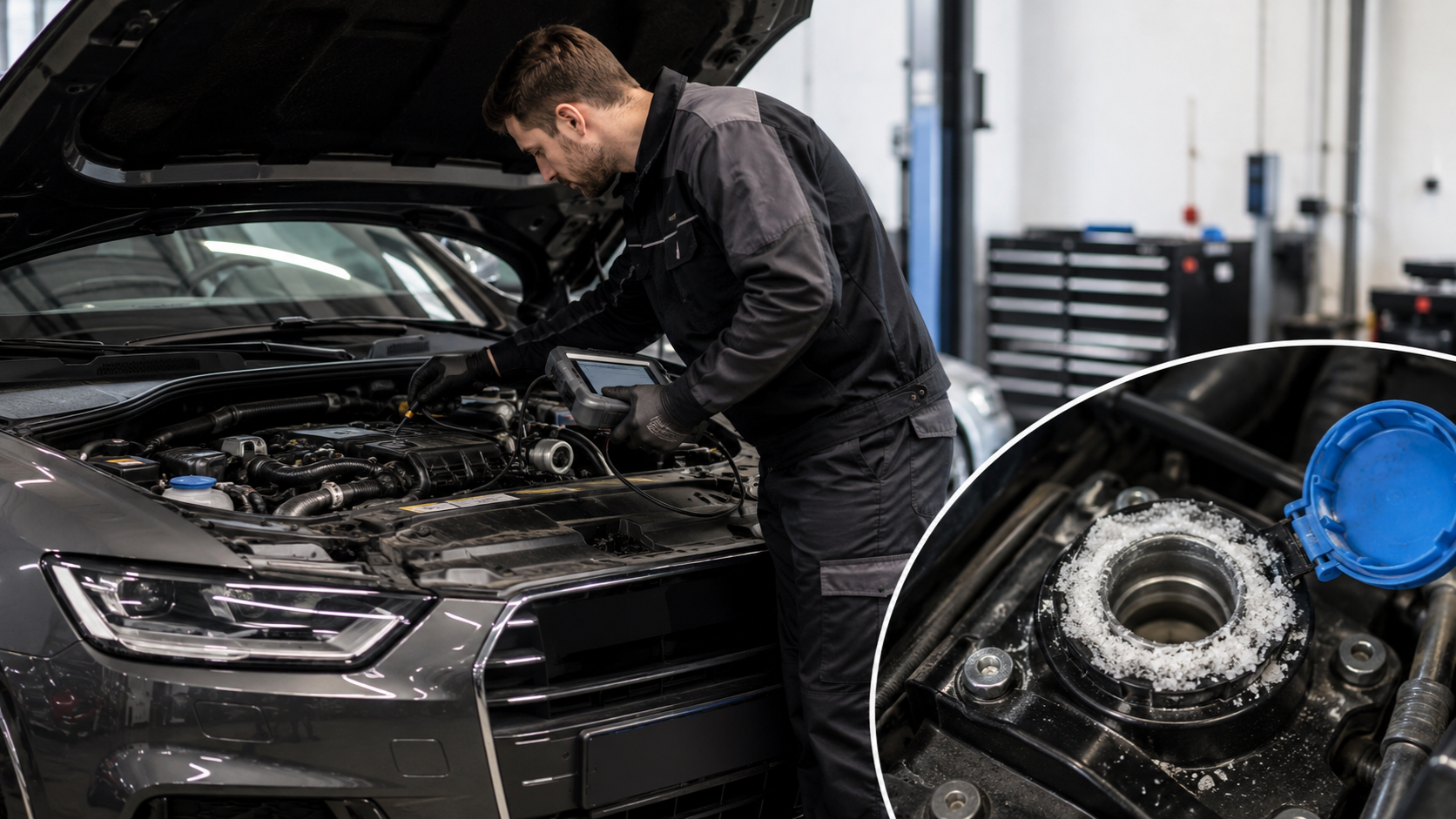
If there’s a white, crusty residue forming around your AdBlue filler cap and an SCR warning light staring back at you from the dash, you already know something’s wrong. What you probably don’t know yet is whether it’s fixable, or whether you’re about to get quoted for a new pump.
We get asked this most weeks, sometimes daily during the colder months when crystallisation spikes. The short answer is: it depends where the crystals are and how long they’ve been building up. The longer answer is below, and it’s worth reading before you agree to any quote, because “AdBlue crystallisation” gets treated as one single fault when really it’s several different ones wearing the same name.
What’s Actually Happening Inside the System
AdBlue is a mix of urea and water, roughly a third urea to two thirds water, injected into the exhaust to break NOx emissions down into nitrogen and water vapour. It’s a neat bit of engineering when it works. The problem is it only stays stable within a fairly tight range of conditions. Push it outside that range and the urea starts separating out of solution, hardening into crystals as it goes.
Those crystals show up wherever the fluid pools or gets forced through a narrow gap. The tank. The delivery lines. The pump. Most often, the injector tip itself, right where the fluid meets exhaust gas hot enough to bake it solid almost instantly. Once that build-up starts restricting flow, you’ll see fault codes, then reduced power, then limp mode if it’s ignored long enough. Some cars won’t even start once it gets bad.
For a fleet, that’s downtime you didn’t budget for. For someone relying on their car daily, it can mean a week without it. And because the build-up is usually slow, most drivers only notice once it’s already fairly advanced. By the time the light comes on, it’s rarely day one of the problem.
Why Does AdBlue Crystallise?
A few things usually combine to cause it rather than one single cause on its own.
Cold snaps followed by warm spells do a lot of damage. AdBlue freezes around minus 11°C and starts to break down above 30°C, so a car that sits outside through a British winter and then gets driven hard on a hot day is doing the fluid no favors, particularly near the injector.
Evaporation is another big one. Any point where warm air can get at the fluid, a loose cap, a worn seal, a line running near a hot part of the engine, lets water evaporate off and leaves the urea behind more concentrated than it should be. That concentrated urea crystallises fast.
Contamination causes more of these faults than people expect. Diesel, dust, water, or the wrong grade of fluid finding its way into the tank throws the whole chemical balance off. We see this constantly on fleet vehicles that get topped up from bulk drums rather than sealed bottles.
Storage matters more than most drivers realise too. AdBlue has a shelf life of around 12 to 18 months if it’s kept properly, but leave it in a metal container or somewhere it gets direct sun and that shelf life shortens considerably.
Then there’s the usage pattern. A car doing mostly short runs, or one that sits unused for long stretches, never gets hot enough or driven long enough to flush anything through naturally. And some manufacturers simply dose more aggressively than others, so certain makes are just more prone to this than the rest of the fleet.
Right, So Can It Be Fixed or Not?
Depends which part of the system we’re talking about.
Tank. Nine times out of ten, yes. A crystallised tank can be flushed and decontaminated professionally without swapping it out, provided the crystals haven’t been sitting around the sensors or the tank heater for months on end. Only the worst, most neglected cases need the tank pulled for a full internal clean.
Pump and delivery module. This one’s more of a coin toss depending on severity. Light to moderate crystallisation in the housing or filter cleans up fine and the pump goes back to working properly. But once crystals have caused the motor to seize, or damaged the internal seals, you’re looking at a replacement module, and that’s not a cheap part. Early action really does matter here.
Injector. People assume a blocked injector is a write-off. It usually isn’t. Most injector blockages respond well to ultrasonic cleaning and specialist descaling that dissolves the crystal deposits without touching the precision spray tip. Corrosion, cracked tips, or an electrical fault are the exceptions that actually need a new injector.
SCR catalyst. This is where things get genuinely limited. If crystallised AdBlue has made it as far as the catalyst, which typically only happens after a warning light’s been ignored for months, it can end up physically blocked or chemically damaged. Catch it early and a proper SCR clean can bring it back. Leave it too long and replacement is really the only reliable fix left.
The pattern across all four is the same: catch it early, and a repair is very likely. Wait, and the odds shift towards replacement parts that cost a lot more than a flush would have. If you’re past the point where repair makes financial sense, an AdBlue delete or removal is often a better long-term call than replacing the same part twice, though that’s a conversation worth having with someone who’s looked at your specific vehicle first.
What We Actually Do During a Repair
There’s no shortcut version of this that actually works long term. Here’s the process:
First, a diagnostic scan to work out whether we’re dealing with tank, pump, injector, or catalyst, and to rule out a sensor fault masquerading as something worse. Then a physical check of the filler neck, tank walls, and whatever lines we can get to, just to see how bad the build-up actually is.
From there it’s an approved flush, using the right cleaning solution and warm water to break the crystals down without introducing anything new into the system. Injectors get ultrasonic cleaning. The dosing module gets stripped and cleaned where that’s possible. Filters get swapped if fitted.
We only replace what’s actually failed, mechanically or electrically, rather than defaulting to swapping the lot. Once the repair’s done, we rescan the system, clear the codes, and run it through a test cycle to check dosing, pump pressure, and spray pattern are all back where they should be. Then a road test, because a clean bill of health on the ramp doesn’t always match how the car behaves once it’s actually being driven.
How to Avoid Going Through This Again
Most of the crystallisation cases we deal with could have been avoided. A few habits go a long way.
Buy ISO 22241 certified AdBlue from somewhere reputable, and steer clear of decanting from unlabelled bulk containers where you can’t be sure what’s actually in it. Store it somewhere cool and out of direct sun, never in metal. Keep the filler cap and seals in decent condition so moisture and dust can’t creep in. Try not to run the tank dry, since low levels concentrate whatever crystals already exist and put extra strain on the pump.
If a warning light comes on, deal with it straight away rather than driving on and hoping it clears itself. Early stage crystallisation is genuinely cheap to sort out. Advanced blockages are not. Worth building an AdBlue check into your regular service too, especially if you’re covering high mileage or doing mostly short trips. Fleet operators in particular should standardise how vehicles get refilled and make sure drivers know what to look out for before a full SCR fault develops.
Is This a DIY Job?
You’ll find plenty of forum advice suggesting a bottle of additive and a top-up will sort it. In our experience, that rarely gets to the root of the problem.
Shop-bought additives generally can’t reach crystals sitting inside the pump or injector without the system being taken apart. The wrong flushing technique can introduce fresh contamination or damage a sensor that was fine to begin with. And without a diagnostic scan, it’s easy to treat a pump fault as a tank issue, or the other way round, and end up no further forward with the fault code still sitting there.
Call a professional once the warning light or limp mode has already appeared, if you can see crystals forming around the filler, if fuel economy has dropped off, or if a DIY attempt hasn’t cleared the code. For fleet vehicles, the cost of downtime alone usually makes a proper diagnostic the cheaper option from the start.
Mobile AdBlue Repair, Wherever You’re Based
FixAdBlue works as a mobile service, so crystallisation repairs, injector cleaning, and SCR diagnostics happen at your home, your workplace, or the roadside. No towing, no waiting for a dealer slot. We cover fleet depots and individual vehicles across the UK, including:
- Scotland, mobile AdBlue support in Edinburgh and Glasgow
- South East England, covering Croydon, Reading, Guildford, and Market Deeping
- Yorkshire, engineers serving Leeds and Sheffield
- The Midlands, callouts across Birmingham, Coventry, Derby, Leicester, Nottingham, and Grantham
- East of England and beyond, Peterborough, York, London, Spalding, and Stamford
Same-day mobile callouts mean a crystallised tank, a blocked injector, or a failing pump can usually be sorted without the vehicle leaving your site at all, which matters a lot if you’re coordinating repairs across more than one depot.
Frequently Asked Questions
The main giveaways are an SCR or AdBlue warning light, the car dropping into limp mode or refusing to start, and a white, chalky residue around the filler cap or underneath near the tank. A few other faults can mimic this though, so a diagnostic scan is the only way to know for certain.
It really depends where the crystals are and how far things have progressed. A tank flush or injector clean costs a fraction of a new dosing module or catalyst, which is exactly why getting it looked at early makes such a difference. We’ll give you an accurate figure once we’ve scanned the vehicle, not before.
For a short while, technically yes. We wouldn’t recommend it though. Most SCR systems are built to cut power the longer a fault sits unresolved, and some will eventually stop the engine restarting altogether. The longer it’s left, the more likely the fault spreads from something cheap to clean into something that needs replacing.
Sometimes, sometimes not. It depends on your manufacturer’s terms and what’s actually caused the fault. Using the wrong grade of AdBlue or letting the tank run dry tends to affect cover, whereas a genuine component failure might not. Worth checking your specific policy, and we’re happy to advise once we’ve seen what’s caused the issue on your car.
Most tank flushes and injector cleans are done in a single callout, often within a couple of hours. If a part needs replacing, it can take a bit longer depending on availability, but we’ll always tell you upfront roughly how long to expect.
If the damage is too far gone for a standard repair to be worth it, an AdBlue delete or removal may be considered as an alternative to replacing the same part again down the line. It’s not right for every vehicle though, so it’s worth a proper conversation before deciding either way.
Get It Properly Looked At
Most AdBlue crystallisation is fixable, but only if it’s caught before it reaches the catalyst. Tanks, pumps, and injectors can usually be brought back to full working order without the cost of a full system replacement, as long as someone looks at it before things get that far.
If your car’s throwing SCR codes, sitting in limp mode, or you’ve spotted that white crust building up around the filler, don’t leave it and hope it goes away on its own. FixAdBlue runs mobile AdBlue repair, injector cleaning, and full SCR diagnostics for cars, vans, and fleets right across the UK. Get in touch and we’ll get you booked in.

7 Comments
[…] if you’re still narrowing down exactly what’s going on with yours. Our article on whether AdBlue crystallisation can be repaired is worth reading too, if crystallisation turns out to be contributing to a tank full warning that […]
[…] you want the background on whether that damage can be undone, we’ve covered it in our guide on whether AdBlue crystallisation can be repaired. This article picks up where that one stops, for the people who’ve already had a clean and found […]
[…] form, and those can break away and travel into the filter. We explain the mechanism in our guide on whether AdBlue crystallisation can be repaired, and if crystals are a recurring theme for you, our article on why crystals keep coming back after […]
[…] on AdBlue pump no pressure covers the pump side of this same symptom picture, and our piece on whether AdBlue crystallisation can be repaired goes into more detail on the crystallisation process […]
[…] We’ve gone into this crystallisation process in a lot more depth in our dedicated guide on whether AdBlue crystallisation can actually be repaired, which is genuinely worth reading alongside this one, since it explains the mechanism behind almost […]
[…] Can AdBlue crystallisation be repaired […]
[…] into more depth. If you are also seeing white crystalline deposits around the injector housing, AdBlue crystallisation repair explains whether it can be cleaned or needs […]