
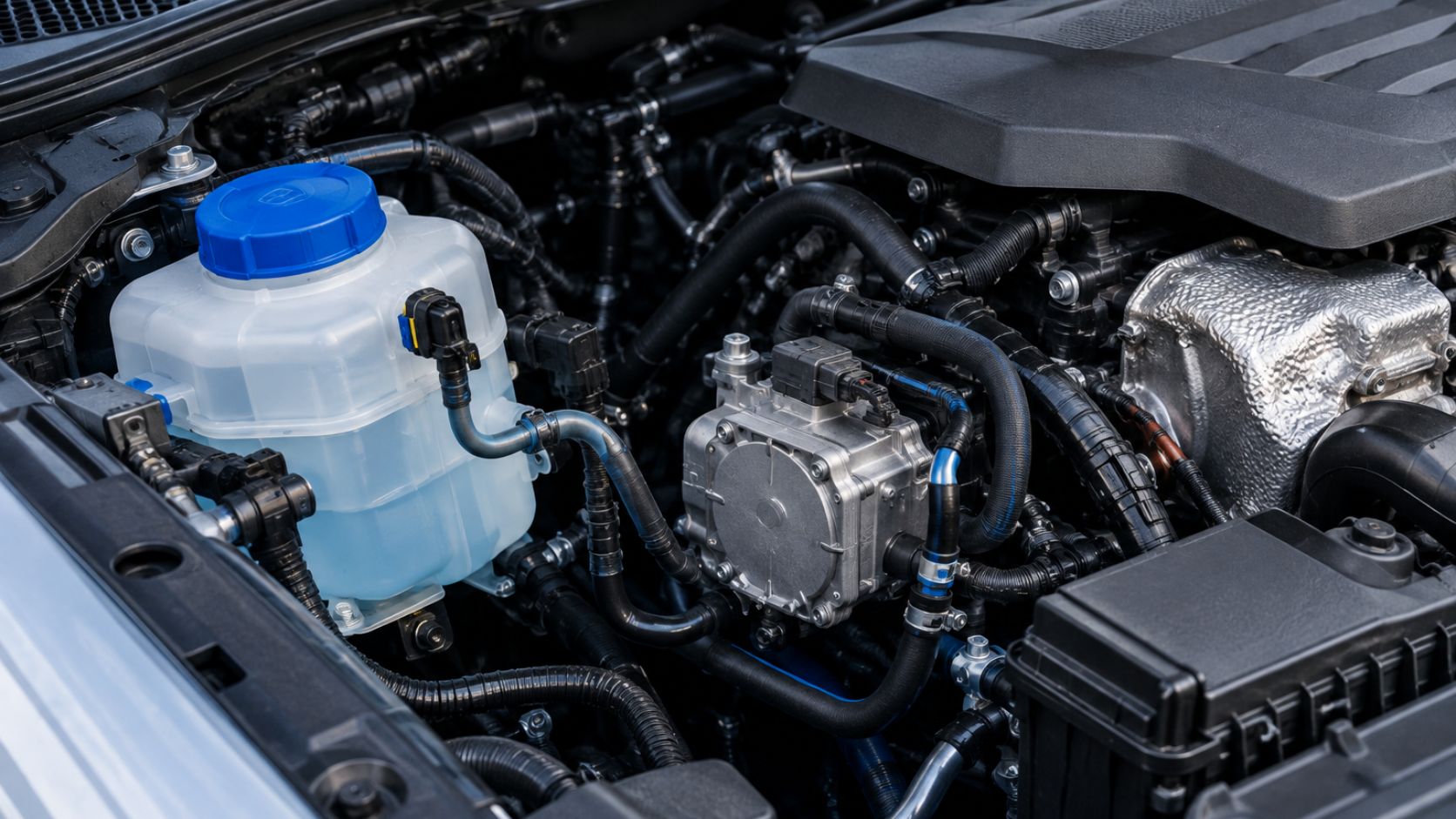
You can hear the pump cycling, sometimes you can even feel a faint hum from the tank area, but the fault code says pressure isn’t building, and the warning light stays on regardless. This is a genuinely different problem to a pump that’s completely silent or dead. A pump that runs but can’t build pressure is usually still mechanically alive, it’s just not able to move AdBlue against resistance properly, which points toward a handful of specific causes rather than a straightforward “replace the pump” answer.
This guide walks through what’s actually happening when this shows up, the real causes behind it, how to tell a genuine pressure problem from a sensor giving a false reading, and what fixing it actually involves.
“If the pump’s running, why isn’t pressure building at all?”
Because running and working aren’t the same thing. The pump has to draw AdBlue from the tank through a filter, push it through the lines, and build enough pressure for the system to hold and deliver it accurately to the injector. If any part of that path is restricted, leaking, or the pump’s internals have worn past the point of generating real pressure even while still spinning, you get exactly this symptom. The motor turns, the system logs that pressure isn’t reaching target, and the two facts sit there looking contradictory until you actually understand what’s happening mechanically.
“What’s actually causing it, then?”
A handful of specific faults tend to explain this pattern.
A blocked or partially clogged suction filter inside the tank is one of the most common causes. The pump draws fluid through this filter before anything else happens, and if it’s restricted by crystallised AdBlue or contamination, the pump can spin freely without actually moving enough fluid to build pressure downstream.
Air getting into the system is another frequent cause. A loose fitting, a small crack in a line, or a seal that’s degraded can let air in rather than AdBlue, and a pump trying to pressurise air rather than fluid simply can’t reach target pressure no matter how well it’s otherwise working.
Worn internal pump components matter too. Pumps use small vanes, gears or diaphragms depending on the design, and as these wear with age and mileage, the pump can still physically turn while losing its ability to generate real pressure. This is genuinely different from a pump that’s electrically dead, and it’s why some pumps fail gradually rather than all at once.
A failing pressure regulator is worth ruling out as well, since its job is maintaining consistent pressure in the system, and if it’s stuck open or malfunctioning, pressure can bleed away as fast as the pump builds it.
Crystallised AdBlue blocking narrow passages further down the line, beyond the tank filter itself, can produce the same symptom from a different point in the system, and it’s more common in vehicles that have run low on fluid or sat for long periods without being driven regularly.
“Could it actually just be a faulty sensor, not a real pressure problem?”
Genuinely, yes, and it’s worth ruling out before assuming the worst. The pressure sensor itself can fail or give an inaccurate reading, which means the system logs a pressure fault even though the pump’s actually building pressure just fine. This is exactly why proper diagnosis matters here rather than jumping straight to a pump or filter replacement. A sensor fault and an actual mechanical pressure fault look identical from the dashboard, but the fix is completely different, and one costs considerably less than the other.
“What fault codes tend to come up with this specific pattern?”
A few codes show up repeatedly when pressure isn’t reaching target despite the pump running:
| Fault code | What it typically points to |
| P204B | Reductant pump performance, often linked to worn internals or restricted flow |
| P2047 | Reductant injector circuit low, sometimes tied to insufficient system pressure |
| P203E | AdBlue system low voltage or pressure related circuit fault |
| P2201 | NOx sensor circuit, occasionally triggered alongside a genuine pressure fault |
Our guide on the P204F AdBlue fault code covers a closely related injector circuit code if that’s what’s actually showing on your scan tool instead, and our wider piece on what an AdBlue system fault actually means is worth a read for the broader picture beyond just this specific symptom.
“Is this connected to a blocked injector, or a completely separate issue?”
Related, but not identical. A blocked or fouled injector stops fluid getting out at the delivery end, whereas a pressure fault is about the system failing to build and hold pressure in the first place, further back in the process. That said, the two can absolutely be connected, since insufficient pressure can sometimes present with symptoms that look injector related from the driver’s seat. Our dedicated guide on AdBlue injector blocked symptoms and repair covers that specific fault if you want to compare the two properly before booking anything in.
“How does crystallisation actually cause this?”
AdBlue crystallises when it dries out, typically where fluid sits static in narrow passages, filters or around seals for extended periods, and those crystals physically restrict flow. A pump can be in perfect mechanical condition and still fail to build pressure if what it’s trying to pump through is partially blocked by crystallised deposits. Our detailed guide on whether AdBlue crystallisation can actually be repaired covers this specific cause properly, including when cleaning resolves it and when components need replacing outright.
“Is it safe to keep driving while this is happening?”
In the short term, usually, but it’s not something to leave for long. Once the system’s logged that it can’t build or maintain pressure, most vehicles begin restricting performance and eventually move toward a restart limitation if it’s not addressed. Our guide on how long you can actually drive with an AdBlue fault and our separate piece on what happens once the countdown to no start begins both cover that escalation properly, so you know roughly what you’re working with time wise.
“How do you actually work out which of these it is?”
Confirming whether it’s a genuine mechanical pressure fault or a sensor giving a false reading is the first real step, and it needs proper diagnostic equipment rather than guesswork. From there, we check the suction filter and tank internals for blockage, inspect lines and fittings for air ingress, test the pump’s actual output against its rated specification rather than just confirming it runs, and check the pressure regulator’s behaviour under load. That combination is what actually separates a filter clean, a pump replacement, and a sensor swap, which are three very different jobs with very different costs.
“What does the actual fix involve once it’s diagnosed?”
Depends entirely on what’s found. A blocked suction filter is often a straightforward clean or filter replacement, considerably cheaper than a pump. Air ingress means finding and sealing the specific point it’s entering, whether that’s a fitting, a line, or a degraded seal. A genuinely worn pump needs replacing, since there’s no reliable way to restore worn internal components. A faulty pressure sensor is a sensor level fix, not a pump job, and getting that distinction right first is what stops you paying for a repair you didn’t actually need.
We work mobile across London and the wider areas we cover, carrying out diagnosis and repair on site rather than requiring you to leave your vehicle at a garage for days, and our repairs come with our workmanship warranty. If ECU adjustment is genuinely needed as part of getting the system running correctly again once the physical fault’s resolved, that’s something we handle as part of the job rather than a separate booking.
“Does this happen more on certain vehicles?”
We see it across most SCR equipped diesels, though certain models are more prone to it due to pump design or how exposed the tank and filter are to contamination over time. Our vehicle specific guides for Ford Transit, Citroën, Peugeot Partner, Nissan, Land Rover and Mercedes cover the more common patterns per make if you want detail specific to what you’re driving, and our wider AdBlue problems by manufacturer guide covers the broader picture across brands.
“Why does this keep happening even after it’s been looked at before?”
If a pressure fault keeps returning after what seemed like a fix, it’s usually because the underlying cause wasn’t fully resolved, a partial filter clean rather than a full one, or a genuine mechanical fault that got misread as something else the first time round. Our guide on why an AdBlue fault keeps coming back covers this pattern properly and is worth reading if this isn’t the first time you’ve dealt with a warning light on this car.
Where We Help
We’re a mobile AdBlue diagnosis and repair service, coming to you rather than requiring a garage visit, covering London and boroughs including Redbridge and Newham, plus our main London coverage page.
Across the South East, we cover St Albans, Slough, Sevenoaks, Loughton, Dartford, Epsom, Esher, Guildford, Reading and Croydon, under our wider South East England coverage.
In the Midlands, we cover Birmingham, Solihull, Dudley, Wolverhampton, Walsall, Coventry, Tamworth, Stoke-on-Trent, Nuneaton, Warwick, Rugby, Leamington Spa, Stratford-upon-Avon, Stafford, Cannock and Lichfield, under our West Midlands and Warwickshire coverage pages.
In Shropshire, we reach Telford, Shrewsbury, Oswestry and Bridgnorth, under our Shropshire coverage page.
Further afield, we cover Nottingham, Leicester, Derby, Grantham, Peterborough, Stamford, Spalding, Market Deeping and Bourne, under our Lincolnshire coverage, plus Leeds, Sheffield, York, Edinburgh and Glasgow. Our full locations page covers everywhere else we reach.
Quick Answers About AdBlue Pump Pressure Faults
Yes, genuinely. A pump can spin, hum, and sound electrically fine while its internal components have worn to the point they can’t generate real pressure any more. Sound alone doesn’t confirm the pump’s actually doing its job properly.
Only through proper diagnostic testing, checking the pump’s actual output against its rated specification rather than relying on the dashboard warning alone. The two look identical from the driver’s seat but need completely different repairs.
Yes, and it’s one of the most common causes. If the pump can’t draw enough fluid through a restricted filter, it doesn’t matter how healthy the pump itself is, pressure downstream simply won’t reach the target.
Not always, no. It can originate from a line, a fitting, the pressure regulator, or even a sensor issue elsewhere in the system. The tank and its filter are common causes, but not the only possibility.
Indirectly, yes. Running consistently low on AdBlue increases the chance of crystallisation forming in narrow passages and filters, which can then restrict flow and cause exactly this symptom even once you’ve topped the fluid back up.
Not if the cause is a blockage, air ingress, or a worn pump. Topping up only addresses fluid level, and this fault is about the system’s ability to move and pressurise that fluid properly, which a top up doesn’t touch.
It can contribute, since AdBlue can partially thicken in very cold conditions and cold starts put extra demand on a marginal pump, but it’s not exclusively a cold weather fault the way a heater related issue would be.
Yes, particularly if it’s air ingress from a loose fitting or an early stage filter blockage. Intermittent faults like this often get worse gradually rather than appearing fully formed from day one.
Depends entirely on the actual cause. A filter clean is considerably cheaper than a full pump replacement, which is exactly why proper diagnosis before any repair matters, so you’re not paying for the wrong job.
Short trips are usually fine in the early stages, but it’s worth booking in promptly rather than letting it run on, since the fault typically escalates toward reduced performance and eventually a restart restriction if left unresolved.
Yes, our mobile setup carries the diagnostic equipment needed to test pump output, check live pressure data, and identify the actual cause on site, rather than needing the vehicle brought into a fixed workshop.
No. Clearing a stored code without addressing what actually caused it just means the fault returns, often within a short distance, once the system logs the same failure again.
Not directly. The risk is the engine control unit restricting performance to manage emissions once it can’t trust the AdBlue system, which is a driveability issue rather than mechanical engine damage.
It can be, depending on the vehicle’s age and specific warranty terms. Any repair work we carry out ourselves comes with our own workmanship warranty regardless of the manufacturer’s position.
Let us know whether you can hear or feel the pump running, any fault codes already logged if you’ve had it scanned, and roughly how the fault’s been behaving, constant or intermittent. That detail helps us prepare the right diagnostic approach before we even arrive.
Get This Looked At Properly
If your AdBlue pump’s running but the fault won’t clear, get in touch through our contact page with your vehicle’s make, model and postcode, and we’ll get a mobile technician out to diagnose it properly on site.
