
Burning through AdBlue faster than you used to? That almost always points to overdosing somewhere, not a sudden change in how you drive.
Here’s how things are meant to work. A healthy setup doses a small, carefully measured amount based on engine load and what the NOx sensors are reporting back. Nothing more, nothing less. Jump up noticeably on consumption, and something upstream of that measurement’s usually wrong, in a way you’d never spot just by popping the bonnet open.
I get asked about this constantly. Usually by someone who’s topped up twice in a month when it used to be once every few. So let’s get into it.
So What’s Causing It?
A stuck or leaking injector tops the list. It’s one of the more common causes we see. The injector’s meant to release fluid in short, precise bursts, full stop. Stick it partly open, or let the internal seal start leaking, and fluid gets released outside that pattern entirely. You end up dosing more than intended without doing anything differently yourself.
A faulty NOx sensor causes the exact same result, just from the opposite direction. Say the sensor after the catalyst reports higher NOx levels than are present, even though cleaning’s working just fine. The ECU responds by pushing the dose up, trying to fix a problem that doesn’t exist. You’re burning through fluid chasing a fault that was never there in the first place.
I’ve seen this one trip people up more than any other, honestly, because nothing on the dash tells you it’s happening. The car just quietly drinks more fluid.
Incorrect dosing calibration is a quieter cause. It shows up occasionally after a repair, a software update, or a part swap that wasn’t recalibrated afterward. Instructions for how much to dose drift from what the engine needs. Nothing mechanical’s wrong here. The numbers are just off.
A leak in the line or at a connector isn’t technically overdosing, but it looks identical from the driver’s seat. Fluid disappears faster than expected, the tank empties sooner than it should, and unless you’re checking underneath the vehicle, you’d swear too much is being used. In reality, it’s leaking out before it even reaches the injector.
A pump running at the wrong pressure can push more fluid through per dose than intended too, especially if it’s compensating for a worn part elsewhere and overshooting as a result.
Then there’s driving pattern. Short, frequent journeys play a part here too, and this one’s about how you drive, not any component failing. Cold starts plus stop start traffic mean the exhaust rarely reaches full operating temperature, and dosing sometimes ramps up trying to hit emissions targets under conditions that just aren’t ideal for it.
Last one on the list, and probably the easiest to prevent. Diluted or poor quality AdBlue forces things to dose more just to hit the same level of NOx reduction, since the fluid itself is weaker than it should be. Stick to a sealed, reputable source and this cause simply doesn’t happen.
How Do You Even Notice This Is Happening?
It usually starts small. You just notice the fluid level dropping faster than it used to, with nothing else on the dashboard changing. No warning light. No fault code. Just a tank that empties sooner than expected.
That’s often the only clue you get for a while.
A warning light or fault code tends to follow eventually if it’s a failing part behind this, since the onboard checks catch an inconsistency sooner or later. Reduced fuel economy can show up too, especially where the engine’s compensating for a related issue elsewhere in the emissions setup. And watch for ammonia around the exhaust, stronger than usual. That smell points toward overdosing specifically, since excess unburnt AdBlue produces it far more than correctly dosed fluid ever would.
Here’s a case that sums this up well. We had a car in a few months back where the owner was topping up every couple of weeks instead of the usual month or so, with nothing showing on the dash at all. Turned out the NOx sensor after the catalyst had drifted, reporting readings that weren’t real, so the ECU kept overdosing chasing a problem that didn’t exist. Sensor replaced, recalibrated, and consumption dropped straight back to where it should’ve been within days.
So is any of this something to worry about, or just something to keep an eye on? Depends. Treat it seriously even without a warning light showing yet, because consistent overdosing from a failing part tends to get worse, not better, and a part compensating for a fault it can’t fix wears out faster under that strain. Catch it early, and it’s usually a far smaller, cheaper fix than waiting for a warning light to force your hand.
One heavier month of mostly short, cold journeys isn’t automatically a fault though. If consumption settles back to normal once your driving pattern changes, that’s conditions, not a failing part. Doesn’t settle? Stays consistently higher no matter how you’re driving? Get it looked at.
Worth Checking Yourself Before You Book Anything In
I always tell people this bit first, because it costs nothing and it genuinely helps. Write down roughly how often you’re topping up now versus a few months back, and whether it’s gradual or a sudden jump. A gradual increase often points toward wear, something like a pump or injector slowly degrading. A sudden jump points more toward a sensor fault or a leak that started at a specific moment.
Check whether any warning light or message has appeared at all, even briefly, and note the exact wording if it has.
Think about your driving pattern too. Mostly short hops around town, or a decent mix of longer runs? That distinction alone rules certain causes in or out before an engineer’s even looked at the vehicle. None of this replaces a proper scan with live data, but it saves time on the day, and it means whoever’s diagnosing it starts with a clearer picture instead of nothing.
How We Trace the Real Cause
A full fault code scan comes first, even with nothing currently showing on the dash, since some early stage faults don’t trigger a warning right away but still leave a trace in stored data.
From there we check live dosing data against what the engine’s doing. Commanded dose versus engine load and NOx readings, to see whether behaviour matches the conditions it’s working under.
Both NOx sensors get tested against known good values next. A drifting sensor reporting false readings is one of the more common causes behind unexplained overdosing, and it’s often the one that catches people out longest.
We’ll inspect the injector too, and check the lines and connectors for any sign of a leak. A physical leak needs a completely different fix to an electronic overdosing fault, even though both drain the tank at roughly the same speed from your side of things.
Only once we know the real cause do we recommend any repair at all. Guess based on consumption alone, and you risk replacing a part that was never the problem.
Does This Happen the Same Way on Every Vehicle?
The underlying mechanics are consistent across any SCR equipped diesel. Exact dosing rates, and how sensitive a particular system is to sensor drift, vary by manufacturer though. We see this fault across a wide mix of vehicles, and our guides on specific manufacturers, including Ford Transit, Citroën, Peugeot Partner, Nissan, Land Rover and Mercedes, cover how AdBlue faults tend to show up on each one specifically.
Running a Fleet or Company Car? A Few Extra Things to Watch
Fleet vehicles tend to show this fault later than private cars, simply because nobody’s tracking litres per mile as closely as an owner driver would. If you manage more than one vehicle, it’s worth setting a simple log, even a basic spreadsheet column for top up dates and rough fluid added, because a jump stands out a lot faster against your own data than it does from memory alone.
Vans and HGVs doing mixed motorway and urban work sometimes show a different pattern again, since the engine spends more time at steady load. A sudden change in a vehicle that’s normally predictable is usually your clearest signal something’s changed mechanically, rather than it being down to a new driver or a different route.
Related AdBlue Guides
Our guide on AdBlue injector blocked symptoms, causes and repair covers the opposite problem to this one, handy if you’re trying to rule out which direction your injector fault’s going. Our article on AdBlue problems explained gives wider context on the system as a whole, and our piece on AdBlue problems by manufacturer breaks things down brand by brand.
If a level sensor fault’s a possibility for you too, our guide on AdBlue level sensor fault: why does the warning stay on? pairs well with this one, since the two can sometimes present together. Our article on can AdBlue crystallisation be repaired covers a related fault that shares some of the same underlying causes, and our broader AdBlue system fault: what does it mean and how do you fix it? guide is a good starting point if you’re still narrowing down exactly what’s going on.
Mobile AdBlue Diagnosis, Wherever You Are
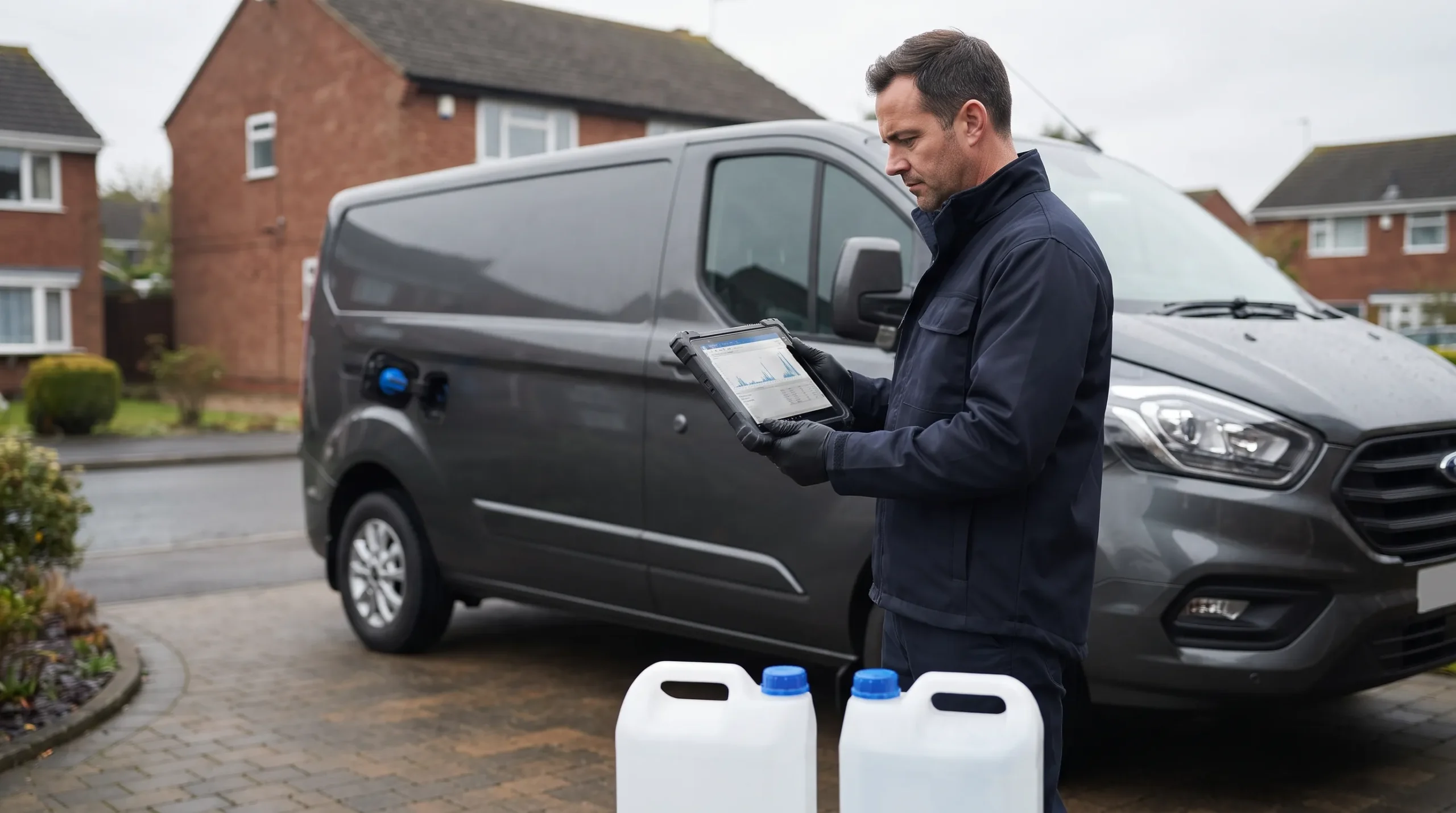
This is exactly the kind of fault that needs live data testing, not a guess based on how often you’re topping up. Our technicians bring professional diagnostic equipment to you, whether that’s at home, at work, or wherever the vehicle happens to be sitting. We watch the live dosing data while the engine’s running, instead of relying on a stored code alone.
I’d rather tell a customer we need another twenty minutes checking than send them away with a part they didn’t need.
All of our AdBlue repair work comes with our workmanship warranty, so you’re covered if anything related to the repair needs revisiting. We’ll always explain exactly what we’ve found and what needs doing before any work starts. And we won’t recommend replacing a part until we’ve confirmed it’s the cause.
Areas We Cover
We run a mobile AdBlue repair and diagnosis service across a wide stretch of the UK, and every area we cover has its own dedicated page with local details. Across London and the South East, that includes Kingston upon Thames, Lewisham, Islington, Haringey, Havering, Waltham Forest, Redbridge, Newham, St Albans, Slough, Sevenoaks, Loughton, Dartford, Epsom, Esher, Guildford, Reading and Croydon, with our wider South East England and London pages covering the region more broadly.
In the Midlands, we cover Solihull, Dudley, Wolverhampton, Walsall, Tamworth, Stoke on Trent, Nuneaton, Warwick, Rugby, Leamington Spa, Stratford upon Avon, Stafford, Cannock, Lichfield and Birmingham, alongside our West Midlands and Warwickshire region pages.
Further out, we cover Shropshire towns including Telford, Oswestry, Bridgnorth and Shrewsbury, our Shropshire region page, and East Midlands and Lincolnshire towns like Peterborough, Stamford, Spalding, Market Deeping, Grantham and Bourne, covered more broadly by our Lincolnshire page.
Further north we cover Leicester, Derby, Coventry, Sheffield, Leeds, York, Nottingham, Glasgow and Edinburgh. If you don’t see your exact area listed, our full locations page covers everywhere we currently operate.
AdBlue Overdosing and High Consumption FAQs
It varies by make and driving style, but most cars and vans get through roughly one litre per 600 to 1,000 miles. A noticeable jump away from your own normal pattern matters more than hitting some fixed number, so track your own baseline instead of someone else’s.
To an extent, yes, especially lots of short, cold journeys. But if it stays high no matter how you’re driving, that’s pointing at a part, not a habit.
Not directly, no, though it’s a clear sign something’s wrong, and whatever’s causing it tends to get worse left unaddressed, sometimes wearing other parts faster in the process.
Depends entirely on what’s actually wrong. A recalibration after a software update is a quick, low cost job. A failed NOx sensor or injector costs more, since parts are involved, but it’s still cheaper than letting the fault run on and wear out something bigger down the line. We’ll always confirm the price before any work starts.
Yes, completely. From the driver’s seat, a tank emptying faster than expected looks identical whether too much is being used or it’s simply leaking out before it’s even dosed. A proper diagnosis is the only real way to tell the two apart.
No. A reset only clears the warning message, not whatever’s causing the extra usage underneath. The real cause needs identifying and fixing first, every time.
Not always. It depends which direction the sensor’s drifted. One reporting falsely high NOx levels tends to cause overdosing, while one reporting falsely low levels can cause underdosing instead, which is exactly why testing against known good values matters either way.
It can accelerate wear on the pump and injector, since everything works harder compensating for weaker fluid, even though it’s unlikely to cause sudden failure on its own.
Yes. Testing live dosing data against engine conditions doesn’t need a full workshop, just the right kit, and our mobile technicians bring exactly that with them wherever the vehicle happens to be.
Yes, the same underlying principle applies to any diesel vehicle running SCR emissions control, HGVs included.
Typically under an hour to pin down the real cause, though confirming it fully sometimes means watching live data over a short test drive rather than a static check alone.
Book a Mobile AdBlue Diagnosis
If you’re topping up more often than you used to and nothing obvious explains it, get in touch through our contact page and we’ll arrange a mobile visit to trace the real cause properly, wherever the vehicle happens to be. Catching this early is almost always cheaper than waiting for a part to fail completely.
