
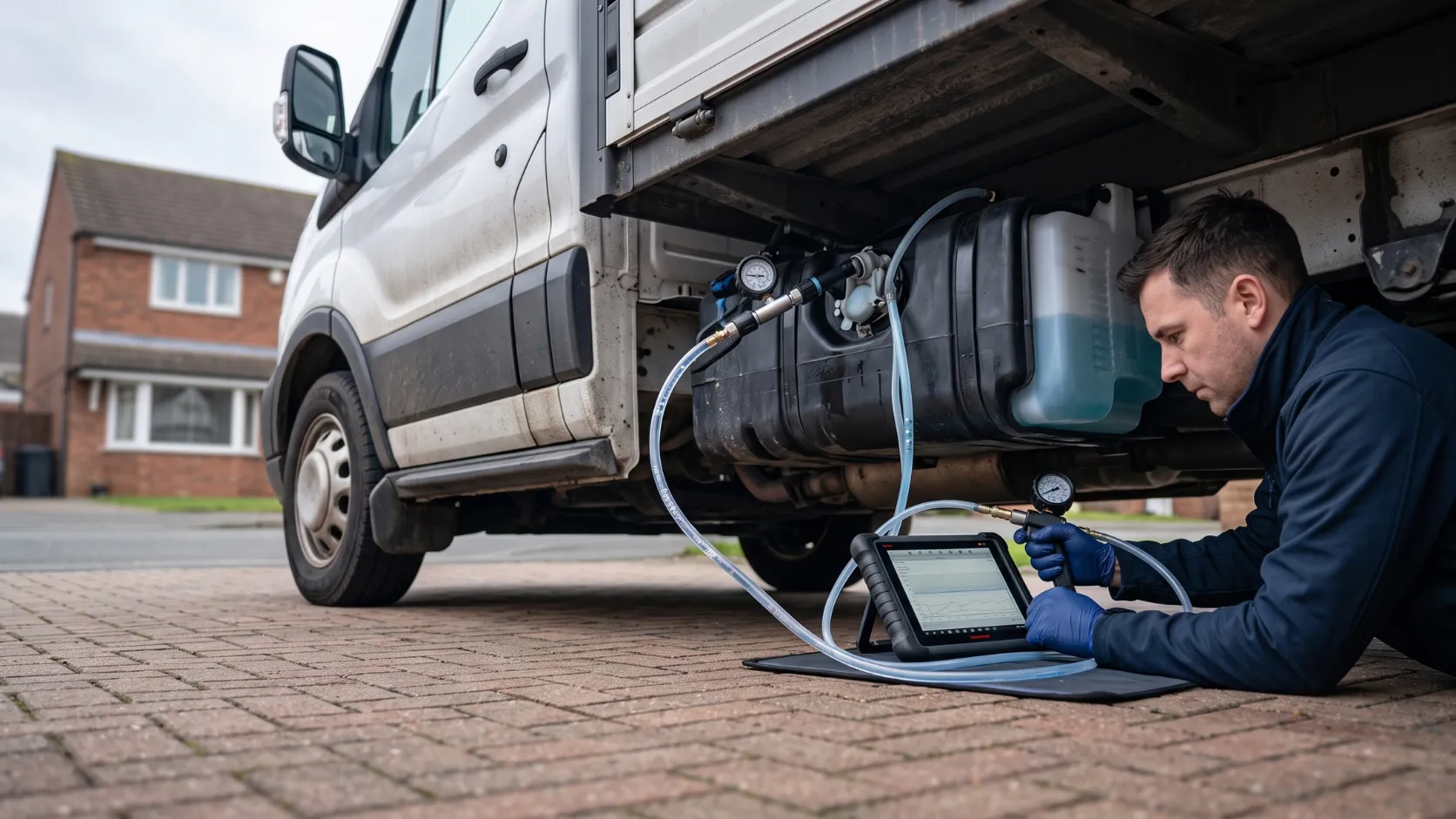
Tank’s full. Warning light’s still on. Vehicle still won’t start properly.
That’s the exact moment most people call us, confused and a bit annoyed, because they did the obvious thing and it didn’t work. Running the AdBlue tank properly dry doesn’t just trigger a warning that clears once you refill. Sometimes the whole system loses its ability to pick fluid back up at all, and a refill on its own does nothing to fix that.
Here’s why. The second that tank runs genuinely empty, air gets pulled into the line where AdBlue should be sitting. Diesel systems shrug this kind of thing off most of the time. AdBlue systems generally don’t, and the pump often can’t shove that air back out just because there’s liquid above it again. It needs an actual priming process. Not a refill. A priming process.
We’re mobile, so wherever the van’s sitting when this happens is generally where we can sort it. No towing required.
Why Topping Up the Tank Doesn’t Fix This
Everyone tries it first. Makes sense, it’s the obvious move.
Doesn’t work here though, not reliably. The air that got in when the tank ran dry doesn’t vanish just because there’s fluid above it now. It sits there, a stubborn little pocket, and the pump has to physically force its way past that pocket before it can build the pressure the system actually needs.
Some pumps manage a small air pocket eventually, on their own, given enough running time. Most don’t. And the system keeps flagging a fault the entire time it’s stuck like that, so the warning light doesn’t care how full your tank gauge says you are.
What’s Actually Happening Inside There
A pump draws AdBlue from the tank, pressurises it, and sends it to a dosing module that injects it into the exhaust. The whole thing depends on one continuous column of fluid with no gaps in it anywhere. Air breaks that column.
Once air’s in the mix, the pump wastes its effort squeezing and shifting that air around instead of actually moving liquid. That’s the real reason it can run and run and run without ever restoring normal pressure.
Think of a straw with a bubble stuck halfway up. Suck as hard as you like. That bubble just slides around. Nothing proper gets through.
Signs You’re Actually Dealing With an Air Lock
A few things tend to show up together here:
- The warning stays on after a full refill, sometimes for hours, sometimes not clearing at all without help
- The pump sounds like it’s working overtime, louder or more frequent than normal, because it’s straining against the air rather than moving fluid cleanly
- The fault briefly clears, then returns within a few miles, which throws people off since it looked fixed for a minute
- The countdown warning keeps ticking even though the dash clearly shows a full tank
If the fault clears properly first, then comes back a day or two later rather than within minutes, that’s a different pattern. Worth reading why an AdBlue fault keeps coming back instead, since that usually points somewhere else entirely.
Why This Happens More Than You’d Think
Running dry isn’t rare, honestly. AdBlue use varies a fair bit by how the vehicle’s driven, and the gauge isn’t as sharp as a fuel gauge. People genuinely don’t see it coming the way they would with diesel.
Cold makes it worse. Fluid thickens when it’s cold, and a thicker fluid lets an air pocket sit stubbornly in a line instead of drifting through with the flow. Part of why this spikes every winter. Our guide on AdBlue warnings after a cold night covers a related cold weather issue, though that one’s usually the heater circuit rather than trapped air specifically.
One of our technicians picked up a Vivaro last winter. Driver had topped the tank three times in a week, each time convinced this was the fill that would finally clear it. Fault just sat there, unmoved, like it was mocking him a bit. Fifteen minutes with a priming tool on site and it was gone. The tank had never been the actual problem, not once.
A second one stuck with us too. A courier driver in a Transit who’d been nursing the tank down to nothing on purpose, trying to stretch a top up between runs. Three refills later and still no joy, because by that point it genuinely wasn’t a fuel level issue anymore. Just needed the air pushed out properly.
Is the Pump Actually Weak Rather Than Just Air Locked?
Sometimes, yes. Worth ruling in or out early since it changes everything about the approach. A pump already on its way out might cope fine on a full tank with zero air in the system, but it won’t have the extra strength to also fight an air pocket on top of its normal job.
If priming alone doesn’t settle it, or the fault comes straight back with no obvious reason, that’s often a struggling pump hiding underneath what looked like a simple air lock. Our guide on AdBlue pump no pressure goes deeper into that specific failure.
Could It Be the Dosing Line Instead?
Possibly. A line that’s partially blocked, not fully, behaves a bit like trapped air in some ways. Resists flow without stopping it outright. Our guide on AdBlue dosing line blocked covers that separate fault, worth a look if priming doesn’t sort things the way it should.
How We Fix It
Not by running the engine for ages and hoping for the best. A proper priming procedure forces fluid through the line under controlled pressure, pushing the trapped air out through a bleed point. Left alone, that air often just won’t work itself loose on its own, not reliably.
We check the non return valve and connections while we’re in there too. A valve that’s not sealing properly can let air straight back in even after a good prime, and that just brings the exact same fault back within days. Once pressure’s holding properly and the air’s genuinely gone, we clear the fault code and confirm it’s actually stuck before we pack up and leave.
Every job we do comes with a workmanship warranty. Something related to our repair gives trouble again, you’re covered. We’d rather stand behind the work properly than just hope it holds.
And If You Just Keep Driving and Refilling?
The warning won’t go away by itself. The countdown behind it keeps counting no matter how many times the tank gets topped up. Eventually that ends in a full no-start lockout, not just an annoying light. Our guide on how long you can drive with an AdBlue fault covers roughly how much time that buys you, though it shifts by vehicle.
One more thing worth saying. Repeatedly topping up a tank that’s already reading full doesn’t help here, and can occasionally make a genuine overfill situation worse. Full gauge, fault still showing? That’s the air lock pattern this whole page is about. Not a level problem at all.
Does the Vehicle Make a Difference?
A bit. Ford Transit vans show up with this often, probably just down to how many of them get run close to empty on long multi-drop days. Citroën and Peugeot Partner models we’ve dealt with tend to need a longer prime cycle to clear the air fully.
Nissan and Land Rover systems run their own specific reset sequence after priming, which is part of why a generic approach doesn’t always land first time. Mercedes tends to be forgiving here, so long as the prime gets done properly in one go rather than rushed halfway through.
Fault Codes That Sometimes Tag Along
Worth knowing P204F specifically, which often points to dosing performance problems that an air lock can easily cause or make worse. Beyond that one code, our wider guide on what an AdBlue system fault actually means is worth a read if your scan tool’s thrown something we haven’t covered here.
Easy to Confuse With a Level Sensor Fault?
Very easily, actually. Both leave a warning showing despite a tank that looks perfectly fine. The difference sits in the detail. A level sensor fault misreports the tank as low or empty when it genuinely isn’t. Air stuck in the line after a real empty event is a completely different animal. Our guide on why the AdBlue warning stays on untangles that distinction properly.
We Come to You, Properly
Not just a line in an advert. Call outs run across London and a wide stretch of the South East, the Midlands, and further out still, with a mobile technician carrying the equipment needed to diagnose and prime the system on site, wherever the vehicle actually sits.
London
Croydon, Newham, Waltham Forest, Redbridge, Kingston upon Thames, Lewisham, Islington, Haringey, and Havering are all covered, alongside the rest of the London area.
South East England and the Home Counties
St Albans, Slough, Sevenoaks, Loughton, Dartford, Epsom, Esher, Guildford, and Reading sit under our South East England coverage.
West Midlands
Out through the West Midlands, that’s Solihull, Dudley, Wolverhampton, Walsall, Birmingham, and Coventry.
Staffordshire
Stafford, Cannock, Lichfield, Stoke-on-Trent, and Tamworth too.
Warwickshire and Shropshire
Warwickshire coverage takes in Nuneaton, Warwick, Rugby, Leamington Spa, and Stratford-upon-Avon. Shropshire means Telford, Oswestry, Bridgnorth, and Shrewsbury.
Lincolnshire and the East Midlands
Peterborough, Stamford, Spalding, Market Deeping, Grantham, and Bourne round out our Lincolnshire coverage.
Further Out Still
Nottingham, Leicester, Derby, Leeds, Sheffield, York, Glasgow, and Edinburgh round things out.
Not seeing your area named above? Our nationwide coverage page and locations hub list everywhere else we reach.
FAQs
Because fluid level stopped being the issue the moment air got into the line. That air needs physically clearing through priming before the system reads correctly again.
Occasionally, on a healthy pump with just a small pocket. Not something worth betting on though. Usually it needs a proper priming procedure.
Not reliably. Some get lucky. Most don’t, and meanwhile the no-start countdown keeps ticking the whole time regardless.
Not always, though they can look alike from the outside. If priming alone doesn’t fix it, or the fault returns fast, a struggling pump’s often hiding underneath it.
Usually not, if it gets sorted properly. The real risk is the air lock itself, and whatever caused the empty tank in the first place.
Often within the hour for a straightforward air lock. A weak pump or a damaged valve underneath adds time, understandably enough.
We come to you. Wherever that is. That’s the entire point of running mobile rather than making people get a van towed first.
Could, yes, if it runs properly dry rather than just low. Keeping it topped up before empty is the simplest way to dodge this one entirely.
Yes. Every job carries a workmanship warranty, so anything related to our repair causing more trouble is covered.
Not this specific fault, no, since the trigger here really is air in the line. Cold brings its own separate set of AdBlue problems worth checking against if the tank never actually ran dry.
No. Some systems need a longer cycle or their own reset sequence afterward, depending on the manufacturer, which is why having the right tool and some real experience with that system matters.
Usually means something’s letting air back in, often a non return valve that isn’t sealing. Not the original air lock magically returning on its own.

1 Comment
[…] and refilling the tank afterward doesn’t automatically push that air back out. Our guide on an AdBlue system that won’t prime after running empty covers that specific scenario in more depth if that’s exactly what’s happened to […]