
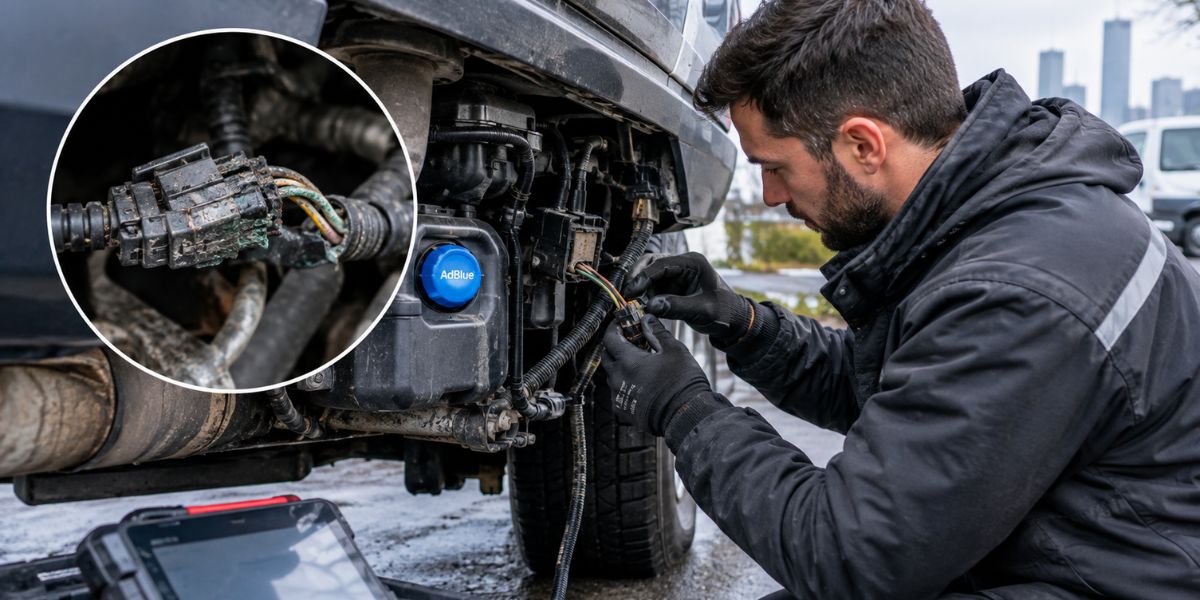
There’s a particular kind of AdBlue warning that catches people out, and it isn’t the one everyone expects. Most drivers assume a dashboard message about the AdBlue system means the tank is running low, or that the fluid itself has gone off somehow. Sometimes that’s exactly it. But a good number of the cars, vans and light trucks we see across London and the wider South East have a fault that has nothing to do with the fluid at all. It’s the wiring behind the system, the connectors and loom sections that carry signals between the dosing module, the NOx sensors, the tank level sensor and the engine control unit. When one of those connections starts to fail, the dashboard doesn’t really know how to describe that properly, so it just throws up an AdBlue warning, because that’s the closest thing it has to say “something in this system isn’t talking to me correctly.”
Honestly, this is the fault that frustrates people the most, because it doesn’t behave the way a straightforward low fluid warning does. It comes and goes. It clears itself for a few days and then reappears out of nowhere, usually at the worst possible moment. It shows up after rain, or on a frosty morning, and then seems to sort itself out by lunchtime once things dry off. If you’ve already topped up the tank, had a sensor replaced, or even had the whole dosing system looked at and the warning keeps finding its way back onto your dashboard, there’s a decent chance the actual fault is sitting in the wiring rather than in any single part.
Why does my AdBlue warning keep coming and going instead of just staying on?
This is usually the first thing people notice, and it’s actually one of the clearest signs you’re dealing with a wiring issue rather than something that genuinely needs a part replaced. A dosing pump that’s properly failed, or a tank sensor that’s given up completely, tends to throw a warning and keep it there, no flickering, no on-and-off. Wiring doesn’t behave that way. A corroded pin inside a connector, or a wire that’s chafed against a bracket until the copper is almost exposed, will make and break contact depending on vibration, temperature and moisture. Drive over a rough patch of road and the connection might reseat itself for a while. Park overnight somewhere damp and it might drop out again by morning.
We’ve had more than one customer describe this exact pattern: the light comes on during a cold snap, disappears for a week once the weather turns milder, then comes straight back the next time it rains hard. That inconsistency is the tell, really. If your AdBlue warning were a genuinely empty tank or a completely dead sensor, it wouldn’t be taking the weather into account.
“Could it really be the wiring, and not the sensor or the fluid itself?”
Yes, more often than people expect. Vehicles doing a lot of stop start driving, which describes most of London traffic on any given weekday, put more physical strain on the wiring loom near the tank and exhaust than a car that mostly does steady motorway miles. Every time the engine heats up and cools down, the metal brackets and wiring clips expand and contract slightly. Do that enough times over a few years, especially with road salt and winter grit working their way into any gap they can find, and connectors start corroding from the inside without ever looking obviously damaged from the outside.
There’s also a simpler reason wiring gets overlooked. It isn’t the first thing anyone checks. A fault code will usually point toward a specific sensor or the dosing pump, because that’s the component the code is technically describing. But a code can’t always tell the difference between “this sensor has failed” and “this sensor isn’t receiving a proper signal because the wire feeding it is damaged.” Swap the sensor without checking the wiring behind it, and the exact same fault tends to come straight back within days.
What the symptoms usually tell you
No two wiring faults look identical, but the pattern of when and how the warning shows up is usually a better clue than the fault code itself. Here’s roughly how it breaks down in practice.
| What you’re noticing | What it usually points to |
| Warning appears in wet weather, clears once dry | Corroded or water damaged connector, often near the tank or dosing module |
| Warning only shows up on cold mornings | Condensation inside an aged connector housing, or a loose earth point |
| Several dashboard warnings appear together | A shared section of loom feeding more than one sensor |
| Fault clears after a battery disconnect, then returns days later | An intermittent signal dropout rather than a fully broken circuit |
| Fault comes straight back after a part was replaced | Wiring or the connector feeding that part, not the part itself |
| Countdown or restart warning despite a recently filled tank | Level sensor signal not reaching the ECU reliably |
| Scratching noise near the tank, or a fault that appeared after the car sat unused | Possible rodent damage to the loom |
A few of these are worth unpacking a little further, because they’re the ones people usually search for on their own before booking anything in.
The warning clearing after a battery disconnect or an ECU reset is a big one. If pulling the battery for ten minutes makes the fault disappear, even temporarily, that’s a signal issue resetting itself rather than a fluid or hardware problem correcting itself. Fluid doesn’t respond to a battery disconnect. Wiring faults sometimes do, at least for a while.
Multiple warnings appearing together is another. If your AdBlue light comes on at the same time as an engine management light, or a message referencing the NOx sensor, it’s worth considering that one damaged section of loom might be feeding more than one circuit. A single chafed wire or a corroded connector block near the tank can easily affect two or three sensors that all happen to route through the same area of the harness.
And then there’s the countdown warning that shows up despite a recently topped up tank. If the level sensor isn’t communicating properly, the ECU has no reliable way of knowing how much AdBlue is actually in there, so it can display a countdown based on old or corrupted data rather than the real level. We’ve covered that specific scenario in more depth in our guide on the AdBlue countdown to no start warning, which is worth a read if that’s the message on your dashboard right now.
Last one: the fault that simply won’t stay fixed. If a previous repair, whether that was a sensor, an injector or a pump replacement, hasn’t actually solved anything and the same warning is back, the wiring feeding that component deserves a proper look before anything else gets swapped out. This exact pattern is one of the most common questions we get asked, and we’ve gone into it separately in why does an AdBlue fault keep coming back.
“What actually causes the wiring to fail in the first place?”
A handful of causes come up again and again, and most of them are down to where the wiring physically sits on the vehicle rather than anything the driver’s done wrong.
- Corrosion. The biggest one by a distance. The dosing module and tank level sensor both sit low down on the vehicle, right in the path of spray, standing water, and whatever grit and salt the road throws up. It doesn’t take much moisture finding its way past an aged or cracked connector seal before corrosion starts eating into the contact surface, and once that happens the connection becomes unreliable long before it fails outright.
- Physical wear and chafing. Wiring routed anywhere near the exhaust, the driveshaft, or the tank straps can rub against a bracket edge over tens of thousands of miles. It’s slow, and most drivers would never notice a wire wearing thin against metal, right up until the insulation finally gives way and the wire shorts or breaks completely.
- Rodent damage. More common than most people assume, particularly on vehicles that spend long stretches parked outside, in a garage, or off the road for a few weeks. A wiring loom is an easy target, and the damage is rarely limited to one wire, since a chewed section can take out several circuits running alongside each other in the same bundle.
- Disturbed connectors from earlier work. Any job involving the AdBlue tank, whether that’s a sensor swap, a delete, a bypass, or removing the tank for something entirely unrelated, carries a real risk that a connector doesn’t get fully reseated afterward. Sometimes that shows up immediately. Sometimes it takes a few weeks of vibration and temperature cycling before the connection finally works itself loose.
“How do you actually check whether it’s the wiring?”
This is where a lot of AdBlue repairs go wrong, if we’re honest about it. It’s tempting to just replace whatever component the fault code names and hope that solves it, but a code alone can’t distinguish between a failed part and a wiring problem feeding that same part. Confirming a wiring fault properly takes a few specific steps, roughly in this order:
| Step | What it’s checking for |
| Visual inspection of the loom and connectors | Corrosion, damp, loose pins, or visible chafing near the tank, dosing module and NOx sensors |
| Earth point check | A poor earth near the tank or engine bay, one of the most overlooked causes of intermittent faults |
| Live data monitoring with the engine running | Sensor readings dropping out or jumping around, which points to a wiring or connection issue rather than a mechanical one |
| Wiggle test on the loom and connectors | Reproducing an intermittent fault that won’t show up with the vehicle sitting still |
| Resistance and continuity testing | Confirming a specific suspect section of wiring rather than guessing |
Skip these steps and there’s a real chance of paying for a new sensor, plugging it into the same corroded connector, and watching the identical fault return within a week or two. It happens more often than it should.
AdBlue wiring faults and London driving
London throws a specific combination of conditions at vehicles that makes wiring faults more common here than in a lot of other parts of the country. Stop start city traffic means engines and exhaust systems are constantly heating and cooling, which is exactly the kind of cycling that works connectors loose over time. Add in wet winters and heavy road salt use, and it’s a fairly reliable recipe for connector corrosion, particularly on delivery vans, taxis, and anything else doing frequent short trips across the city rather than long steady motorway runs.
We carry out AdBlue wiring diagnostics and repairs right across London and the surrounding areas, with mobile diagnostic equipment that traces a fault down to the actual section of loom involved instead of replacing parts on a guess. The table below covers where we currently work.
| Region | Areas covered |
| London | AdBlue Removal London, Croydon |
| South East England | Regional hub, Slough, Dartford, Sevenoaks, Esher, Epsom, St Albans, Loughton, Guildford, Reading |
| West Midlands | Regional hub, Birmingham, Wolverhampton, Dudley, Solihull, Coventry |
| Staffordshire | Stoke-on-Trent, Stafford, Cannock, Lichfield, Walsall |
| Warwickshire | Regional hub, Nuneaton, Rugby, Warwick, Stratford-upon-Avon, Tamworth |
| Shropshire | Regional hub, Telford |
| East Midlands & Lincolnshire | Regional hub, Peterborough, Grantham, Stamford, Spalding, Market Deeping, Bourne, Nottingham, Leicester, Derby |
| North & Scotland | Leeds, Sheffield, York, Glasgow, Edinburgh |
If your town isn’t listed above by name, the full locations page is the best place to check, since we’re adding new areas fairly regularly.
If it isn’t a wiring fault
Wiring isn’t always the answer, and it’s worth ruling out the other usual causes before assuming that’s what you’re dealing with. Our guide to AdBlue system faults and what they mean is a reasonable starting point if you’re not sure which category applies to you. From there, we’ve covered a number of the more specific scenarios individually:
- AdBlue level sensor fault where the warning won’t clear
- Tank full warning that stays on anyway
- Blocked AdBlue injector
- Malfunction warning that tends to appear after a cold night
- How long you can actually keep driving with an AdBlue fault showing
- P204F AdBlue fault code explained
- Can AdBlue crystallisation be repaired
- AdBlue problems explained
- AdBlue problems by manufacturer
Quick Answers About AdBlue Wiring Faults
Yes. If the level sensor isn’t sending a reliable signal, the dashboard can show a warning or a countdown regardless of how much AdBlue is actually sitting in the tank.
Not reliably. The same code can point to a failed sensor, a wiring fault, or a module issue, which is exactly why live data and a physical check matter more than the code alone.
It does. Condensation building up overnight inside an aged connector housing can cause a temporary poor connection that clears once things warm up, which is why some faults only ever show up on frosty mornings.
A visual look for obvious damage near the tank is reasonable enough to do at home. Confirming an intermittent fault properly, though, really does need live data equipment and a wiggle test carried out with the engine running, which is best left to someone with the right diagnostic tools.
Generally, yes. Left alone, a wiring fault tends to keep returning, and depending on the vehicle it can eventually lead to reduced power or a full countdown to no start, so it’s usually worth having it diagnosed properly rather than replacing parts one at a time and hoping.

3 Comments
[…] connection can do something similar. We’ve written about the electrical side in our guides on wiring faults and connector corrosion, and our NOx sensor services page explains what we do when the sensor turns […]
[…] properly. If you suspect the wiring rather than the injector mechanism itself, our guide on AdBlue wiring faults walks through how that side of things is diagnosed […]
[…] level sensor, a blocked injector, or a wiring fault further up the harness. See our guides on AdBlue wiring fault, AdBlue injector blocked, and AdBlue level sensor fault for how those […]