
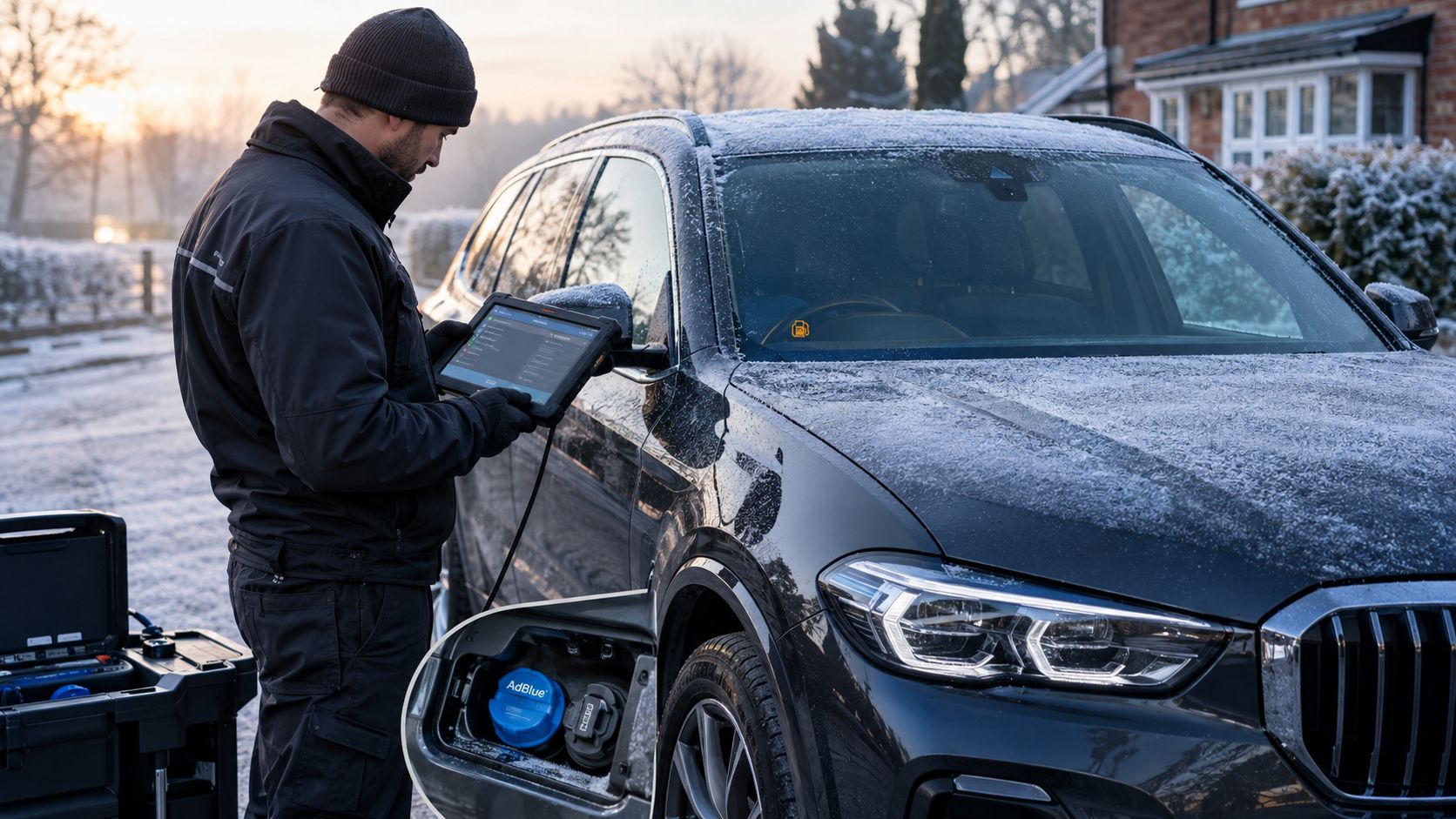
If your dashboard lit up with an AdBlue malfunction warning the morning after a cold night, you’re not alone. This is one of the most common winter callouts we get across the UK, from Scotland down to the South East, and in the vast majority of cases it’s AdBlue freezing or thickening in the tank overnight, not a broken sensor. The sensor is usually just reporting a genuine problem, temporarily frozen fluid, rather than being faulty itself.
That’s the reassuring part. The less reassuring part is that a proper cold snap is also exactly the kind of stress test that finishes off a sensor that was already close to failing. So while frost is the most likely explanation wherever you are in the UK, whether that’s a frosty driveway in Yorkshire or an unheated car park in Surrey, it isn’t automatically the only one. This guide walks you through how to tell the two apart, what to do while you wait it out, and where to get it looked at properly if it isn’t clear.
Why UK Winters Are Particularly Hard on AdBlue
AdBlue is a solution of around 32.5% urea in deionised water, used in diesel engines with SCR (Selective Catalytic Reduction) systems to reduce NOx emissions. That water content is the key detail. AdBlue behaves a little like a very weak antifreeze mix, stable at normal temperatures but vulnerable once it gets genuinely cold, and it starts to freeze at approximately minus 11°C.
UK winters bring exactly the conditions that trigger this. Overnight temperatures regularly dip below freezing across the Midlands, Scotland, and the East of England between November and March, and even milder regions like the South East and London see sharp overnight frosts once or twice a week during cold spells. Most vehicles rely on a heating element built into the AdBlue tank, usually fed by engine coolant, to thaw the fluid enough for the system to take an accurate reading. Until that happens, the car genuinely can’t confirm how much usable AdBlue it has, so it plays it safe with a warning.
This is why the warning tends to cluster around specific conditions, wherever you are:
- The first hard frost of the season, when the system hasn’t dealt with freezing AdBlue in months
- Vehicles parked outside overnight rather than in a garage
- Short journeys, where the engine and tank never get warm enough to fully thaw the AdBlue
- A tank that was already running low heading into the cold snap, since less fluid freezes through faster than a fuller one
Sensor or Cold Weather: How to Tell the Difference
Two sensors are typically involved. The AdBlue level sensor sits in the tank and measures how much fluid is present. Thickened or partly frozen AdBlue can give it an inaccurate reading, since it’s built to read a liquid, not a slush. Our piece on AdBlue level sensor faults and why the warning stays on covers this sensor’s more common genuine failure points too, cold weather or not.
The NOx sensor sits in the exhaust and checks whether AdBlue dosing is actually reducing emissions correctly. If the AdBlue was too thick or frozen to flow properly, dosing can be inconsistent for a short period, which the NOx sensor flags even though nothing is mechanically broken.
Signs the cold is the real cause:
- The warning appeared specifically the morning after a frost, not out of nowhere on a mild day
- The car was parked outside rather than somewhere sheltered
- The message is informational rather than a countdown to no-start
- It eases or clears once the car has been driven for 15 to 30 minutes and the tank has had time to warm through
- You’ve had no previous AdBlue warnings or performance issues
Signs it may genuinely be a sensor fault:
- The warning doesn’t clear even after a full warm-up drive on a milder day
- It returns repeatedly regardless of the weather
- You notice a drop in power, a lit engine management light, or a mileage countdown warning
- A diagnostic scan returns a specific sensor fault code, such as P204F, rather than a generic low AdBlue message
If it keeps returning after multiple cold snaps have already passed, it’s worth reading our explainer on why an AdBlue fault keeps coming back, since a recurring fault is a different situation to a one-off cold morning warning.
Cold Weather vs Sensor Fault: Quick Comparison
| Symptom | More likely cold weather | More likely sensor fault |
| Timing | Appears after a frost | Appears in any weather |
| Warning type | Informational message | Countdown to no-start |
| Clears with driving | Yes, within 15 to 30 minutes | No, or only briefly |
| Fault code on scan | None, or generic low level | Specific sensor code (e.g. P204F) |
| History | First occurrence | Recurring over weeks |
| Performance impact | None | Power reduction or limp mode |
What to Do If the Warning Appears
- Don’t top up AdBlue unnecessarily. If the tank already has a reasonable amount in it, adding more won’t fix a cold-related reading issue.
- Check whether it’s informational or a countdown. A countdown to no-start is more urgent. Our guide to AdBlue countdown to no-start explains exactly what that warning means and how much time you realistically have.
- Take a proper drive. A 20 to 30 minute run gives the tank heater time to thaw the fluid and the system time to take an accurate reading.
- See if it resolves within a day or two. Many cold-related warnings clear once the weather eases or the car has had a longer run.
- If it doesn’t clear, get it scanned. A diagnostic check is the only reliable way to separate a frozen tank from a genuine sensor fault. For a broader view of the general risks of driving on, see how long you can drive with an AdBlue fault.
Does This Vary by Manufacturer?
To some extent, yes. Tank heater design, sensor placement, and how aggressively the system reacts to an uncertain reading all differ between manufacturers. Mercedes owners can find brand-specific patterns in our Mercedes AdBlue system fault guide, and Land Rover drivers often see different fault codes and behaviour, covered in Land Rover AdBlue warning light, causes, and fault codes. For a wider comparison, see AdBlue problems by manufacturer.
Could It Be Crystallisation Rather Than Simple Freezing?
Freezing is temporary and reverses once the fluid warms. Crystallisation is different, it happens when AdBlue dries out on a surface, often around a leaking or dripping injector, and leaves behind solid urea deposits that don’t melt away with a drive. If your warning has lasted longer than a typical cold snap, or you’ve spotted a chalky white residue near the AdBlue system, read can AdBlue crystallisation be repaired.
If you’ve already topped the tank right up and the warning is still showing, that’s a different pattern, and our article on AdBlue fault with the tank full warning still on deals with that scenario directly. And if you’d rather understand the fault in general terms first, our overview of what an AdBlue system fault means and how to fix it and our wider AdBlue problems explained guide are both good starting points.
Should You Keep Driving With the Warning On?
If it’s purely informational, with no drop in performance and no countdown to no-start, it’s generally fine to keep driving while you monitor it over the next day or so. If it escalates, if you notice reduced power, or if the dashboard starts counting down engine starts, that’s the point to stop assuming it’s the weather and get it looked at properly.
Where We Cover This Across the UK
Cold-related AdBlue warnings show up everywhere in the UK, but the pattern is much the same nationwide, a hard frost overnight followed by a dashboard warning the next morning. We offer mobile, same-day AdBlue diagnosis and repair across the country, including:
London & the South East London, Croydon, Reading, Guildford, St Albans, Slough, Sevenoaks, Loughton, Dartford, Epsom, and Esher, or see our wider South East England coverage.
West Midlands, Staffordshire & Warwickshire Birmingham, Coventry, Solihull, Dudley, Wolverhampton, Walsall, Tamworth, Stoke-on-Trent, Nuneaton, Warwick, Rugby, Leamington Spa, Stratford-upon-Avon, Stafford, Cannock, and Lichfield, or see our West Midlands and Warwickshire hub pages.
Shropshire Telford, Shrewsbury, Oswestry, and Bridgnorth, or our Shropshire hub page.
East Midlands & Lincolnshire Nottingham, Leicester, Derby, Grantham, Peterborough, Stamford, Spalding, Market Deeping, and Bourne, or our Lincolnshire hub page.
Yorkshire Leeds, York, and Sheffield.
Scotland Glasgow and Edinburgh, where overnight frosts tend to arrive earlier and more often than further south, making this warning especially common from late autumn onward.
Not sure which page covers you? Our full locations directory lists every area we currently serve.
Our AdBlue Services
If a warm-up drive doesn’t clear the warning, or you’d rather have it confirmed properly, we offer a full range of AdBlue services nationwide:
- AdBlue Repair, including fault diagnosis to confirm whether the cause is cold weather, a sensor, or something else
- AdBlue Fix for a straightforward resolution once the cause is confirmed
- AdBlue Bypass where appropriate
- AdBlue Removal and AdBlue Delete
- NOx Sensor Services for issues specific to the exhaust-side sensor
- Mobile AdBlue removal and repair across the UK, so you don’t need to book the car into a garage
Preventing This Next Winter
- Park somewhere sheltered, such as a garage or car port, whenever a hard frost is forecast
- Keep the AdBlue tank reasonably topped up heading into winter, since a fuller tank takes longer to freeze through than a nearly empty one
- Take at least one longer drive after any cold snap rather than relying only on short trips
- If you’ve had this warning more than once, have the tank heater itself checked, since a weak heater is often what turns a normal winter morning into a repeated fault
The Bottom Line
An AdBlue malfunction warning after a cold night is, more often than not, the system responding to frozen or thickened fluid rather than a failed sensor, wherever in the UK you’re driving. Give the vehicle a proper drive to warm through before assuming the worst. If the warning keeps returning regardless of the weather, escalates to a countdown, or comes with a drop in performance, that’s when it’s worth having the AdBlue system and its sensors properly diagnosed rather than waiting it out. Our mobile diagnosis and repair team covers locations across the UK and can usually get to you the same day.
Frequently Asked Questions
Yes. AdBlue starts to freeze at around minus 11°C. Most vehicles have a built-in tank heater to thaw it after a cold start, which is why the warning often clears after a longer drive.
No. AdBlue expands only slightly compared to water, and tanks are designed with this in mind. The main effect is a temporary warning light and possibly less accurate dosing until the fluid thaws.
It varies by vehicle, but a drive of 15 to 30 minutes is usually enough for the tank heater to melt sufficient fluid for the system to take an accurate reading again.
It can happen anywhere temperatures drop below freezing overnight, but areas that see earlier and more frequent frosts, such as Scotland and parts of the Midlands, tend to see it more often through autumn and winter than milder coastal or southern areas.
Not usually on its own, but if a sensor was already borderline, the added strain of freezing conditions can be what pushes it into failing properly. If the warning doesn’t clear after a full warm-up drive, it’s worth getting checked.
Only if the tank is genuinely low. If it’s already at a reasonable level, adding more AdBlue won’t fix a cold-related reading issue, and overfilling can cause problems of its own.
Yes, we cover locations across London, the South East, the Midlands, Yorkshire, and Scotland with mobile, same-day service. See our locations directory to find your nearest coverage area.

7 Comments
[…] still working out what’s going on. If cold weather’s a factor for you, our guide on AdBlue malfunction warnings after a cold night is worth a look, and our piece on the P204F AdBlue fault code covers a related dosing code that can […]
[…] the pattern. Does the fault appear at start-up, after a long drive, or in cold weather? A warning after a cold night can have several causes, and a partly blocked filter is one of […]
[…] also thickened up, both issues can show up together and get confused for one another. Our guide on an AdBlue warning after a cold night covers that separate cold weather pattern if it’s relevant alongside everything else going […]
[…] same thing. A genuinely frozen tank in deep cold is its own separate situation, and our guide on an AdBlue warning after a cold night covers that scenario […]
[…] line instead of drifting through with the flow. Part of why this spikes every winter. Our guide on AdBlue warnings after a cold night covers a related cold weather issue, though that one’s usually the heater circuit rather than […]
[…] few other articles cover ground that connects directly to this fault. Our piece on AdBlue malfunction warnings after a cold night goes into what happens once fluid actually does freeze, which is often the next stage after a […]
[…] you are getting an AdBlue malfunction warning after a cold night, the tank heater is one of the first things worth checking before assuming it is a sensor or […]