
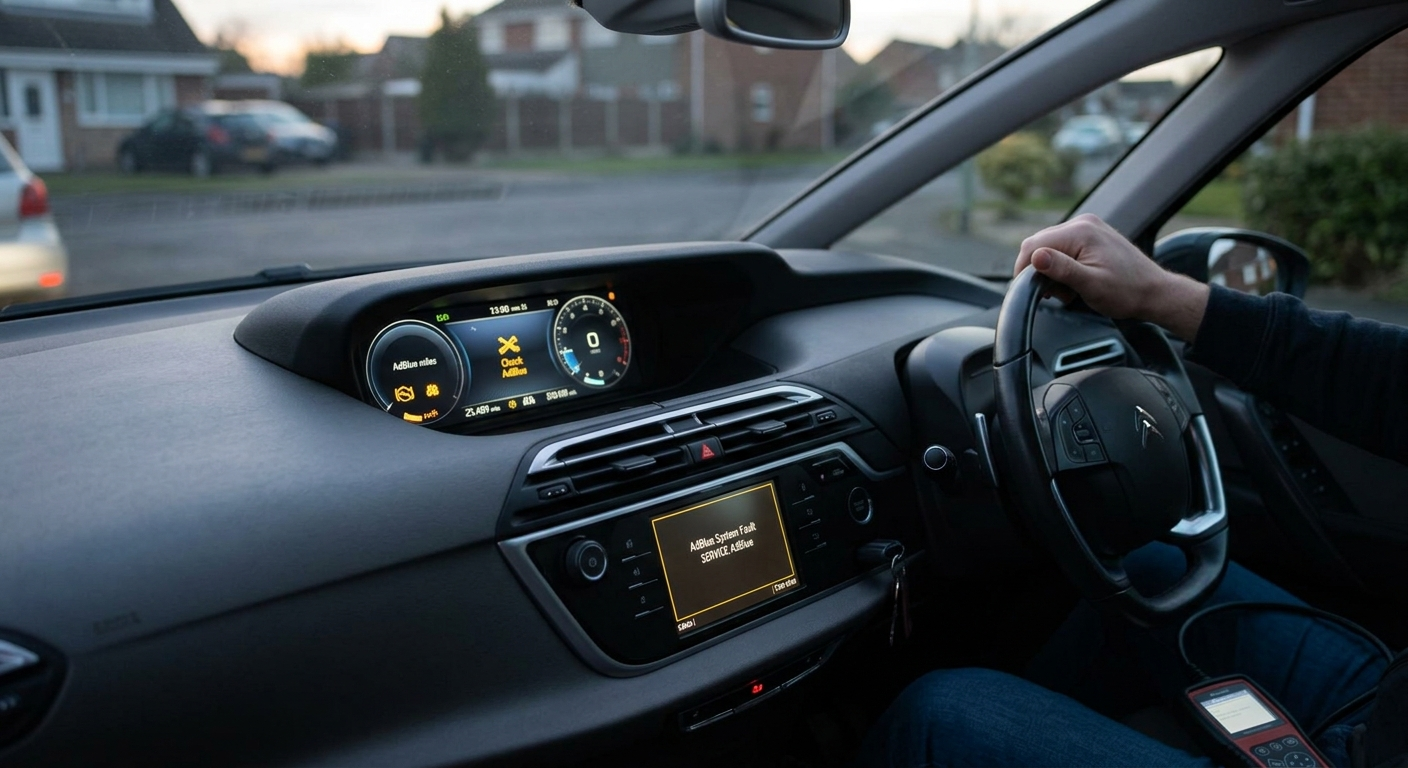
You have had the AdBlue warning cleared. The light went off. You drove away thinking it was sorted. Then three days later, sometimes less, the same warning is back on the dashboard.
This is not a glitch. It is not bad luck. And it is not something that another reset will fix.
When an AdBlue fault returns after being cleared, it means the component or condition that triggered it in the first place is still there. Your car runs continuous self-checks on its AdBlue system every time the engine reaches operating temperature. If the fault condition still exists, it gets logged again, the light comes back on, and you are right back where you started.
The reset clears the record of the fault. It does not repair the system. Those are two completely different things, and confusing them is how drivers end up paying for multiple resets while the actual problem gets worse.
Below is every real cause of a recurring AdBlue fault, what each one looks like in practice, how to tell them apart, and what each one actually needs to fix it properly.
Why Clearing the Code Does Nothing by Itself
Your car’s Engine Control Unit stores fault codes when something in the AdBlue system fails its own performance check. These checks run automatically. The SCR system monitors NOx sensor readings, AdBlue dosing pressure, catalyst efficiency, fluid quality, and pump operation. When any of these fall outside expected parameters, a code is stored and the warning appears.
Clearing the code deletes the stored record. The moment the engine runs its next diagnostic cycle, usually within 50 to 100 miles of driving, the same checks run again. If the same problem is still there, the same code gets stored and the warning comes back.
Some garages clear codes as the first step in diagnosing a fault, which is entirely normal. The issue is when clearing the code also becomes the last step. A warning that returns within a week of being cleared has not been diagnosed. It has been postponed.
Quick Reference: Common Causes, Codes, and What Is Actually Needed
| Root Cause | Common Fault Codes | Key Symptom | What Is Actually Needed |
| Faulty NOx sensor (upstream or downstream) | P20EE, P229F, P2200, P2201 | Fault returns within days, no performance change | NOx sensor replacement |
| SCR catalyst degraded | P20EE, P204F | Fault persistent, sometimes limp mode on dual carriageways | Catalyst replacement or AdBlue system bypass |
| Dosing injector blocked or failed | P20E8, P204F, P20B9 | AdBlue barely drops between top-ups, or drops unusually fast | Injector clean or replacement |
| Contaminated AdBlue in tank | P229F, P203F | Quality warning, fault appeared after a refill | Tank drain, flush, correct refill |
| AdBlue pump worn or failing | P20E8, P20EE | Pressure-related codes, sometimes audible buzzing | Pump replacement |
| Wiring or connector fault | Various, often intermittent | Fault comes and goes, sometimes disappears overnight | Harness inspection and repair |
| AdBlue tank heater failure | P204B, P20CE | Faults worse in cold weather, often clear in summer | Heater element repair or replacement |
| AdBlue level sensor fault | P203F, P0CD4 | Fault logged despite correct fluid level | Sensor replacement |
For a broader breakdown of AdBlue problems and what causes them, that guide covers the full picture.
The NOx Sensor: The Most Misdiagnosed Cause
This is the single most common reason an AdBlue fault keeps returning, and it is also the most frequently misdiagnosed.
Most diesel vehicles with SCR systems have two NOx sensors. One sits upstream, before the SCR catalyst, measuring the nitrogen oxide content coming out of the engine. The other sits downstream, after the catalyst, measuring what is left after the AdBlue has done its job. The ECU compares the two readings constantly. The downstream reading should be significantly lower than the upstream one, confirming that NOx is being converted.
When the downstream NOx sensor starts drifting, sticking on a fixed voltage, or giving readings that do not respond to changes in throttle or load, the ECU concludes that the catalyst is not working. Code P20EE (SCR NOx Catalyst Efficiency Below Threshold) is the typical result. This code looks, on the surface, like a failing catalyst. It is not always. In a significant number of cases, it is a faulty downstream sensor mimicking a catalyst problem.
The only reliable way to tell them apart is live data monitoring. With the engine at operating temperature and under load, a healthy downstream NOx sensor should produce readings that change dynamically as throttle input changes. A faulty one will either flatline at a fixed value, read implausibly high compared to the upstream sensor regardless of conditions, or produce erratic spikes. If both sensors are reading within normal ranges individually but the calculated conversion efficiency is consistently low, that is more likely to be the actual catalyst.
This fault is disproportionately common on certain platforms. Mercedes-Benz C and E Class OM651 and OM654 engines see a lot of downstream NOx sensor failures. BMW N47 and B47 engines have a known history with this too. VW group TDI engines fitted to Passat, Tiguan, and Transporter T6 platforms are also frequent offenders. On Ford Transit Custom 2.0 EcoBlue engines, NOx sensor faults account for a large proportion of recurring AdBlue warnings. If you drive one of these and the fault keeps returning after a reset, the sensor is the first thing worth properly testing.
You can see a full breakdown of AdBlue problems by manufacturer including which faults are most common on specific platforms.
Our NOx sensor services cover testing and replacement across all major vehicle makes, including mobile callout.
The SCR Catalyst: When the Converter Is Genuinely Worn Out
The SCR catalyst is a honeycomb substrate coated in materials that, when AdBlue decomposes into ammonia at high temperature, facilitate a chemical reaction converting NOx into nitrogen and water. Over time, the coating degrades. Oil ash from a slightly worn engine can block the substrate channels. Contamination events where coolant or fuel enters the exhaust stream accelerate the process dramatically.
A genuinely degraded catalyst shows specific live data characteristics. Both NOx sensors will be operating within their individual normal ranges, but the conversion efficiency figure the ECU calculates will sit persistently below the required threshold, typically below 70% on most platforms. It will not respond to resets for long. It will not improve after a NOx sensor replacement. And it will often get slightly worse over time as the substrate continues to deteriorate.
Catalyst replacement costs vary considerably. On a Ford Transit, a genuine Ford SCR catalyst assembly can cost £900 to £1,400 fitted. On a Mercedes E Class with a combined DPF and SCR unit, costs can reach £2,000 or above. On older vehicles where this repair cost exceeds a reasonable proportion of the car’s value, a permanent AdBlue bypass is often a more practical route. The bypass eliminates the SCR system from the ECU’s monitoring loop entirely, so the fault will not return.
The AdBlue Dosing Injector: Blocked, Crystallised, or Worn
Every time the SCR system is active, the dosing injector pulses a fine mist of AdBlue directly into the exhaust gas stream. AdBlue is a water-based solution, and after the injector fires, residual fluid left in the nozzle tip can crystallise in the heat. Over time, this crystalline deposit builds up and restricts the injector’s output.
A partially blocked injector delivers less AdBlue than the ECU is commanding. The system detects insufficient NOx reduction and logs a fault. The fault clears when the code is deleted, but on the next drive cycle the injector is still blocked, the reduction is still insufficient, and the fault comes straight back.
There are two patterns in how this presents. Some vehicles with a partially blocked injector show dramatically reduced AdBlue consumption because less fluid is actually being injected. Others show the opposite, because the ECU compensates for poor NOx reduction by commanding more fluid, which accelerates consumption. Without actual flow rate testing, the injector can be overlooked entirely.
For a detailed look at what a blocked injector looks like in practice, the guide on AdBlue injector blockage symptoms and repair goes into more depth. If you are also seeing white crystalline deposits around the injector housing, AdBlue crystallisation repair explains whether it can be cleaned or needs replacing.
Contaminated AdBlue: The Cause That Gets Overlooked
AdBlue has a specific composition: 32.5% high-purity automotive urea dissolved in deionised water, produced to ISO 22241 standard. It is not interchangeable with agricultural urea solutions, screenwash, or any other fluid. The quality sensor in the tank measures the electrical conductivity of the fluid to confirm it matches specification.
A few situations cause quality faults. AdBlue that has been stored in heat above 25 degrees Celsius for an extended period begins to degrade. Fluid poured through a dirty funnel or container that previously held another substance picks up contamination. Some drivers buy AdBlue from market stalls or small online sellers whose stock has not been stored correctly or is not to automotive spec.
The quality fault code, usually P229F, will return on every drive cycle because the fluid in the tank does not change between resets. Topping up with fresh correct-spec AdBlue over contaminated fluid does not help either, because dilution does not restore the conductivity to the correct range quickly enough.
If your AdBlue tank is full but the warning is still on, contamination or a quality sensor issue is often the reason. The proper fix is draining the tank completely, flushing it, and refilling with fresh ISO 22241 fluid from a reputable source.
The AdBlue Pump: Pressure Faults and Cold Weather
The AdBlue pump sits inside or adjacent to the tank assembly and is responsible for drawing fluid and pressurising it to approximately 5 bar before it reaches the dosing injector. If the pump cannot maintain the required pressure, code P20E8 appears. The system detects low reductant pressure, the dosing cycle does not complete correctly, and the fault returns as soon as the next drive cycle runs.
Pump faults are more common on vehicles over five years old and on those that operate regularly in sub-zero temperatures. AdBlue freezes at minus 11 degrees Celsius. While the tank has an integrated heating element to prevent this, repeated freeze-thaw cycles stress the pump seals and internal components.
A worn pump produces a slightly different sound during startup. Some drivers describe a faint buzzing or whirring from the rear of the vehicle in the first few minutes after a cold start, which is the AdBlue system priming. A pump that is struggling will sometimes be noisier than normal during this phase, though this is not always obvious from inside the vehicle.
Our AdBlue repair service covers pump diagnosis and replacement across all major platforms, with mobile callout available across the UK.
Wiring and Connectors: The Fault That Keeps Getting Missed
The AdBlue system is not a single unit. It is a network of components connected by wiring that runs from the tank assembly at the rear of the vehicle, along the underside, up to the dosing injector, SCR catalyst, NOx sensors, and associated control modules. This wiring is exposed to road salt, water ingress, heat cycling from the exhaust, and years of vibration.
A corroded multi-plug connector, a chafed wire rubbing against a heat shield, or a pin that has slightly backed out of its housing can cause a fault code that points at the sensor or component that connector feeds. Replace the component, clear the code, and the fault returns because the actual problem was never the component. It was always the connection feeding it.
This is frustratingly common and often takes longer to diagnose than a straightforward component failure. If a component has been replaced and the fault is still returning, a full wiring inspection is the next step before replacing anything else.
The AdBlue Tank Heater: A Winter-Specific Fault
Inside the AdBlue tank is a heating element designed to warm the fluid when ambient temperatures drop. Because AdBlue freezes at minus 11 degrees Celsius, the heater is essential for cold weather operation. If the heater element fails or its control circuit develops a fault, the system cannot guarantee fluid availability at low temperatures.
Code P204B or P20CE is the typical result. What makes this fault distinctive is its seasonality. Drivers often report that the fault appears in October or November, clears through summer when the heater is never needed, and then returns again in autumn. Some assume the fault has resolved itself. It has not. The system simply stopped needing to use the heater and stopped detecting the failure.
If you are getting an AdBlue malfunction warning after a cold night, the tank heater is one of the first things worth checking before assuming it is a sensor or catalyst issue.
How Many Resets Before Your Car Will Not Start?
Every vehicle with an AdBlue system has a built-in lockout mechanism. Once the ECU determines that the system has been faulty for long enough, or has been reset too many times without repair, it initiates a countdown. At the end of that countdown, the car will not restart after the next ignition off.
| Manufacturer | Countdown Format | Warning Text |
| Mercedes-Benz | Start cycle countdown | “Engine start not possible after X starts” |
| BMW | Mileage countdown | “No Engine Start in X miles” |
| Volkswagen / Audi | Mileage countdown | “AdBlue range Xkm. Drive to workshop” |
| Ford | Mileage countdown | “AdBlue X miles to service” |
| Vauxhall / Opel | Mileage countdown | Displayed in DIC, varies by model |
| Renault / Peugeot / Citroen | Miles or start countdown | Varies by platform |
The full guide on the AdBlue countdown to no-start explains exactly what happens at each stage and how much time you realistically have. If you are already seeing a countdown and need to know how long you can drive with an AdBlue fault, that covers the safe limits by vehicle type.
What a Proper Diagnosis Should Actually Include
A code reader tells you which part of the system failed its check. It does not tell you why. The following is what distinguishes a proper AdBlue diagnostic from a code-clear-and-hope:
Live NOx data from both upstream and downstream sensors, read simultaneously at operating temperature and under varying throttle load. This is the only reliable way to separate a failing NOx sensor from a failing catalyst.
AdBlue quality testing from the tank itself, not just reading the quality code. A dedicated quality tester measures the actual conductivity of the fluid and confirms whether it is within specification.
Dosing injector pressure and flow rate test. This checks whether the injector is delivering the volume of fluid the ECU is commanding.
SCR catalyst efficiency calculation from live NOx data, not just from the fault code. The code says efficiency is below threshold. The live data shows by how much, and whether it is getting worse.
Full wiring inspection for any component that has been replaced without resolving the fault.
Without these, a diagnosis is incomplete regardless of which components have already been replaced.
When Repair Is Not the Right Answer
On high-mileage vehicles where the SCR catalyst has deteriorated beyond cost-effective repair, or where multiple components have failed together, a permanent AdBlue fix or AdBlue removal is sometimes the more practical solution. This removes the SCR system from the ECU’s monitoring loop entirely. The fault will not return because the system is no longer checking components it cannot verify.
If you want to understand all your options before deciding, our mobile AdBlue removal and repair service covers the full UK and includes a diagnostic assessment before any work is carried out.
“`htmlFrequently Asked Questions
Because the system that triggered the fault is still in the same condition it was before the reset. Your car checks its AdBlue system every time the engine runs through its warm-up cycle. If the same fault condition is still present, the same code gets stored and the warning returns. The only way to stop it returning is to fix the actual cause.
Ask specifically for a live data diagnostic, not just a code read and clear. You want to see live NOx sensor readings from both sensors at operating temperature, an AdBlue quality test from the tank, and a dosing pressure check. If your garage cannot provide these, it is worth taking the vehicle to a specialist.
Technically yes, but it is not a good idea. The more times the fault is reset without being repaired, the closer you get to the manufacturer’s lockout threshold. Once the vehicle enters no-start mode, it will not restart after switching off. Recovering a vehicle that has locked out is more complicated and more expensive than fixing the fault while the car is still driveable.
Yes. If the fluid in the tank is contaminated or not to ISO 22241 specification, the quality sensor will log a fault on every drive cycle. This will not resolve by adding more fresh fluid on top. The tank needs to be drained and refilled with correct-spec AdBlue.
An AdBlue level warning and an AdBlue system fault are different things. A full tank does not prevent a dosing injector, NOx sensor, pump, or catalyst from triggering a fault code. The level sensor and the system performance checks are separate. If the AdBlue level sensor itself is at fault, that is a separate diagnosis.

7 Comments
[…] broader guides on what an AdBlue system fault actually means and how to fix it, why an AdBlue fault keeps coming back and how long you can actually drive with an AdBlue fault all give useful wider context if […]
[…] one, that’s progress. The first problem is gone and the next one is now visible. Our guide on why an AdBlue fault keeps coming back covers repeat faults more […]
[…] rather than within minutes, that’s a different pattern worth checking against our guide on why an AdBlue fault keeps coming back instead, since that usually points somewhere […]
[…] back a day or two later rather than within minutes, that’s a different pattern. Worth reading why an AdBlue fault keeps coming back instead, since that usually points somewhere else […]
[…] deserves a serious look. This is exactly the kind of situation drivers describe when their fault keeps coming back no matter what’s already been done to […]
[…] Last one: the fault that simply won’t stay fixed. If a previous repair, whether that was a sensor, an injector or a pump replacement, hasn’t actually solved anything and the same warning is back, the wiring feeding that component deserves a proper look before anything else gets swapped out. This exact pattern is one of the most common questions we get asked, and we’ve gone into it separately in why does an AdBlue fault keep coming back. […]
[…] but only after the real fault has been fixed. If you’ve been through this already, read why does my AdBlue fault keep coming back after a reset? and why does my AdBlue fault keep coming […]