
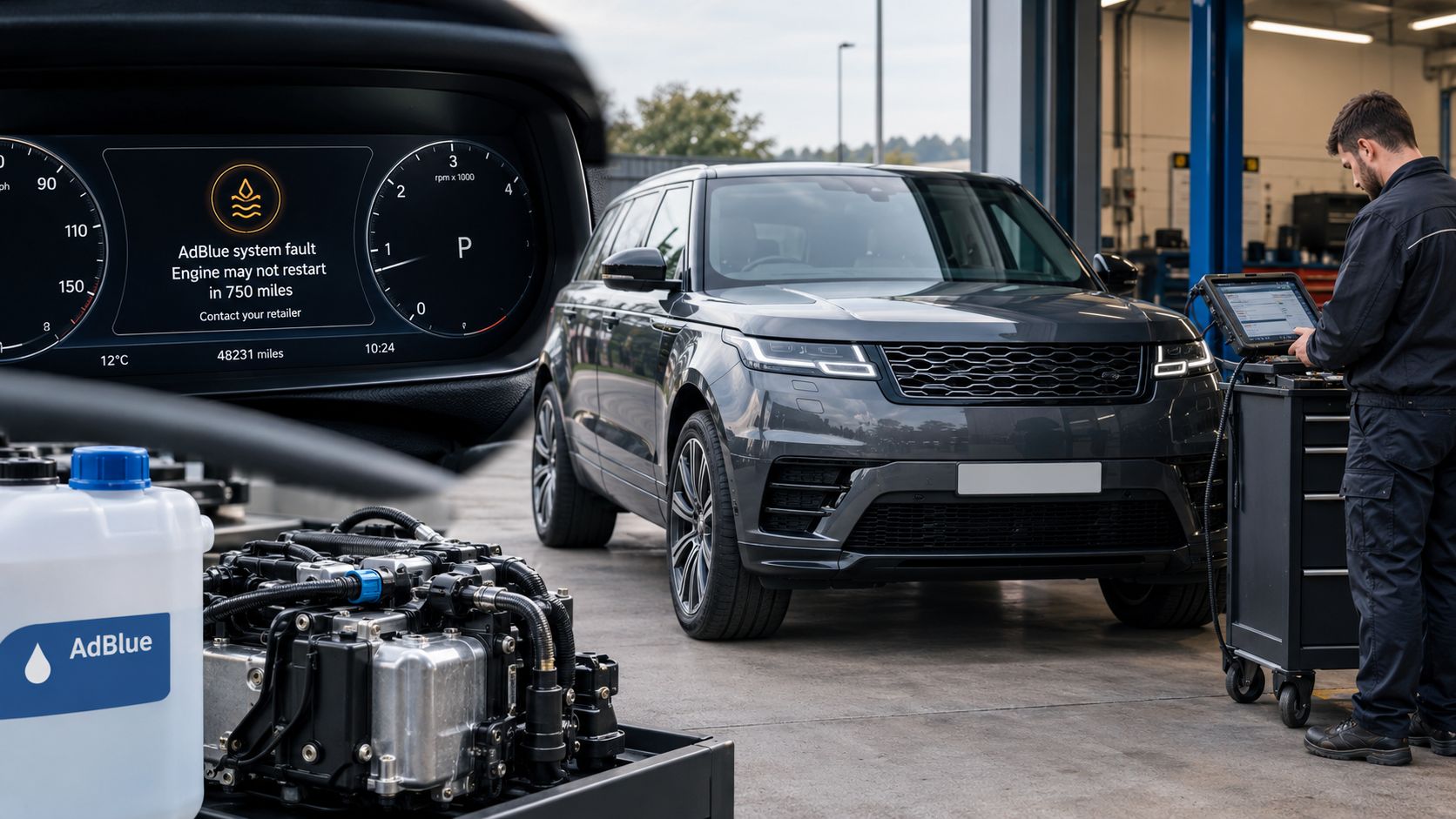
A Land Rover AdBlue warning light usually means one of three things: the tank’s genuinely low, the level sensor’s giving a false reading, or there’s a fault somewhere in the dosing system itself. On Land Rover and Range Rover models specifically, there’s a fourth cause worth knowing about too, one that catches a lot of owners out because it’s almost the opposite problem. Overfill the tank rather than underfill it, and the ultrasonic sensor some models use can misread a completely full tank as empty.
That’s the short version, and if you’re staring at this warning on a Discovery, Discovery Sport, Evoque, Range Rover Sport or full-size Range Rover right now, it’s worth understanding why Land Rover models throw this warning slightly differently to a lot of other diesels. So here’s what’s actually going on, the fault codes you’re likely to see, and how it gets fixed properly.
Why Land Rover AdBlue Faults Are a Bit Different
Most modern diesels use a fairly straightforward float-style level sensor in the AdBlue tank. Several Land Rover and Range Rover models, particularly Discovery, Discovery Sport, Evoque and the Range Rover Sport and full-size Range Rover, use an ultrasonic sensor instead, which measures fluid level by bouncing a signal off the surface of the AdBlue.
Here’s the quirk. That sensor needs a small air gap at the top of the tank to read correctly. Fill the tank right to the very brim with no air space left, and the sensor can genuinely misread it as empty, triggering the exact warning you’re trying to avoid by topping up in the first place. It’s a well-known issue among Land Rover specialists and owners’ forums, and it’s precisely the opposite of what most drivers would assume, since “the light’s on, so I’ll fill it right up” is the natural response, and on these models it can occasionally make things worse rather than better.
Common Symptoms of a Land Rover AdBlue Fault
- AdBlue or engine warning light appearing on the dash, sometimes straight after a refill
- A message warning the engine won’t restart after a certain number of miles
- Reduced power or the vehicle entering a limited driving mode
- The fluid gauge showing an inaccurate reading, sometimes reading empty when the tank’s genuinely full
- The warning appearing intermittently rather than staying on constantly
- Occasionally no other symptoms at all beyond the warning itself, with the vehicle otherwise driving normally
Quick Reference: Common Causes by Land Rover Model
| Model | Most Common Cause | Notes |
| Discovery / Discovery Sport | Level sensor misread, low fluid | Ultrasonic sensor sensitive to overfilling |
| Range Rover Evoque | Level sensor fault, tank overfill | Smaller tank capacity, faults can appear sooner |
| Range Rover Sport | Dosing module or injector fault | Higher-mileage vehicles more prone to blockages |
| Range Rover (full-size) | NOx sensor or quality sensor fault | Complex dual-tank setups on some model years |
| Freelander 2 (older) | Wiring or ECU communication fault | Known for broader electrical fault patterns |
This is a general guide based on the faults we see most often, not a guarantee for your specific vehicle, since individual history, mileage and previous repairs all play a part too.
Common Fault Codes on Land Rover AdBlue Systems
If you’ve had a scan done, codes like P20E8, P207F, P204F, P20EE, P229F, P203F, P203E, P2564, P2565 and P2566 tend to come up most often on Land Rover and Range Rover models specifically. These span reductant pressure and dosing faults through to level and quality sensor circuit issues. Land Rover’s own diagnostic software sometimes labels these slightly differently to a generic OBD reader, so if you’ve had a basic scan done and the description doesn’t quite match what you’re reading online, that’s usually why, not a sign of anything more unusual going on. Send us your exact code and we’ll tell you straight away what it’s likely pointing to on your specific model.
Should You Top Up the Tank First?
Worth a top-up if you’re genuinely unsure the tank’s low, but do it properly rather than brimming it completely, particularly on Discovery, Discovery Sport, Evoque, Range Rover Sport and full-size Range Rover models with the ultrasonic sensor. Filling to the recommended level with a small air gap left at the top gives the sensor a proper chance to read correctly, rather than triggering the exact fault you’re trying to clear.
If the warning’s still there after a sensible top-up, or it reappears within a day or two, that’s a fairly strong sign you’re dealing with a genuine sensor or system fault rather than simply low fluid, and it’s worth getting looked at properly rather than repeatedly topping up and hoping.
How We Diagnose and Fix a Land Rover AdBlue Fault
We start with a full diagnostic scan using the same Land Rover and Range Rover-specific software a main dealer would use, not a generic reader that might miss model-specific detail. That matters more on these vehicles than most, given how differently some models present the same underlying fault.
Where the level sensor’s the issue, whether that’s a genuine failure or a reading thrown off by overfilling, we sort that as part of our AdBlue repair service. Where the dosing module or injector’s at fault, that falls under a proper AdBlue fix, and where the NOx sensor’s the real culprit rather than AdBlue itself, our NOx sensor services covers that directly. If your countdown’s already run out and the vehicle won’t restart, our no-start countdown bypass gets you moving again without a dealer appointment hanging over you.
For older or higher-mileage Land Rovers with recurring AdBlue trouble, particularly ones that keep needing the same fix repeated, it’s sometimes worth discussing an AdBlue delete or AdBlue removal, both of which take the system out of the equation permanently. If you’d rather keep the system working as designed but stop the recurring grief, our AdBlue bypass is worth a look too. Every repair carries a lifetime warranty for as long as you own the vehicle.
Why This Fault Keeps Coming Back on Some Land Rovers
If this isn’t the first time you’ve dealt with an AdBlue warning on the same vehicle, you’re not alone. It’s a pattern we see fairly often on Land Rover models specifically, usually because the original fix addressed the symptom rather than the actual cause, whether that’s a sensor replaced without checking why it failed, or a fault cleared without confirming the ECU strategy’s actually reset properly. We’ve gone into this in a lot more depth in our guide on why an AdBlue fault keeps coming back, which is worth reading if this is your second or third time dealing with the same warning.
If you’re not sure how much driving time you’ve actually got left before it escalates, our piece on how long can you drive with an AdBlue fault covers that in detail, and if the countdown’s already hit zero, what happens when it reaches 0 miles explains exactly what you’re dealing with. If you suspect the injector specifically rather than a sensor, our guide on blocked AdBlue injectors covers those symptoms and causes too, and our broader piece on AdBlue system faults is worth a read if you’re trying to understand the full range of what an AdBlue warning can actually mean.
The overfilling issue covered earlier in this guide is closely related to a fault we cover in more depth elsewhere too. If your warning’s staying on even with a full tank, whether that’s from overfilling or a genuine sensor fault, our piece on AdBlue fault: tank full, warning still on walks through exactly why that happens and what to do about it. Related to that, our guide on AdBlue level sensor faults goes into the sensor side specifically, which is directly relevant given how many Land Rover faults trace back to the level sensor itself.
If you’ve had a code read and it’s showing P204F specifically, one of the more common codes across Land Rover and other manufacturers alike, our dedicated guide on the P204F AdBlue fault code breaks down exactly what it means and what fixing it involves. And if crystallisation’s a suspect, particularly relevant with the ultrasonic sensor design discussed above, our piece on whether AdBlue crystallisation can be repaired covers that specifically.
For a broader view across different manufacturers, not just Land Rover, our guide on AdBlue problems by manufacturer is worth a look, and our general explainer on AdBlue problems explained covers the basics if you’re still getting to grips with how the system works overall. If you drive a Mercedes alongside your Land Rover, or you’re comparing notes with a friend or family member’s vehicle, our piece on Mercedes AdBlue system faults covers how the same underlying issue presents differently on that platform.
Land Rover AdBlue Repairs in London
London’s one of our busiest areas for Land Rover and Range Rover work specifically, and it makes sense given how many of these models are on the road across the capital. Our mobile engineers cover the whole of Greater London, bringing Land Rover-specific diagnostic software and the same OEM-level tools a main dealer would use, without the dealer pricing or the wait for an appointment slot.
Most London call-outs are sorted at your home or workplace within the hour of us arriving, whether that’s a Discovery Sport showing a warning after the school run or a Range Rover Sport that’s dropped into limp mode on the way into the office. If you’re anywhere across London and dealing with a Land Rover-specific AdBlue fault, it’s worth having someone familiar with these models specifically look at it, rather than a generic diesel fix that might miss the model-specific quirks covered above.
Mobile Engineers Across the UK
Beyond London and the South East, where we also cover Croydon, Reading, Guildford, Epsom, Dartford, Loughton, Sevenoaks, Slough and St Albans, we travel a lot further too. North of the border, Edinburgh and Glasgow. Across Yorkshire, Leeds, Sheffield and York.
The Midlands keeps us busiest outside London and the South East, covering Coventry, Derby, Leicester, Nottingham, Birmingham and Grantham, plus the wider West Midlands taking in Walsall, Wolverhampton, Dudley and Solihull. We’re also across Shropshire, including Stoke-on-Trent and Tamworth, and Warwickshire, covering Rugby, Warwick and Nuneaton.
Further east, we regularly cover Lincolnshire, including Market Deeping, Stamford, Spalding and Peterborough.
Can’t see your area listed? Get in touch anyway, since we travel well beyond these towns fairly often, and same-day callouts are usually available across most of the UK if you book before midday.
Running a fleet of Land Rover Defenders or Discovery Commercials? It’s worth pairing any AdBlue work with a look at our HGV remapping service too.
Frequently Asked Questions
Often down to overfilling. Several Land Rover and Range Rover models use an ultrasonic level sensor that needs a small air gap at the top of the tank to read correctly, and brimming it completely can trigger a false empty reading.
Discovery, Discovery Sport, Evoque, Range Rover Sport and full-size Range Rover models are the ones we see most often, largely due to the ultrasonic sensor design and, on higher-mileage vehicles, dosing system wear.
Codes like P20E8, P207F, P204F, P20EE, P229F, P203F, P203E, P2564, P2565 and P2566 come up frequently, covering dosing, pressure and sensor circuit faults.
Yes, on models using an ultrasonic level sensor. Filling right to the brim with no air gap can cause the sensor to misread a full tank as empty.
It varies by model, generally somewhere between 14 and 18 litres depending on the vehicle, with the Evoque typically on the smaller end and larger Discovery and Range Rover models holding more.
For a while, yes, but most models start a mileage countdown once the fault’s logged, after which the engine won’t restart once switched off. Best sorted before that point.
No. Mobile independent specialists using Land Rover-specific diagnostic software can usually diagnose and fix it faster and cheaper, without the wait for a dealer appointment.
It can, if the underlying cause, overfilling habits or a related fault, isn’t addressed alongside the sensor itself. A proper diagnostic helps avoid this.
Yes. The two systems are closely linked, so a failing NOx sensor can trigger warnings that look identical to a genuine AdBlue fault.
It depends on the actual cause once diagnosed. A sensor issue costs less than a dosing module or injector replacement. We confirm a fixed price after diagnosis rather than guessing.
Yes. Book before midday and we’ll usually reach you the same day, anywhere across Greater London, at your home or workplace.
Yes, though it’s generally better suited to older or higher-mileage vehicles with recurring faults rather than newer models still within warranty, and it comes with legal considerations worth discussing first for road use.
Land Rover AdBlue Warning On? Get It Sorted Today
Whether it’s a Discovery Sport, Evoque, Range Rover Sport or full-size Range Rover, don’t keep topping up and hoping it clears. Get a free, no-obligation quote and we’ll tell you exactly what’s causing it. Browse our full AdBlue fix services, read more about our mobile AdBlue removal and repair coverage across the UK, or call 0330 043 4431 to speak to an engineer now.

6 Comments
[…] by make. Guides on specific vehicles, including Ford Transit, Citroën, Peugeot Partner, Nissan, Land Rover and Mercedes, cover how this tends to show up on each one if you’re trying to narrow things […]
[…] Our guides on specific manufacturers, including Ford Transit, Citroën, Peugeot Partner, Nissan and Land Rover, cover how AdBlue faults tend to show up on each of those, if you’re trying to work out […]
[…] our guides on specific manufacturers, including Ford Transit, Citroën, Peugeot Partner, Nissan, Land Rover and Mercedes, cover how AdBlue faults tend to show up on each of those […]
[…] over time. Our vehicle specific guides for Ford Transit, Citroën, Peugeot Partner, Nissan, Land Rover and Mercedes cover the more common patterns per make if you want detail specific to what […]
[…] covers the basics. If you’re running a mixed fleet, our guides on Nissan AdBlue faults, Land Rover AdBlue warning lights and Mercedes AdBlue system faults cover those platforms […]
[…] fault guide, and Land Rover drivers often see different fault codes and behaviour, covered in Land Rover AdBlue warning light, causes, and fault codes. For a wider comparison, see AdBlue problems by […]