
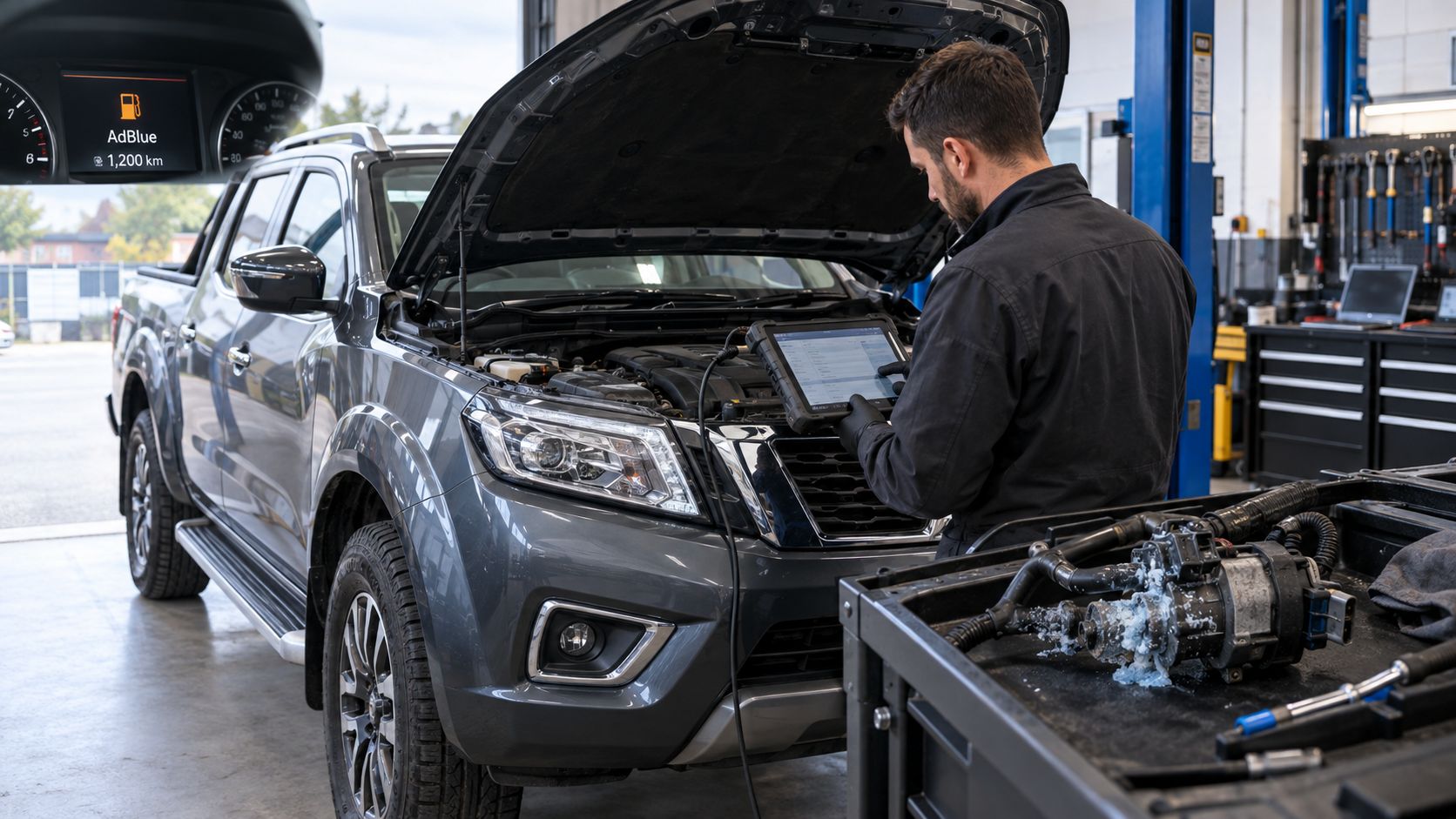
Most Nissan AdBlue faults come down to one of three things: a failing NOx sensor, a blocked or crystallised dosing injector, or a level sensor giving the ECU a reading it can’t trust. On Nissan diesels specifically, the NOx sensor is the one that comes up most often, and it’s frequently the real cause behind a countdown that no amount of topping up the tank will clear.
If you’re seeing an AdBlue warning or a mileage countdown on a Navara, Qashqai, X-Trail, Juke or Primastar, this guide covers what’s actually triggering it, the fault codes Nissan tends to throw, and how it gets resolved properly rather than temporarily.
Why Nissan AdBlue Faults Often Trace Back to the NOx Sensors
Nissan’s SCR setup, like most Euro 6 diesels, uses NOx sensors both upstream and downstream of the catalytic converter. The ECU compares the two readings to confirm the system’s actually reducing NOx as it should be. Under normal conditions, it’s looking for around a 90% reduction after the SCR catalyst once the system’s up to operating temperature.
Here’s where it gets tricky on Nissan models. A downstream sensor reading high doesn’t automatically mean the sensor itself has failed. It could mean the SCR catalyst has failed, or, and this catches technicians out fairly regularly, it could mean the dosing injector is leaking. NOx sensors can’t actually distinguish between NOx and ammonia, so an over-dosing or leaking injector can produce a high reading from the rear sensor that looks exactly like a failed sensor or a failed catalyst.
This matters because it’s a genuine reason Nissan AdBlue faults sometimes get “fixed” with a new sensor that doesn’t actually resolve anything. If the injector was the real problem, a fresh NOx sensor just reads the same ammonia and throws the same fault a few weeks later.
Common Nissan AdBlue Symptoms
- AdBlue warning light on the dash, with or without an engine management light
- A mileage countdown warning that the engine won’t restart after a set distance
- Reduced power or the vehicle entering limp mode
- The warning persisting after a top-up, sometimes reappearing within days
- Fluid depleting noticeably faster than expected, which can point to a leaking injector
- Warnings appearing more often in cold weather, pointing toward a tank heater issue
Common Causes by Nissan Model
| Model | Most Common Cause | Notes |
| Navara (2.3 dCi D23) | NOx sensor fault | U059E and related sensor codes come up frequently |
| Qashqai (1.5/1.7 dCi) | NOx sensor or dosing injector | Short-journey city use increases crystallisation risk |
| X-Trail (1.6/2.0 dCi) | Level sensor or injector fault | Warning often persists after refill |
| Juke (1.5 dCi) | NOx sensor, tank heater | Smaller tank, faults can surface sooner |
| Primastar / NV300 | Injector crystallisation | Van use patterns, stop-start delivery driving |
This reflects the faults we see most often rather than a guarantee for your specific vehicle, since mileage, service history and previous repairs all factor in.
Fault Codes Common on Nissan AdBlue Systems
Nissan diesels commonly throw U059E, which relates to invalid data being received from the nitrogen oxide sensor, alongside more universal codes like P204F, P20EE, P229F, P207F, P203F and P2047. U059E in particular is one worth knowing about if you drive a Navara, since it comes up regularly on the 2.3 dCi and is almost always tied to the NOx sensor circuit rather than the AdBlue fluid itself.
If you’ve had a code read and it’s P204F specifically, one of the most common AdBlue codes across all manufacturers, our dedicated guide on the P204F AdBlue fault code covers exactly what it means and how it’s typically resolved. Send us whatever code is showing on your Nissan and we’ll tell you straight away what it’s likely pointing to.
Why a Top-Up Often Doesn’t Fix a Nissan AdBlue Warning
This is one of the most common frustrations we hear from Nissan owners. The tank gets filled, the warning clears briefly, and within a few days it’s back, sometimes with the countdown picking up exactly where it left off rather than resetting.
Almost always, that means the fluid level was never the real problem. A NOx sensor, a leaking or blocked injector, or a level sensor fault will keep triggering the warning regardless of how full the tank is. We’ve covered this pattern in detail in our guide on AdBlue fault: tank full, warning still on, and if the sensor side specifically is what you’re dealing with, our piece on AdBlue level sensor faults goes deeper into why the warning stays put.
Crystallisation on Nissan Diesels
Nissan diesels used mainly for short, stop-start journeys, think Qashqai school runs or Primastar delivery work around town, are more prone to AdBlue crystallising around the dosing injector. The injector needs high exhaust temperatures to work properly, and a vehicle that rarely gets a proper motorway run doesn’t always reach them consistently.
If crystallisation is a suspect on your vehicle, our guide on whether AdBlue crystallisation can be repaired covers what’s involved, and if you think the injector itself is blocked rather than the sensor being at fault, our piece on blocked AdBlue injectors walks through the symptoms and fix.
What If the Countdown’s Already Started?
If your Nissan is showing a countdown rather than just a warning light, you’ve typically got somewhere between 400 and 1,000 miles before the engine refuses to restart, though the exact figure varies. Our guide on how long can you drive with an AdBlue fault covers this in more detail, and if you’re already at zero and the vehicle won’t start at all, what happens when the countdown reaches 0 miles explains exactly what you’re dealing with and what comes next.
How We Diagnose and Fix a Nissan AdBlue Fault
Because so many Nissan AdBlue faults trace back to the NOx sensors, and because a high rear-sensor reading can mean three completely different things, proper diagnosis matters more here than simply reading a code and ordering a part. We check data from both sensors, upstream and downstream, during a proper drive cycle rather than at idle, since NOx conversion only happens once the system’s at operating temperature. That’s how you tell a genuinely failed sensor apart from a leaking injector or a failed catalyst producing the same reading.
Where the NOx sensor is genuinely at fault, our NOx sensor services covers that directly. Where the injector’s blocked, crystallised or leaking, that’s handled through our AdBlue fix service, and where a component needs replacing outright, our AdBlue repair service fits proper OEM or OEM-equivalent parts rather than the cheapest option available. If your countdown’s already run out, our no-start countdown bypass gets you moving again without waiting on a dealer appointment.
For older or higher-mileage Nissans with genuinely persistent AdBlue trouble, an AdBlue delete or AdBlue removal takes the system out of the equation permanently, and our AdBlue bypass is worth discussing if you’d rather keep the system running as designed while stopping the recurring warnings. Every repair carries a lifetime warranty for as long as you own the vehicle.
If this isn’t the first time you’ve had this fault fixed on the same vehicle, our guide on why an AdBlue fault keeps coming back is worth reading, since the NOx sensor versus injector confusion described above is one of the most common reasons a Nissan AdBlue repair doesn’t hold.
For a wider view across other makes, our guide on AdBlue problems by manufacturer compares how the same underlying faults present differently, and our general explainer on AdBlue problems explained covers how the system works overall. If you’re comparing against other makes specifically, our guides on Mercedes AdBlue system faults and Land Rover AdBlue warning lights cover those platforms in detail. And if you want the general picture of what an AdBlue warning can mean before narrowing down to your specific model, our piece on AdBlue system faults is a good starting point.
Nissan AdBlue Repairs in London
Nissan diesels make up a decent share of our London callouts, particularly Qashqai and X-Trail models used for daily city driving, and Primastar and NV300 vans doing delivery and trade work across the capital. Both use patterns that lend themselves to exactly the crystallisation and short-journey issues described above, so it’s a fault we see constantly across London.
Our mobile engineers cover the whole of Greater London, bringing OEM-level diagnostic equipment capable of reading both NOx sensors properly rather than just pulling a generic code. Most London jobs are sorted at your home, workplace or depot within the hour, which makes a real difference if it’s a working van rather than a personal car sitting idle.
Mobile Engineers Across the UK
Beyond London and the South East, where we also cover Croydon, Reading, Guildford, Epsom, Dartford, Loughton, Sevenoaks, Slough and St Albans, we travel a lot further too. North of the border, Edinburgh and Glasgow. Across Yorkshire, Leeds, Sheffield and York.
The Midlands keeps us busiest outside London, covering Coventry, Derby, Leicester, Nottingham, Birmingham and Grantham, plus the wider West Midlands taking in Walsall, Wolverhampton, Dudley and Solihull. We’re also across Shropshire, including Stoke-on-Trent and Tamworth, and Warwickshire, covering Rugby, Warwick and Nuneaton.
Further east, we regularly cover Lincolnshire, including Market Deeping, Stamford, Spalding and Peterborough.
Can’t see your area listed? Get in touch anyway, since we travel well beyond these towns fairly often, and same-day callouts are usually available across most of the UK if you book before midday. If you run a fleet of Primastar or NV300 vans, it’s worth pairing any AdBlue work with our HGV remapping service, and you can read more about our mobile AdBlue removal and repair coverage across the UK.
Frequently Asked Questions
NOx sensor faults come up most often across Nissan diesels, particularly on the Navara 2.3 dCi, followed by dosing injector blockages and level sensor issues.
It relates to invalid data received from the nitrogen oxide sensor, and it’s one of the more common codes on Nissan diesels, typically pointing to a NOx sensor circuit issue rather than a fluid problem.
Because the actual cause usually isn’t low fluid. A NOx sensor, injector or level sensor fault will keep triggering the warning no matter how full the tank is.
Yes, and it’s a genuine diagnostic trap. NOx sensors can’t distinguish between NOx and ammonia, so a leaking or over-dosing injector can produce a high rear-sensor reading that looks like a failed sensor.
Typically 400 to 1,000 miles depending on the model and fault, though the figure on your dashboard is always the accurate one to go by.
The 2.3 dCi D23 sees NOx sensor codes fairly regularly, including U059E. It’s a well-documented pattern rather than an unusual occurrence.
Yes. The dosing injector needs high exhaust temperatures to work properly, so frequent short trips can let AdBlue crystallise around it over time.
No. Mobile independent specialists use the same OEM-level diagnostic tools dealers rely on and can usually resolve it faster and cheaper, without the wait for an appointment.
Not always. If the real cause is a leaking injector or failed SCR catalyst producing the same sensor reading, a new sensor won’t hold. Proper diagnosis before replacing parts matters here.
Yes. AdBlue freezes around -11°C, and a failing tank heater can trigger warnings or crystallisation once temperatures drop.
It depends on the actual cause once diagnosed. A sensor fix typically costs less than an injector or pump replacement. We confirm a fixed price after diagnosis rather than guessing.
Yes. Book before midday and we’ll usually reach you the same day, anywhere across Greater London, at your home, workplace or depot.
Nissan AdBlue Warning On? Get It Sorted Today
Whether it’s a Navara throwing NOx sensor codes or a Qashqai stuck on a countdown, don’t keep topping up and hoping it clears. Get a free, no-obligation quote and we’ll tell you exactly what’s causing it. Browse our full AdBlue fix services, or call 0330 043 4431 to speak to an engineer now.

5 Comments
[…] we have a dedicated guide: Mercedes, Land Rover, Ford Transit, Citroën, Peugeot Partner or Nissan. We also have a page on BMW systems. For the bigger picture, our guides on AdBlue problems […]
[…] Nissan and Land Rover systems tend to be more sensitive to a battery disconnect generally, sometimes throwing warnings in other systems too, not just AdBlue. Mercedes tends to handle a battery change without much fuss, provided the reconnection’s done in the right order. […]
[…] Nissan and Land Rover systems run their own specific reset sequence after priming, part of why a generic approach doesn’t always land first time on those. Mercedes tends to be forgiving here, provided the prime’s done properly in one go rather than rushed halfway through. […]
[…] AdBlue problems explained covers the basics. If you’re running a mixed fleet, our guides on Nissan AdBlue faults, Land Rover AdBlue warning lights and Mercedes AdBlue system faults cover those platforms […]
[…] compares Peugeot, Citroën, Ford, Mercedes and more. Running a mixed fleet? We’ve written up Nissan, Land Rover and Mercedes faults, and there’s a BMW page too. Heavier vehicles are covered […]