
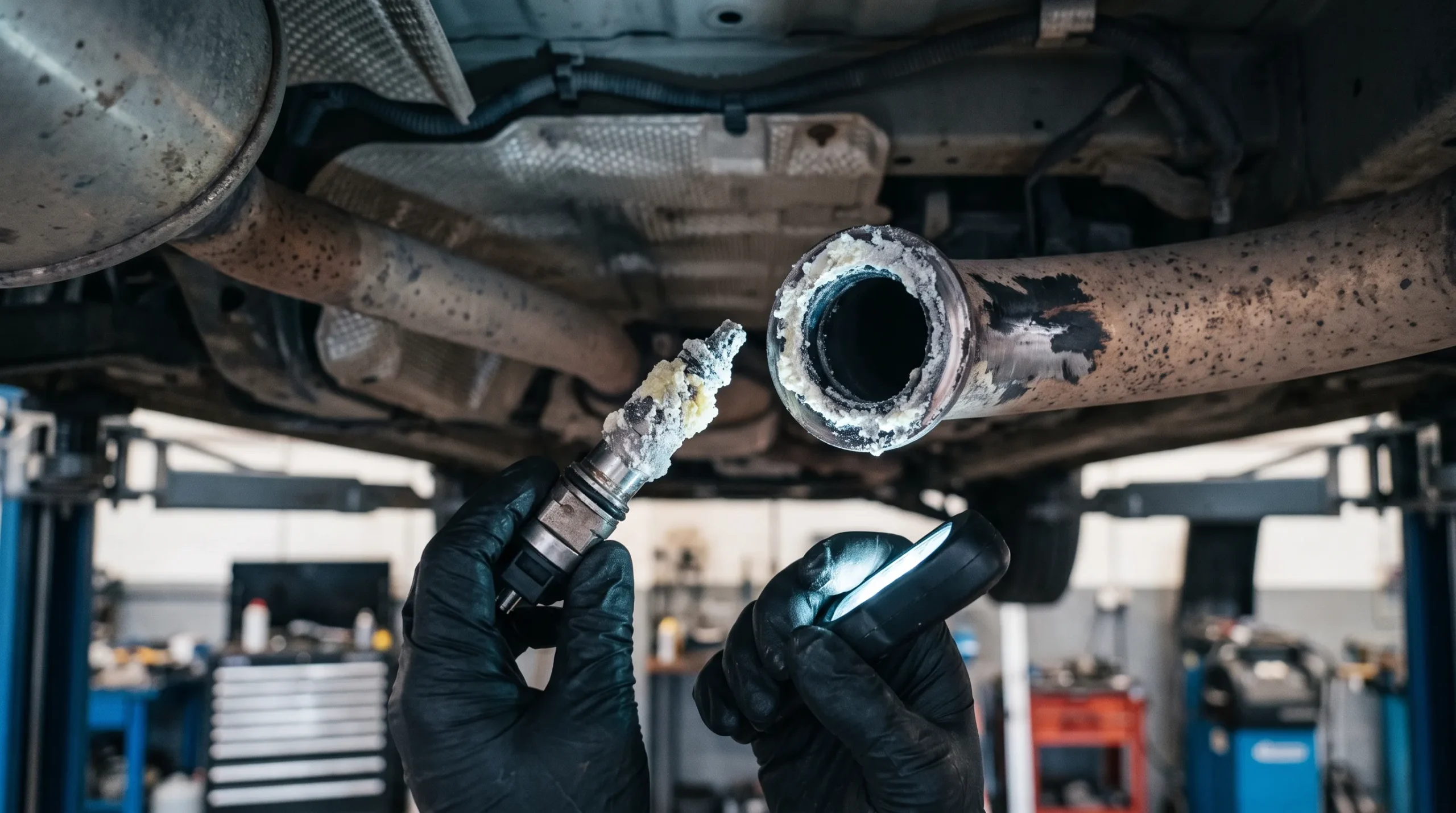
You paid for the clean. The garage pulled the injector, chipped the white crust out of the pipework, sprayed everything down, and sent you off with a clear dashboard. Then a few weeks later (sometimes a few days) the light’s back on. Someone has a look underneath, and there it is again: the same chalky white deposit, sitting in exactly the same spot.
It’s a miserable feeling. You start wondering whether the first garage did a bad job, whether the part is cursed, or whether you’ve just bought a car that’s decided to hate you.
Usually it’s none of those. In our experience, the clean itself was done fine. The trouble is that cleaning only deals with the mess, and the mess isn’t the problem. The crystals are a symptom. Something is still making them, and until that gets found, you can scrub the system every month and watch the deposits grow back.
So let’s talk about why that happens, what’s normally hiding behind it, and what it takes to stop it for good.
What Those Crystals Actually Are
AdBlue is about a third urea and two thirds purified water. When it’s sprayed into a hot exhaust, the water flashes off and the urea breaks down into ammonia, which is the stuff that actually neutralises the NOx. If everything’s working, nothing is left behind. It all disappears out of the tailpipe as harmless gas.
Crystals appear when that process goes wrong. If the fluid lands somewhere too cool for the urea to break down, or sits still somewhere warm enough to evaporate the water but not hot enough to finish the job, what’s left dries into a hard white solid. It builds in layers, a bit like limescale in a kettle, and it loves to settle on injector tips, mixer plates, pipe bends and anywhere the fluid can gather.
If you want the background on whether that damage can be undone, we’ve covered it in our guide on whether AdBlue crystallisation can be repaired. This article picks up where that one stops, for the people who’ve already had a clean and found it didn’t last.
Why a Clean Doesn’t Always Last
Picture a damp patch on a ceiling. You can paint over it as many times as you like, but if there’s a slow leak in the pipe above it, the stain comes back. Crystals behave in exactly the same way. Whatever created the first batch is still there once the clean is finished, so the second batch is only a matter of time.
There’s another side to it too. If the deposits are scraped out without anyone checking how the injector sprays, or the injector is refitted with a tired old seal, the system goes back together in almost the same state it came apart in. It might behave for a fortnight, especially if you do a long motorway run straight afterwards. Then it slides back into its old habits.
So the useful question isn’t “how do I get rid of these crystals?” It’s “what’s feeding them?” Here are the usual suspects, roughly in the order we tend to find them.
The Injector Is Dribbling Instead of Spraying
This is the big one. A healthy injector fires a fine, even mist straight into the exhaust flow. A worn or partly clogged one dribbles, or squirts in a lopsided pattern, and the liquid ends up on the pipe wall instead of in the gas stream. Anything that lands on a wall dries out and crystallises.
You can clean the deposits off, refit the same injector, and watch it carry on doing exactly what it did before. The nozzle can look spotless to the naked eye and still be spraying badly, which is why we don’t trust a visual check on its own. Our guides on an injector that’s blocked and one that isn’t spraying properly go into how those spray faults develop.
The Exhaust Never Gets Hot Enough
AdBlue needs real heat to do its job. The exhaust has to stay above roughly 200°C at the point where the fluid goes in, and it has to stay there for long enough. A car that spends its life on short, stop-start journeys struggles to manage that.
London drivers will know exactly what we mean. Twenty minutes crawling across the North Circular, a school run, a quick shop, then the car sits outside for the rest of the day. The dosing system keeps trying to inject, the fluid keeps landing on metal that’s still too cool, and the deposits stack up. We see it a lot on delivery vans and taxis, and on family cars that never get out of town. No amount of cleaning changes the driving pattern behind it.
A Heater or Temperature Sensor Has Quietly Failed
AdBlue starts to freeze at around minus 11°C, so the tank and lines have heating elements built in. If one of those heaters has packed up, or a temperature sensor is feeding the ECU the wrong readings, the system can dose at the wrong time or in the wrong amount. You end up with excess fluid and nowhere for it to go.
This is one reason a warning that appears after a cold night deserves more attention than people usually give it. Clearing it and carrying on can hide a heating fault that’s slowly building deposits in the background.
Pump Pressure Isn’t Where It Should Be
The injector relies on the pump to push fluid through at the right pressure. When that pressure drops, the spray turns weak and uneven. Weak spray means large droplets, and large droplets land on surfaces rather than vaporising in the exhaust. If you’ve had any symptoms that point to pressure, our guide on an AdBlue pump with no pressure is worth a read alongside this one.
The Mixer or Pipework Is Rough, Pitted or Still Dirty
Some exhaust layouts have bends or mixer plates where fluid naturally gathers. If those surfaces have become pitted over time, or there’s an old layer of deposit left behind from a half-hearted clean, new crystals form on the rough surface far faster than they ever did on clean metal. Leftover crystals are basically seed for the next batch.
That’s why a proper clean has to reach the mixer and the downpipe, not just the bit you can see next to the injector.
The Fluid Itself Is Poor
Old, diluted or contaminated AdBlue crystallises faster and leaves more residue behind. A bargain brand with no ISO 22241 certification, a top-up from an unsealed container, or a bottle that’s spent a summer in a hot garage can all push things in the wrong direction. It’s an easy one to fix, but it’s also one people rarely think about.
A Sensor or Wiring Fault Is Feeding Bad Information
A failing NOx sensor can make the ECU believe more dosing is needed than actually is, so it over-injects. A dodgy connection can do something similar. We’ve written about the electrical side in our guides on wiring faults and connector corrosion, and our NOx sensor services page explains what we do when the sensor turns out to be the culprit. And if the level sensor is part of the confusion, our piece on an AdBlue level sensor fault and why the warning stays on covers that angle.
The Software Calibration Has Drifted
This one’s rarer, but we do see it. On vehicles that have had previous work, or that run outside their usual conditions, the dosing map can stop matching how the hardware actually behaves. If the car has been through any remapping, our pages on performance remapping and economy remapping explain how calibration changes can interact with the emissions system, and for larger vehicles our HGV remapping page covers the commercial side.
How to Tell Which One You’ve Got
Honestly, you can’t, not reliably from the driver’s seat. That’s why we push back on the “clean it and see” approach. But a few patterns are worth noticing, because they help a technician point in the right direction.
If the crystals come back within days, that usually means the injector is spraying badly or something is wrong with the dosing itself. If they build slowly over a month or two, short trips and cold spots move up the list. If the warning comes back together with a tank-full warning that refuses to clear, there may be a level sensor problem tangled up in it. And if it’s the kind of fault that keeps coming back whatever you try, that’s the loudest sign nobody has found the root cause yet. We also have a second guide on why an AdBlue fault keeps returning if you want another angle on the same pattern.
Fault codes help too. A scan that throws something like P204F points at SCR efficiency, which is often downstream of exactly this kind of build-up. And if you’d like those codes explained in plain English, our guide on what an AdBlue system fault means is a good place to start.
How We Fix It So It Stays Fixed
When someone arrives with crystals that keep returning, we change the question from “how dirty is it?” to “why is it dirty?” The process usually runs like this.
We start with a proper scan on dealer-level equipment, and we look at the fault history as well as the live codes. Past faults often tell the story that current ones don’t.
Then we test the injector rather than just looking at it. An active dosing test shows whether it sprays a clean, even mist or dribbles. We check pump pressure, heater operation and sensor readings against what they ought to be, because if one of them is drifting we’d rather find it now than after a third clean.
Next we inspect everything downstream: the mixer, the pipework, the spot where the spray lands. Any old deposit baked into the surface gets removed properly, because leftover crystals are the starting point for the next lot.
After that, we repair the cause. That might be a new injector or seal, a replacement heater, a pump repair, a sensor swap, or sometimes just honest advice about how the car’s being used. Only then do we clean, because cleaning a system that’s been properly fixed lasts. Our AdBlue repair and AdBlue fix pages explain what those services cover. If you can’t bring the vehicle in, our mobile AdBlue repair service may be able to come to you instead.
If you’d like to know more about who we are and how we work, our about page has the background, and our blog has more guides like this one.
What You Can Do Yourself
You won’t fix a failing injector on the driveway, but a few habits genuinely cut down how often crystals form.
Use certified AdBlue from a sealed container, and keep it somewhere that doesn’t swing between roasting and freezing. Try to fit in a proper run of twenty to thirty minutes at steady speed every week or so. It keeps the exhaust hot enough to burn off residue before it sets. Don’t sit on early warnings, because the sooner a dosing fault is dealt with, the less build-up there is to remove. And if you’ve had crystals cleaned once already and they’ve returned, ask the garage what they found as the cause, not just what they removed. A vague answer usually means nobody looked.
If you want the wider picture, our guides on AdBlue problems explained and AdBlue problems by manufacturer show how often this pattern shows up. Some makes are more prone than others, and we’ve written specific guides for owners of Mercedes, Land Rover, Ford Transit, Citroën, Peugeot Partner and Nissan vehicles, plus a page on BMW systems.
How Long Can You Keep Driving Like This?
Longer than you’d probably like to be pushing your luck, but not forever. Crystals that keep building eventually restrict the flow, trigger the countdown, and can lead to a restricted restart. Our guides on how long you can drive with an AdBlue fault and the countdown to no-start explain how that escalation tends to play out. Heavy deposits can also spread further down the exhaust, and that’s where our DPF solutions come into the picture if the problem has travelled.
Areas We Cover
We deal with recurring crystallisation across our whole service area, and if you’re near one of the places below, your local page has more detail on how we work there.
In the capital, our AdBlue diagnosis London page and our London page cover the city, and we also work across the neighbouring boroughs of Redbridge and Newham. Stop-start city driving is one of the biggest contributors to this fault, so it’s something we see a good deal of here.
Across the South East, we cover Croydon, Guildford, Reading, St Albans, Slough, Sevenoaks, Dartford, Epsom, Esher and Loughton, along with the wider South East England region.
In the Midlands, we cover the West Midlands as a whole, including Birmingham, Solihull, Dudley, Wolverhampton, Walsall, Tamworth, Coventry and Nuneaton. In Warwickshire we’re active in Warwick, Rugby, Leamington Spa and Stratford-upon-Avon, with the county as a whole covered on our Warwickshire page. Staffordshire and Shropshire are covered through Stoke-on-Trent, Stafford, Cannock, Lichfield, Shrewsbury, Telford, Oswestry, Bridgnorth and the wider Shropshire area.
Heading east and north, our East Midlands and Lincolnshire coverage includes Nottingham, Leicester, Derby, Grantham, Peterborough, Stamford, Spalding, Market Deeping and Bourne, plus the broader Lincolnshire page. In Yorkshire we cover Leeds, York and Sheffield.
And in Scotland, we cover both Edinburgh and Glasgow.
If your area isn’t named above, our full locations page has the complete list, and our location leads page is a good starting point if you’re not sure which area page applies to you.
FAQs: AdBlue Crystals Coming Back After Cleaning
Because cleaning removes the deposits but not whatever caused them. A dribbling injector, low exhaust temperature, a failed heater or a pressure fault will keep producing crystals until it’s repaired.
Anywhere from a few days to a couple of months. A fast return usually points to an injector or dosing fault, while slower build-up is more often linked to short trips and cold spots.
No. The injector is the most common cause, but pump pressure, heaters, sensors and the condition of the mixer all play a part. Only an active test can separate them properly.
Yes. The exhaust has to stay hot enough to break down AdBlue. Repeated short trips leave it too cool, so the fluid dries into deposits instead of vaporising.
Light deposits can sometimes burn off during a sustained run, but hardened build-up won’t. That needs proper removal by a technician.
It can. Diluted or contaminated fluid leaves more residue behind, so certified AdBlue from a sealed container is a sensible habit.
Yes. A faulty heater or temperature sensor can cause incorrect dosing, which leaves excess fluid behind to dry out.
For a while, usually, but the fault will escalate toward a countdown and a restricted restart if it’s ignored.
It depends on what testing shows. If it sprays cleanly after cleaning, it may be fine. If it dribbles or has a worn seal, replacement is the lasting fix.
Heavy, long-term deposits can restrict flow and affect the SCR system and components further downstream.
It depends on the cause. A pump or sensor repair costs very differently from an injector replacement, which is why we diagnose first and quote afterwards.
Fix the root cause, use certified fluid, include regular longer drives, and act on warnings early.
Get It Fixed Properly This Time
If you’ve already paid for a clean and the crystals are back, another clean probably isn’t what you need. You need someone to find out why it keeps happening. We’ll test the system, show you what’s really going on, and fix the cause rather than the symptom. Get in touch through our contact page to book a diagnostic check, wherever you’re based in London, the Midlands, Scotland or the wider UK.
