
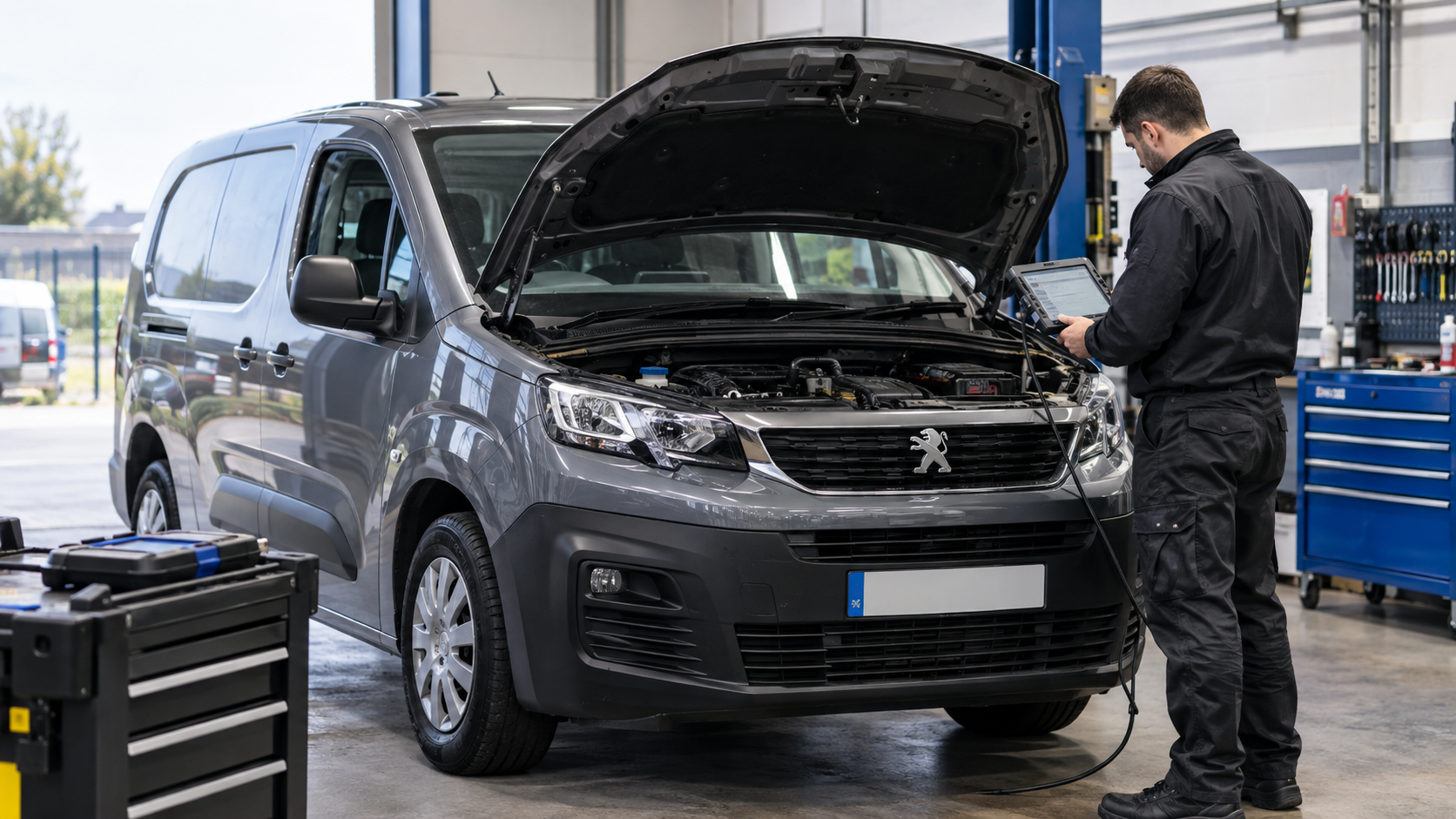
A Peugeot Partner AdBlue fault almost always comes down to a short list of parts: the NOx sensors, the AdBlue injector, the pump, the tank heater or the tank level sensor. Bad fluid, lots of short journeys and a tired battery cause most of the rest. The van shows a warning first, then a mileage countdown, and when that reaches zero it won’t restart after you switch it off. Most vans give you somewhere between 400 and 1,000 miles, depending on the model.
Fault codes narrow things down fast. P20E8 points at pressure, P204F at dosing, P20EE and P229F at the NOx sensors. Our diagnosis starts from £249, which is a starting price and not a fixed one. We come to you, and if you book before midday we can often be there the same day. Below are the questions Partner owners ask us most, in roughly the order they ask them.
Why does my Partner say AdBlue fault when I’ve just filled the tank?
Because a full tank only tells the van one thing: there’s fluid in there. The fault is about something else.
Every time you drive, the Partner checks its own emissions system. The pump, the injector, the heater and the sensors all report back, and if one of them gives a reading the computer doesn’t like, you get a warning. Topping up doesn’t touch that.
The trap is that people keep adding fluid, hoping the light will give up. Please don’t. An overfilled tank causes its own trouble and the warning stays put. If the light came on right after a fill, the level sensor is a good suspect, because it can report an empty tank when it’s full. We’ve written about exactly this in AdBlue fault but tank is full: why is the warning still showing? and AdBlue level sensor fault: why does the warning stay on?
What actually goes wrong inside the Partner’s AdBlue system?
Picture the exhaust as a place where nasty NOx gas needs cleaning before it leaves the van. The Partner sprays a small dose of AdBlue (urea and water) into the exhaust, and in the catalyst that fluid turns the gas into nitrogen and water. Simple idea. But it needs a pump, an injector, heaters, sensors and a computer all working together, and that’s a lot of small parts living in a hot, dirty place.
The NOx sensors are the usual culprit on higher mileage vans. There’s one before the catalyst and one after, and the computer compares them to check the cleaning is working. Heat, soot and vibration wear them down. When one drifts or stops answering, the van can’t prove the system works, so it raises the alarm even though nothing has physically snapped. That’s why a sensor fault can feel exactly like a pump fault from the driver’s seat. Our NOx sensor services page covers what we do about it.
The injector is the next big one. When the exhaust runs too cool, some of the AdBlue doesn’t vaporise. It dries into a hard white crust on and around the injector, and over a few weeks the spray gets narrower until the van can’t dose properly. You’ll see dosing or performance codes, and the fault keeps coming back. Read AdBlue injector blocked: symptoms, causes and repair for the full picture.
The pump has to push fluid to the injector at the right pressure. When it gets old, or a line is partly blocked with crystals, it can’t reach that pressure and you get a low pressure code. It’s more likely if the tank has been run almost dry more than once.
The heaters keep the fluid liquid in winter. AdBlue starts freezing at about minus 11 degrees Celsius, so a failed heater element or a bad connector shows up on frosty mornings, then vanishes by lunchtime. Annoying, but it’s a useful clue.
The tank sensors measure level and temperature. If one sends rubbish, the van thinks something’s wrong when it isn’t.
Then there’s the boring stuff that people forget. A weak battery, a corroded plug or old software can throw faults that aren’t real. A proper scan with live data is what tells a real failure from an electrical hiccup, and it saves you buying parts you never needed. For a wider look, try AdBlue problems explained and AdBlue system fault: what does it mean and how do you fix it?
Is it the NOx sensor or the pump? How would I even know?
You wouldn’t, not from the driver’s seat, and that’s fine. Codes give a strong hint though.
P20E8 means the reductant pressure is too low, which points at the pump side: the pump itself, a blocked line or crystals. P204F is a general performance code that usually leads us to the injector and how well it’s dosing. P20EE says the SCR system isn’t cleaning as well as it should, and that often means a NOx sensor or the injector upstream of it. P229F is a NOx sensor signal that’s stuck. P2047 is an injector circuit problem, so we look at the plug and wiring first. P204C and P21AB point at the tank sensor and the level sensor. P20BD and P20BA are the heater control circuits.
One warning about all of this. A code is a clue, not a shopping list. The same code can come from more than one part, which is why we check the live data behind it before anyone spends money. If you want to go deep on the most common one, read our guide to the P204F AdBlue fault code. And if your scanner shows something we haven’t mentioned, WhatsApp it to us and we’ll tell you what it means.
How many miles have I got once the countdown starts?
Usually somewhere between 400 and 1,000 miles, but it depends on the van, and your Partner may be different. Don’t treat the number on the dash as a suggestion.
The countdown only goes one way. It doesn’t pause when you park up and it doesn’t reset when you switch off. Early on, when the light is just on with no miles showing, you’ve got time to book a proper diagnosis this week. Once miles are counting down, book now and think twice about long trips away from home. Under about 100 miles, it’s a same day job.
At zero, the van will keep running while it’s on, but it won’t restart once you switch off. That’s how drivers get caught at a fuel station or on a customer’s drive. If you’re close to zero, avoid switching the engine off and call us. More detail in how long can you drive with an AdBlue fault? and AdBlue countdown to no start: what happens at 0 miles?
It only comes on when it’s freezing. Is that normal?
Common, yes. Normal, no. It usually means a heater element or its wiring is on its way out, and the cold is just showing it up. Have it checked before winter, not in the middle of it. We go through it in AdBlue malfunction warning after a cold night.
I had it reset and the light came back. Why?
A reset clears the message. It doesn’t repair the part that caused it. As soon as the van runs its checks again it finds the same problem and the light returns, sometimes within days.
A reset does have a place, but only after the real fault has been fixed. If you’ve been through this already, read why does my AdBlue fault keep coming back after a reset? and why does my AdBlue fault keep coming back?
What’s the white crust around the filler or the exhaust?
Dried AdBlue. It’s called crystallisation, and it means fluid isn’t being sprayed or burned off properly, or that it has leaked and dried. It often goes hand in hand with a blocked injector or an exhaust that never gets hot enough. Sometimes it can be dealt with, sometimes the part has to go. Can AdBlue crystallisation be repaired? explains when each applies.
Do short trips really cause this, or is that just what people say?
They really do, and it comes down to heat. The SCR system needs a properly hot exhaust to spray cleanly and to burn off small deposits. A van that does ten minutes here and fifteen minutes there rarely gets that far. The fluid that doesn’t vaporise dries out and turns into crystals, and the sensors spend their whole life heating up and cooling down.
A steady, longer run now and then can help keep things cleaner. It won’t repair a part that has already failed, though, so don’t expect a motorway trip to switch the light off. What it can do is slow the build up. If your Partner is mostly a stop start delivery van, mention that to the engineer. It often explains a fault that keeps coming back, and it changes what we recommend.
Can I just clear it myself with a cheap code reader?
You can read the code with one, and that’s genuinely useful. Send it to us and we can often tell you what it points to before we’ve even left the yard.
Clearing it is a different story. Some cheap readers can’t reach the AdBlue side of the van at all, and none of them show the live data that tells you why the fault happened. Wiping the code also wipes the history an engineer would like to see. And as we said above, the van will only find the same fault again. So read it, write it down, but keep the clearing for after the repair.
How do I stop it coming back once it’s fixed?
Fix the cause, not the message. That sounds obvious, but it’s the reason most repeat faults happen. A part gets swapped on a guess, the real cause is still there, and the light returns a month later.
After that, a few habits help. Use clean, sealed AdBlue and don’t run the tank almost empty as a routine. Give the van a longer steady run when you can. Get the heater circuits checked before winter if you’ve had a cold weather fault. Keep an eye on battery health, because low voltage causes false faults. And deal with the first warning light instead of waiting for the countdown. None of it is complicated, but it adds up over a year of city work.
Can bad AdBlue cause this? And what if I put diesel in the tank?
Yes to the first. Old, watered down or contaminated fluid can trigger a quality fault, and buying from a sealed bottle or a proper pump matters more than most people think.
Diesel in the AdBlue filler is a bigger problem. It can damage the pump and lines if it goes unnoticed, so don’t start the engine, and give us a ring. The opposite mistake is worse still. If AdBlue goes into the diesel tank, don’t start the engine at all and get help.
“Will my Partner go into limp mode?”
On some vehicles, yes. A confirmed SCR fault can bring an emissions warning and reduced power, with the countdown still ticking in the background. If the van feels flat and you’ve got an emissions message next to the AdBlue one, don’t wait for it to get worse.
What’s the difference between the warning light, the countdown and the ‘engine won’t restart’ message?
It’s one fault showing up in three stages.
The warning light means the van has spotted a problem. Nothing else changes yet, and it’s easy to shrug off because the van drives exactly as it did yesterday. The countdown means the fault is confirmed and the van has started giving you miles to sort it out. The restart message means those miles have run out. The van isn’t broken at that point. It has just been told not to restart with a confirmed emissions fault, so it won’t.
Every stage is a chance to deal with it on better terms. Catch it at the light and you can book a visit for a time that suits you. Wait for the last message and you’re making an emergency call from a car park. Our guide to the AdBlue countdown to no start walks through what you’ll see at each point.
Why do Partners in London seem to get hit harder?
Because London is about the worst place you can run a diesel van if you want its AdBlue system to stay happy.
Think about a normal day for a courier or a tradesperson in the capital. Twenty minutes crawling to the first drop. Engine off, engine on. Another short hop. More queues. The exhaust never gets properly hot for long, and the SCR system likes heat. So crystals build up on the injector, the sensors go through constant heat cycles and wear faster, and the heaters and pump work hardest on cold starts. If the van sleeps on the street overnight, a frosty morning finds out any weak heater straight away.
The Partner is a favourite with couriers, tradespeople and small fleets, so we see this pattern all the time. London also has some of the strictest emissions rules in the UK, which is a good reason to fix an emissions warning instead of living with it.
We cover the whole of Greater London. North London includes Barnet, Enfield, Haringey, Camden and Islington. In the east we help drivers in Newham, Hackney, Tower Hamlets, Redbridge, Havering and Barking and Dagenham. South London means Croydon, Bromley, Lewisham, Greenwich, Lambeth, Southwark, Sutton and Merton. In the west it’s Ealing, Hounslow, Hillingdon, Brent and Harrow. Start with our AdBlue page for London, or see the pages for Croydon, Epsom, Esher, Dartford, Sevenoaks, Loughton, Slough and St Albans if you’re on the edge of the city.
How does a mobile AdBlue diagnosis in London work, and what does it cost?
You ring, WhatsApp or fill in the form with your make, model, postcode and what the dash is saying. Tell us where the van is parked too, whether that’s a driveway, a yard or a resident bay, so we can plan the visit.
The engineer turns up, plugs in professional diagnostic equipment and reads the codes. Then comes the part that matters: watching the live data while the system runs, so we can see which part is misbehaving instead of guessing. You get a clear answer and a clear price before any repair starts, and the repair is done where the van is standing. Every job comes with a lifetime warranty, and we’re backed by over 500 five star reviews.
Our AdBlue diagnosis in London starts from £249. That’s a starting price, not a fixed price. Once we understand what’s wrong with your Partner, we confirm the final cost. Book before midday and we can often reach you the same day. For the repair side, see AdBlue Fix and AdBlue Repair.
Should I take it to a garage, a dealer or use a mobile engineer?
Each has a place. A dealer will know the van well, but you’ll often wait for a slot, and you may lose the van for a day or more. A general garage can be quick, though some will swap parts based on the code alone, and that’s how people end up paying twice.
A mobile visit means the van stays where it is and you keep working. We diagnose on site with dealer level equipment, read the live data and tell you what’s failed. If a part genuinely needs replacing, we’ll say so plainly and quote it before doing anything. It’s also useful if the countdown is low and you’d rather not risk driving to a workshop. Our AdBlue Repair page shows what we can deal with on the spot.
“What if the van is on a busy London street or a resident bay?”
That’s normal for us. Most London Partners don’t have a private yard, so we plan around it. Tell us the postcode and the parking situation when you book, and whether the van is on a driveway, a side street or a controlled bay. If it’s somewhere awkward, we can often suggest a safer spot nearby, or a time of day when it’s quieter.
The engineer needs the van reachable and safe to work beside, and for some tests the engine needs to run. That’s about it. If you’re on a red route or a very tight road, say so and we’ll work out the best way to do it.
Do you cover my area?
Probably. We’re mobile, so we travel to you across the UK. Here’s where we have local pages.
South East England: the South East England hub, plus Croydon, Reading, Guildford, Epsom, Esher, Dartford, Loughton, Sevenoaks, Slough and St Albans.
West Midlands: the West Midlands hub, Birmingham, Coventry, Walsall, Wolverhampton, Dudley and Solihull.
Warwickshire: the Warwickshire hub, Rugby, Warwick, Nuneaton, Leamington Spa and Stratford-upon-Avon.
Staffordshire: Stoke-on-Trent, Stafford, Cannock, Lichfield and Tamworth.
Shropshire: the Shropshire hub, Shrewsbury, Telford, Oswestry and Bridgnorth.
East Midlands and Lincolnshire: Derby, Leicester, Nottingham, the Lincolnshire hub, Grantham, Bourne, Market Deeping, Stamford, Spalding and Peterborough.
Yorkshire and Scotland: Leeds, Sheffield, York, Edinburgh and Glasgow.
Not listed? Send us your postcode. Our page on mobile AdBlue repair across the UK explains how far we travel, and the full locations hub has everything in one place.
My van is a Berlingo or a Combo. Is it the same story?
Pretty much. The Partner shares a lot with the Citroën Berlingo and the Vauxhall Combo, and owners of those see very similar AdBlue behaviour. Our guide to AdBlue problems by manufacturer compares Peugeot, Citroën, Ford, Mercedes and more. Running a mixed fleet? We’ve written up Nissan, Land Rover and Mercedes faults, and there’s a BMW page too. Heavier vehicles are covered under HGV remapping.
What should I do today, and what should I leave alone?
Check the fluid level and top up with clean, sealed AdBlue if it’s low. Write down the exact message and any code you can see. Notice when it happens: cold starts, after fuelling, after a long drive. Then book a diagnosis before the countdown gets low, not after.
Leave alone: extra fluid poured in hopefully, repeated resets, anything other than AdBlue going into the AdBlue filler, and parts bought on a guess. And if your van does nothing but short runs, tell the engineer. It explains more repeated faults than people expect.
Peugeot Partner AdBlue Fault FAQs
Straight answers to common questions about Peugeot Partner AdBlue faults, warning lights, countdowns and repairs.
The fault is about how the system is working, not how much fluid is in the tank. The pump, injector, heaters and NOx sensors all report to the computer, and if one of them gives a reading it doesn’t trust, the warning comes on. A scan with live data shows which part it is. Our guide to the AdBlue system fault explains it in more detail.
Yes. The van uses the NOx sensors to check that the exhaust is being cleaned. If a sensor drifts or stops answering, the van can’t prove the system works, so it starts the countdown even when the pump and injector are fine. See our NOx sensor services page.
P20EE means the SCR system isn’t cleaning the exhaust as well as it should. It often leads us to a NOx sensor, or to an injector that isn’t dosing properly. The code is a starting point, so we check the live data before saying which part has failed.
P20E8 means the reductant pressure is too low. The usual causes are a tired pump, a blocked line or crystals. It’s worth acting on, because a pressure fault can lead to a countdown if it keeps happening.
An on and off warning usually points to something that only fails in certain conditions. A heater fault that shows up in the cold is a common one. A loose connector, a weak battery or a sensor on its way out can do the same. It’s tempting to ignore it when it clears, but the fault is still there, and it usually returns. Read why does my AdBlue fault keep coming back?
For a short time, yes. The van still drives normally in the early stages. But if a countdown is showing, every mile uses up your allowance, so book a diagnosis before it gets low. Once it reaches zero, the van won’t restart after you switch off. See how long can you drive with an AdBlue fault?
On some vehicles, yes. A confirmed SCR fault can bring an emissions warning and reduced power. If your Partner feels flat and you also have an AdBlue or emissions message, get it looked at rather than waiting.
A new battery, or a flat one that has been jump started, can cause low voltage faults or leave the system confused for a while. Sometimes the light clears on its own after a few drives. If it stays on, there may be a real fault behind it, so it’s worth a scan.
Crystals can block the injector and lines, which stops the system dosing properly. Left alone, that can lead to repeat faults and a bigger repair. Catching it early is cheaper. Our post on whether AdBlue crystallisation can be repaired covers what can be done.
Yes. We’re a mobile service, so the engineer comes to you, whether that’s a driveway, a yard or a safe spot at the roadside. We diagnose on site and quote before starting any repair. Take a look at our AdBlue Repair page.
Our AdBlue diagnosis in London starts from £199. That’s a starting price, not a fixed price. Once we understand the fault on your van, we confirm the final cost before any work begins.
If you book before midday, we can often reach you the same day. Tell us your postcode and where the van is parked when you get in touch. We cover all of Greater London, and you can start with our AdBlue page for London or the full locations hub.
Still got a question about your vehicle? Ask a technician directly.
Contact Us →Get it looked at before the countdown runs out
If your Partner is showing an AdBlue fault, don’t wait for the miles to run down. Call 0330 043 4431, message us on WhatsApp or get a free quote. Tell us the make, model, postcode and what the dash says, and we’ll take it from there.
More guides: AdBlue problems explained, AdBlue problems by manufacturer, AdBlue system fault, AdBlue injector blocked, AdBlue level sensor fault, P204F fault code, AdBlue countdown to no start, how long can you drive with an AdBlue fault, can AdBlue crystallisation be repaired, AdBlue malfunction warning after a cold night, mobile AdBlue repair across the UK

2 Comments
[…] one of the following, we have a dedicated guide: Mercedes, Land Rover, Ford Transit, Citroën, Peugeot Partner or Nissan. We also have a page on BMW systems. For the bigger picture, our guides on AdBlue […]
[…] a longer settling period after battery work before the level sensor fully relearns. Citroën and Peugeot Partner models we’ve dealt with sometimes need a direct scan tool reset rather than relying on a […]